The Monthly Digest

Digest – June

In this last month we’ve done a bunch more stuff. Again.


Some things have been added to the Clinical Data section.


Poll of the Month

There was some recent discussion on the blog for a recent Gemelo puzzle about the enumerations used in most barred puzzles for answers shown by Chambers as being hyphenated or comprising multiple words. Currently the answer DOUBLE BASS would be enumerated as (6,4) in a blocked puzzle, but (10, 2 words) in a barred puzzle; ONE-SIDED would be shown as (3-5) in a blocked puzzle but (8) in a barred puzzle. Over to you.

How should multi-word and hyphenated answers be enumerated in barred puzzles?

Continue reading

Digest – May

In the last month we’ve done a bunch more stuff.


Some things have been added to the Clinical Data section.


We’ll soon be doing even more stuff.

Notes for Azed 2,764

There are usually one or two points of interest in an Azed puzzle, and here we pick them out for comment. Please feel free to add your own questions or observations on any aspect of the puzzle (including clues not listed below) either by using the comment form at the bottom of the page or, if would prefer that your question/comment is not publicly visible, by email.

Azed 2,764 Plain

Difficulty rating: 2.5 out of 5 stars (2.5 / 5)

Overall, I felt that this one was somewhere around the middle of the difficulty range. It didn’t perhaps have the élan of Azed’s very best, with some undesirable repetitions (eg the same elements in the wordplays for 10a/12a and 13a/21d, ‘tons; in 19a/8d), but although a few of the surface readings seemed a bit weak, there were some nice ones in there as well.

Setters’ Corner: This week I’m going to look at clues 34a/3d/9d, where the definitions are (i) “house-warming”, (ii) “sound like cushats” and (iii) “Jock’s staggered”. In (iii), the Scottishness of the word meaning ‘bewildered’ or ‘staggered’ [a 5-letter word meaning ‘turn aside’, though perhaps not ‘turn off’, following the middle letter of ‘Aintree’] is indicated explicitly by the use of “Jock’s”. In (ii), another Scots word [an anagram of COLORED] is not explicitly qualified as such, but the use of the word ‘cushats’ – rather than ‘doves’ – provides the necessary implication. In (i), a ‘Scot and US’ word according to Chambers [an anagram of FAN in a word for ‘heat’] is not flagged in any way. The definitions in 3d and 9d are entirely acceptable, but the definition in 34a really ought to have either an explicit or an implicit indication that the word in this sense isn’t a fully-fledged element of the English language.

Across

10a How surprising, concert recalled an enormous butterfly! (6)
A 2-letter interjection of surprise (‘how surprising’) and a 4-letter word for the type of concert that doesn’t aim to put bums on seats are reversed (‘recalled’).

11a Sickly-looking child, in small poster (6, 2 words)
A 3-letter word meaning ‘pale and sickly’ is followed by an informal one for a young lad (or a small amount), producing the (4,2) answer. Chambers describes a poster as being ‘a large printed bill, notice, advertisement, picture or placard for displaying on a wall, etc.’, so I think that even a ‘small poster’ would be much bigger than the item here; something like ‘Sickly-looking child getting little notice’ would surely work better.

13a Work that stands out to be situated in surplus returned (7)
A 3-letter word meaning ‘to be situated’ is contained by a reversal (‘returned’) of a word (more often encountered as a preposition or an adverb) for anything that is surplus.

15a Old hamper revealing personal piece? (4)
The usual abbreviation for ‘old’ is followed by a dialect word for a pannier or hamper. The solution is hyphenated, 2-2.

17a I can’t wait for the denouement, fear opening 50% of powers? (9)
A 5-letter word for ‘fear’ is contained by (‘opening’) the first half of an 8-letter word for ‘powers’, of the sort that one might direct all of into a particular project. Again the answer is hyphenated, this time 3-6.

22a Translator translated English poet for the crown? (7)
The standard (if not exactly common) abbreviation for ‘translator’ precedes an anagram (‘translated’) of the usual abbreviation for ‘English’ and POET.

24a Dye incorporated in blue ribbon? (5)
An abbreviation for ‘incorporated’ is put inside a pair of letters that describe a person who abstains from strong drink. The blue ribbon was the badge of the North American temperance movement of the 19th century, its use relating to verse 38 of Numbers 15: “Speak unto the children of Israel, and bid them that they make them fringes in the borders of their garments throughout their generations, and that they put upon the fringe of the borders a ribband of blue.” The ribbon was worn by those who had taken a pledge of abstinence from the consumption of alcoholic drink, as advocated by the badge’s creator, Francis Murphy. In 1880, the movement dispatched one Richard Booth to the UK,  where he held a number of mass meetings; in 1885, he  headed to Australia and New Zealand, his campaign there being described as ‘highly successful’ (I know – it seems very hard to believe, but that’s what Wikipedia says). I’m not sure that ‘blue ribbon’ and the abbreviation here quite come to the same thing, but I’m all in favour of inventive clueing.

29a Spread wherein nobleman throws rave (4)
An 8-letter title given to a German nobleman – originally the military governor of a border province, but subsequently a prince of certain states of the Holy Roman Empire – dispenses with (‘throws’) the consecutive letters RAVE.

Down

2d Church chandelier, straw one with ring within (6)
A 4-letter word for what straw comes from (though perhaps not for straw itself) and a single-letter word for ‘one’ have a letter shaped like a ring inside (‘with ring within’).

4d Lose control, strikes on the up (4)
An informal word meaning ‘to hit, strike, destroy, shoot, etc’, which I think I first came across in the title of a Philip K Dick novel, The ??? Gun, is reversed (‘on the up’).

5d Fine pasta, at being swallowed emphatically (7)
The usual abbreviation for ‘fine’ and a 4-letter word for ‘pasta in the form of small pieces like rice or barley’ (being the Italian for ‘barley’) are put around the letters AT (‘at being swallowed’) to produce a musical direction.

6d Rough cloth we’ll spread out to dry (5)
The letters WE (from the clue) are contained by (‘[wi]ll spread out’) a 3-letter word meaning ‘to dry’ or ‘to spread out for drying’ which was one of the first words to be inducted into the Cryptic Crossword Setters’ Hall of Fame.

7d Paddy with artist imbibing ales drunkenly in gym (9)
An alternative (3-letter) diminutive form of the name ‘Patrick’ containing (imbibing’) an anagram (‘drunkenly’) of ALES is followed by the abbreviation frequently indicated – rightly or wrongly – by ‘artist’. The answer describes a place devoted to the practice of wrestling or athletics.

8d Tons included in clan was staggering (5)
The usual abbreviation for ‘tons’ is contained by a word for a clan; the definition doesn’t refer to drunken movement but to alternate or various disposition, although the answer could certainly be used when describing Whitefriars ‘Drunken Bricklayer’ vase, which will be familiar to regular viewers of UK antiques programmes.

14d Cowboy maybe in group of three entering river abroad (9)
A 4-letter word for a set of three (or an aquatic bird) is contained by the name of a river in Lower Saxony.

20d Gentleman covering up heath plant (7)
A 3-letter term for a gentleman and a word for a covering for the shoulders are reversed (‘up’).

21d Insect suckers: one may be observed in e.g. emmet lair (7)
The single-letter word for ‘one’ is contained by a more common word for an emmet and a familiar word indicated by the verb ‘lair’ (“Vnder this herb a Snake full cold doth lear”). I don’t know why Azed has chosen to write the clue this way – “Insect suckers one observed in emmet lair” strikes me as being perfectly good. 

26d Mostly fine yarn in old pot (5)
A 6-letter word for a fine worsted yarn is deprived of its last letter (‘mostly’) to produce an archaic term for a pot, or the name of the railway town in which Marie Lloyd ended up when she wanted to go to Birmingham – given King George V’s famous observation about Bognor, one can only imagine what he might have had to say about this place.

(definitions are underlined)

Notes for Azed 2,763

There are usually one or two points of interest in an Azed puzzle, and here we pick them out for comment. Please feel free to add your own questions or observations on any aspect of the puzzle (including clues not listed below) either by using the comment form at the bottom of the page or, if would prefer that your question/comment is not publicly visible, by email.

Azed 2,763 Plain

Difficulty rating: 2 out of 5 stars (2 / 5)

Another plain puzzle that seemed to be close to the middle of the difficulty spectrum, with some friendly anagrams perhaps tugging it a fraction towards the easier end. Some entertaining clues, and one or two wordplays which fully tested the flexibility of the English language.

Clue Writers’ Corner

The Rules and Requests section suggests that this is a non-competition puzzle, but in fact entrants must submit a clue to the entry at 22 across. The paragraph should read:

Send correct solution (one only) and clue to replace definition asterisked (on separate sheet also bearing name and address, securely attached) to the Azed judge at Azed No. 2,763, PO Box 518, Oxford, OX2 6WX. Entries must be received by Monday week following publication at the latest and be postmarked no later than the Saturday following publication. Please include a brief explanation of your clue. Emailed entries will be accepted for overseas submissions only, addressed to jcrowther2000@hotmail.com and must reach Azed by no later than the Saturday following publication of the relevant competition puzzle.

When it comes to defining a noun which specifies a particular quality, there are a few possible approaches. The following take as an example the answer VERBOSITY:

  1. A simple definition, such as the one provided by Azed. It doesn’t have to be explicitly given by Chambers, but it needs to be a near-synonym. So ‘prolixity’ would be a perfectly good definition, as would ‘wordiness’. The problem with definitions like this is that they are not the easiest to integrate into an interesting clue. If using a definition like this, it’s essential to disguise the break between the wordplay and the definition and to make the clue as interesting as possible; deception based on these definitions is almost impossible, because prolixity is, well, prolixity, and that’s one reason why experienced clue writers tend to eschew this sort of definition. If I had to choose a single-word definition of VERBOSITY for a clue, I would select ‘windiness’, because that does provide the opportunity to say something significantly different in the surface and cryptic readings.
  2. A definition which would not be found in the dictionary but tells it like it is, eg ‘being prone to wind’.
  3. A definition which uses a negative, eg ‘never closing trap’.
  4. A definition based on someone who displays the quality, eg ‘Dickens suffered from it’.
  5. A definition based on exemplification in the clue, eg “Starts off vigorously expounding, rapidly becomes overblown, slipping into tedious yammering – suggesting this?”.

As always, I would encourage readers to have a go at the competition – if you’re not a regular competitor, my top tips would be (i) keep it simple; (ii) avoid the extremely obvious (eg OVERTURE as an anagram of TROUVERE in the May comp); (iii) make the surface reading as convincing as you can; and (iv) check your clue carefully to make sure that the cryptic reading is sound.

Setters’ Corner: This week I’m going to look at clue 3d, “Auld Nick that is on the phone to America (6)”. The wordplay has the abbreviation of the Latin for ‘that is’ following a US slang term for the telephone, with the answer being a Scots term for the Devil (not explicitly indicated in the definition, but implied by the use of ‘Auld’ rather than ‘Old’). The point of interest here is one that divides setters and editors, namely the use of ‘on’ as a juxtaposition indicator. I think everyone agrees that it is allowable in down entries as a neutral indicator, ie ‘A on B’ leading to AB, and its use as a postposition indicator in across entries, ie ‘A on B’ giving BA is also generally accepted (sense 18 of the word in Chambers, ‘just after’, supporting this). Then things start getting a little more controversial. The meaning of ‘close to, beside’ surely tells us that ‘A on B’ in an across clue is legitimate for AB, and since ‘A after B’ is fine in both across and down clues for BA, that sense of  ‘just after’ must mean that ‘A on B’ is fine for BA in a down entry. So all four combinations are technically valid – but I would never use ‘A on B’ in a down clue to indicate BA (as Azed has here) because it is so blatantly counterintuitive and is unlikely to go down well with solvers.

Across

11a Stop relative leading advance (4)
Chambers gives one sense of the noun ‘relative’ as ‘a relative word, esp a relative pronoun’, and it is just such a word which must go before (‘leading’) the usual single-letter abbreviation for ‘advance’.

12a Martin’s not one breaking window (7)
A slightly strange wordplay here, which I think works marginally better without the word ‘not’. This gives us an 8-letter word meaning ‘of or relating to Martin ??????, the great German Protestant reformer’ (ie “Martin’s”) with the single-letter word for ‘one’ being removed (‘breaking’, ie ‘bursting forth’). Otherwise, we have ‘not one’ indicating the loss of the single-letter word which is dividing (‘breaking’) the 8-letter one – except it isn’t dividing the word, it’s an integral part of it. Either way, there really ought to be a comma after “Martin’s”.

13a Obscure Scots herb turned up with recipe on pastry crust (6)
A reversal (‘turned’) of UP (from the clue) is followed by the single-letter abbreviation for ‘recipe’ and a 3-letter word for a pastry crust, or at least something within a pastry crust. The answer is one of those Chambers entries that must get very nervous every time a new edition is under discussion.

14a Soft fabric, small one, mostly costly included (6)
A 3-letter word for something small, particularly a child or a drink, has a word meaning ‘wealthy’ or ‘costly’, lacking its last letter (‘mostly’), inserted (‘included’).

18a Like an acid found in Swiss lake limitlessly? (4)
The name of a Swiss lake – and city – is deprived of its first and last letters (‘limitlessly’).

26a Grating sound made by weak horse swallowing bit of straw (4)
A word for an inferior horse (or a disreputable person, as in ‘It was that young ???’) contains (‘swallowing’) the first letter (‘bit’) of ‘straw’.

29a Gnashers like this will get bent back in twisted irons (8)
A word meaning ‘thus’ (‘like this’), usually seen in brackets in quoted text to indicate that while the preceding word may look wrong it’s what the person being quoted really said or wrote, is reversed (‘will get bent back’) inside an anagram (‘twisted’) of IRONS.

31a Hoo-ha when island bovine’s ingested toxic compound (6)
A 3-letter word for a hoo-ha or racket has the single-letter abbreviation for island and a word for an animal of the cattle family put inside (‘ingested’).

32a Position skin design in middle of masses (6)
An earlier 4-letter spelling of a familiar word for a ‘skin design’ (more recently the name of a controversial Russian female pop duo) is sandwiched by the central letters (‘middle’) of ‘masses’.

Down

5d Elated, speaks softly in sound poetic constructs (6)
Far up in the sky
Soothing murmurs of the dove
Sound a lot like these

7d Line of planks to fit out round radius (6)
A 5-letter word meaning to ‘fit out’, or more generally ‘to invest in or support by supplying with money’ (as in ‘she agreed to ????? their new enterprise’), is set round the usual abbreviation for ‘radius’.

8d Distinguish sailors after end of voyage, dry on top (6)
A 2-letter abbreviation for a UK warfare force that includes a lot of sailors is placed after the last letter (‘end’) of ‘voyage’, and a word meaning ‘dry’, specifically applied to wine, is put on top of the combination.

9d Power put into demonstration not quite in condition (7)
A 3-letter Latin word for power or force is contained by (‘put into’) a 5-letter word for a demonstration that establishes the truth of a proposition, the latter having been shorn of its last letter (‘not quite’).

13d Go exercising on range of hills – Americans may get stuck up it! (10)
A 3-letter word for ‘go’ in the oomph sense is followed by a 2-letter abbreviation for a type of exercise and a word for a hill-range. The definition reminded me of one of Azed’s classics, “Reason for infanta’s visit?” for NUT-TREE.

20d Prince vaunting more of a shower? (7)
Outside Monaco, the Prince here is probably best known for being part of the ‘wedding of the century’ in April 1956, when he married Grace Kelly, thereafter Princess Grace. The second definition probably warrants the question mark at the end, but it seems perfectly fair.

21d No longer pays for armed guards king dismissed (6)
A 7-letter word for the sort of armed guards that might (one assumes) be supplied by a suitable agency has the monarchical abbreviation for ‘king’ removed (‘dismissed’). A comma (or a word such as ‘with’) must be inferred between ‘guards’ and ‘king’.

23d Count calling for more music in opening race (start off) (6)
The word IN (from the clue) is contained by (‘opening’) a word (taken from Italian) for a race, from which the first letter has been omitted (‘start off’). The Count is the one who kicks off Act I Scene I of Twelfth Night thus:

If music be the food of love, play on.
Give me excess of it, that, surfeiting,
The appetite may sicken and so die.
That strain again! It had a dying fall.

Although he is the Duke of Illyria, he is also frequently referred to as ‘Count’.

28d Slow dance, sort of jig filled with love (5)
A term for something which is used by anglers to attract fish contains (‘filled with’) the usual single-letter representation of ‘love’. The indication of this term is surely the wrong way round, though – a jig is a sort of ???? rather than a ???? being a sort of jig.

(definitions are underlined)

Notes for Azed 2,762

There are usually one or two points of interest in an Azed puzzle, and here we pick them out for comment. Please feel free to add your own questions or observations on any aspect of the puzzle (including clues not listed below) either by using the comment form at the bottom of the page or, if would prefer that your question/comment is not publicly visible, by email.

Azed 2,762 Plain

Difficulty rating: 2.5 out of 5 stars (2.5 / 5)

A puzzle that seemed overall to be around the middle of the difficulty spectrum. There were some entertaining clues, along with a couple of unusual anagram indicators that I shan’t be adding to the list on this site – neither ‘mottled’ nor ‘unharmonious’ seems to me to suggest rearrangement, although they both look like anagrinds, so I doubt that they will have given solvers any problems.

Setters’ Corner: This week I’m going to look at clue 3a, “Edible lichen in red pie mashed as filling for medicinal pill (12, 3 words)”. The wordplay has an anagram (‘mashed’) of RED PIE contained within (‘as filling for’) a round medicinal tablet, this word being derived from the Greek for a wheel. The point of interest is the definition of the (5,2,5) answer: not what’s in the clue, ‘Edible lichen’ being absolutely fine as far as it goes, but what isn’t there. Chambers gives the subhead itself as ‘French’; this means that the term has not (unlike Derek Trotter’s bain-marie) been assimilated into the English language, or, as Chambers puts it, ‘the word is still regarded as a foreign word, rather than as a naturalized English word’. In these situations, setters are generally expected to indicate to which language the word belongs. So CORBIE might be ‘Scots crow’ and AMI might be ‘Nice friend’. Here the definition should really be something along the lines of ‘Edible lichen from France’.

Across

1a Crustacean specialist is sat cooking round pancake with piece of firewood (12)
An anagram (‘cooking’) of IS SAT contains (’round’) a 4-letter thin rolled pancake associated with Mexico and a nice chunky piece of firewood.

14a Coloured type of sorrel, shrub with medicinal properties (4)
The single-letter abbreviation for ‘Coloured’, rarely seen in puzzles, is followed by a South American wood sorrel with edible tubers. No doubt JJ Cale was extolling the medicinal properties of the shrub when he sang that “if you got bad news, you want to kick them blues” a dose or two would put him right.

15a Drawing off liquid to drink, ducks mature? (9)
A 3+3+3 charade of a word meaning ‘to drink’, a term of endearment perhaps slightly more transpondine than ‘ducks’, and a word meaning ‘[to] mature’.

19a Serious English letter from Tel Aviv marquis? (4)
Two definitions here for the price of one, although I think most editors these days would feel that the last name of the (in)famous French ‘writer, libertine, political activist and nobleman’ was surplus to requirements and would simply leave it off. The wordplay has a 3-letter word for ‘serious’ being followed by the usual abbreviation for ‘English’.

25a Cut once expressing contempt? Ring off (4)
An 8-letter word meaning ‘expressing contempt’ is deprived of the consecutive letters RING (‘Ring off’). The answer is given by Chambers as ‘obsolete’, hence the ‘once’ in the definition.

26a See painful spot, one that’s returned? This may apply spray (7)
A 2-letter interjection meaning ‘see!’, a 4-letter painful spot, and a single-letter word for ‘one’ are all reversed (‘returned’) to produce a familiar word. The comma separating the wordplay elements means that “that’s returned” doesn’t work grammatically in the cryptic reading, since it can only legitimately refer to the bit after the comma; it would need to say “…that have returned”, which of course makes no sense in the surface reading. The alternative “See painful spot, one returning?” would be fine.

33a Displays of panache in line within bazaars (6)
The usual abbreviation for ‘line’ is contained by (‘within’) a familiar 5-letter word for ‘bazaars’.  The answer is the plural form of a word which is only ever seen in the singular. I see why Azed has chosen the definition here – ‘stylishnesses’ or the like won’t cut it – but the problem is that he is describing a manifestation of a trait, while the answer refers to the trait itself.

35a Regarding edge in dividing money, this was outstanding quality (12)
The combination of that popular bit of commercial jargon meaning ‘regarding’, a 3-letter ‘edge’ and the letters IN (from the clue) is contained by (‘dividing’) a 5-letter word for multiple units of a small monetary value in Britain – this is the plural of a singular form which Chambers gives as ‘(in pl) money in general’, but that is a different plural from the one here.

Down

4d Circlet, pink, worn inside (7)
A 5-letter word for a deep orange-pink colour (and a substance made up of myriad small skeletons) has a common 2-letter word of many meanings inside. Is one of those meanings ‘worn’? Probably not – something like ‘Circlet, pink, around leg’ would be better.

5d Former sweethearts? Mum’s kept in contact (6)
A 2-letter word for ‘mum’ is contained by the sort of ‘contact’ that can be hard or soft. The answer is ‘archaic’, which is why the definition is qualified by ‘Former’.

8d Hidden island once spoken about (8)
One of those ‘missing comma’ clues, where the cryptic reading requires a pause – either a comma or a word like ‘with’ – between ‘island’ and ‘once’. The largest of the Greek islands has a 3-letter Miltonic past tense of a word meaning ‘speak’ outside (‘about’).

9d Manuka in scene of action without height and energy (7, 2 words)
A 7-letter word for a scene of action (often followed by ‘of war’) loses the usual single-letter abbreviation for ‘height’ and is followed by the standard abbreviation for ‘energy’, the result being a (3,4) name applied to several plants including the manuka.

10d Tot? Literally that renders one boozer! (4)
One of those Azed trademark answer-referencing clues. If you take the answer (‘a small alcoholic drink’, ie ‘tot’) and break it down into 1+2+1 letters, X YY Z, then “[having] X YY Z renders TOT [as] [a word for a habitual] BOOZER”. If that doesn’t make any sense, a more explicit version can be seen by clicking below:

Explanation
TOT with T AS S makes SOT

19d Beginning of business yielding winner of prize in farmers’ show? (7)
The letters of a (4,3) description of a pre-eminent ram (clearly a deserved prize-winner at the show) can also be interpreted as the (5-2) answer.

21d What sounds like Victorian bestseller, like Cold Wind in Scotland? (7)
The homophonic bestseller is a famous 1861 novel by Mrs Henry [Ellen] Wood, a ‘sensation’ novel which was hugely successful when adapted for the stage. It was such a sure-fire success (probably due more to the nature of its content than to its dramatic quality) that theatres whose current production was not wowing the punters would post the reassurance “Next week, ???? ?????”, and this became a catchphrase seen in many cartoons of the day.  I suspect that most people associate it with the line “Gone! And never called me mother!”, which doesn’t appear in the book but comes from one of the many theatrical versions.

29d Being cinnamon stone, but not on it (4)
An 8-letter word for cinnamon stone (a variety of garnet containing calcium and aluminium) loses the consecutive letters ON IT (‘but not on it’).

(definitions are underlined)

Notes for Azed 2,761

There are usually one or two points of interest in an Azed puzzle, and here we pick them out for comment. Please feel free to add your own questions or observations on any aspect of the puzzle (including clues not listed below) either by using the comment form at the bottom of the page or, if would prefer that your question/comment is not publicly visible, by email.

Azed 2,761 Plain

Difficulty rating: 2.5 out of 5 stars (2.5 / 5)

There were several very straightforward clues in this one, but also a few tricky wordplays, so overall I felt it was probably around the middle of the difficulty range. Some of the surface readings did feel a little ‘clunky’, and would perhaps have benefited from a little extra polishing.

Setters’ Corner: It struck me a little while ago that it might be worth taking some of the topics that I’ve covered in Setters’ Corner over the last few years and working them into some sort of structure. The result is a new area called The Setting Room. This can be accessed directly from the top menu, or via the post on the home page. I’ve tried to include as many topics as possible, but there will inevitably be gaps, and some errors as well! I’d really appreciate feedback so that I can improve the facility, whether that’s covering additional topics, expanding on particular points, addressing specific questions, including content submitted by readers, correcting errors…or anything else.  It is definitely not meant to be a set of hard and fast rules – the solvers of different puzzles have very different expectations, so a clue that would be instantly rejected by the Listener editors might very well be published in any UK back page puzzle, and vice versa. It is more of an attempt to present a set of broadly Ximenean principles as they relate to the crosswords of today. It’s very much a work in progress, and input of any kind will be gratefully received.

Across

1a Useless male welcoming lives being a fop? (6)
A 3-letter word meaning ‘useless’ (often applied in ‘the old days’ to cheques which bounced) and the usual abbreviation for ‘male’ are set around (‘welcoming’) a word meaning ‘lives’. The ‘being’ in the definition is a gerund, so ‘being a fop’ indicates a noun, in the way that ‘being reserved’ could lead to ‘modesty’ (‘Being reserved could be considered an appealing trait’/’Modesty could be considered an appealing trait’).

11a Unfit, I note? Then one has something to deal with that (5)
The rather strained wordplay here has I (from the clue) being followed by the single-letter abbreviation for ‘note’, a single-letter word for ‘one’, and the abbreviation for ‘physical training’, the last being ‘something to deal with that’, ie something to deal with a lack of fitness.

15a She pursues would-be partner of herself, plaited hair trailing (8)
A 3-letter word meaning ‘of herself’ (or himself etc) is followed by a word for ‘a plait or braid of the hair of the head’. The answer is classified by Chambers as ‘rare’, so something along the lines of ‘She rarely pursues…’ would have been preferable.

19a To make romantic love (in Rome) I’ll get caught in entwining of legs (9)
The Latin (‘in Rome’) word for ‘love’ and the letter I (from the clue) are contained by (‘caught in’) an anagram (‘entwining’) of LEGS.

23a Old angler having roll round depth (7)
A 6-letter word for a roll of names or a list of employees with assigned duties is put round the usual abbreviation for ‘depth’, the result being an archaic term which might also be how the singer Mr Stewart is known to his friends.

26a Gutter for Jock, first to last? That’s wallop for you (4)
One of the alternative spellings of the Scots word for a roof-gutter has its first letter moved to the end (‘first to last’), producing a term for a heavy blow (ie “That’s [a] wallop for you”).

28a Dry measure in set? It protects against chromosomal deterioration (8)
A 4-letter Hebrew dry measure equivalent to just over 5 imperial pints is contained by an informal term for the sort of set that used to stand in the corner of the living room, on occasion hiding rather incongruously behind the doors of a fine wooden cabinet, but now more often takes up most of one wall (despite weighing a lot less!)

30a I count beads as transferred in junior church offices (13)
I’m far from convinced about ‘transferred’ as an anagram indicator – it doesn’t seem to carry any sense of rearrangement. The answer (in the singular) appears in Chambers without explicit definition – the Chambers entry for the word without the prefix confirms the required meaning, but does raise the question of whether it could ever be used in the plural.

32a Feature of spore, section thrice stripped from libido (5)
The usual abbreviation for ‘section’ is removed (‘stripped’) three times from an 8-letter word which I think has a meaning closer to ‘sensuality’ than ‘libido’, and was a quality which Mr Stewart (see 23a) asked us in 1978 whether we thought that he possessed.

33a Heading for the deep drainage channel in green turf (7)
A 2-letter dialect word for a drainage channel in the Fens is contained by a word for green turf almost always seen in a poetic 10-letter compound starting with ‘green’.

Down

1d Annoyed with rejection of excuse treated with contempt (6)
A 10-letter word meaning ‘annoyed’ is deprived (‘with rejection’) of a word for an excuse or a defendant’s answer to a charge.

2d Straighten end off hook right and left (6)
A 5-letter word for a hook, missing its last letter (‘end off’), is followed by the single-letter abbreviations for ‘right’ and ‘left’. I don’t think the cryptic reading quite works as the clue is written – there needs to be a comma either between ‘off’ and ‘hook’ or, conceivably, between ‘hook’ and ‘right’.

3d A clique involved in reverse of occasional bravado (8)
The letter A (from the clue) and a 4-letter word for a clique are contained by a reversal (‘reverse’) of a word meaning ‘occasional’, as in ‘I make the occasional mistake in these blogs’.

21d Bad fall in the night? Catch one deprived of oxygen (6)
If you managed to solve this one ‘blind’, kudos! A 4-letter alternative spelling of a word for the catch ‘which engages with the notches of the tumbler in order to keep the hammer at full or half cock, and which is released (at full cock) by pressure upon the trigger’ is followed by the word ONE (from the clue) from which the chemical symbol for oxygen has been removed (‘deprived of oxygen’). The answer is an interesting word (the obsoleteness of which Azed has chosen to ignore), describing a light fall of moisture or fine rain after sunset in hot countries, formerly regarded as a noxious dew or mist. John Bullokar in An English Expositor: Teaching the Interpretation of the Hardest Words Used in our Language explained it thus:

A foggy mist or dampish vapour falling in Italie about sunne set, at which time it is vnwholesome to be abroad especially bareheaded

25d Wee Catherine, Gaelic style, centre of cortege trailing (5)
The central letter (‘centre’) of a 5-letter word for a cortege is moved to the end (‘trailing’), producing a diminutive (‘wee’) version of the Gaelic form of the name ‘Catherine’.

27d Old cow? Pat mounts under one (4)
A 3-letter word for a ‘pat’ in the sense of a small, soft mass (but more often associated with the sort of thing that Harry Enfield’s plasterer Loadsamoney was wont to wave proudly about) is reversed (‘mounts’) after a single-letter word for ‘one’. The verb which forms the answer is obsolete, hence the ‘old’; like a number of such words, it is given by Chambers as Spenserian, although Spenser was neither the first nor last person to use it.

29d Mild expletive to render en clair, without extremes (4)
A 6-letter word meaning ‘to render en clair’ or ‘to turn into readable text’ is shorn of its first and last letters (‘without extremes’). The answer sounds like some sort of robotic fish.

(definitions are underlined)

The Setting Room

Having covered a variety of topics on an ad hoc basis in Setters’ Corner, I thought that it would make sense to create a more structured knowledge (and opinion!) base covering the principles of crossword setting. This can be found on the Setting Room page; there is a separate page, Setting Room Reception, where comments and questions can be posted.

The individual items are grouped together in topics, which are ordered alphabetically. Clicking on a topic will take you to the relevant part of the page, where the items are presented ‘accordion-style’; clicking on the summary will reveal the complete item.

I would very much like to know what you think about the facility, and would welcome corrections, additions, suggestions, questions etc. General comments (eg “It’s rubbish”) should be left on this page, while anything else (“Is this clue valid?”, “How does a Playfair puzzle work?”) should ideally be added to the Setting Room Reception page. If you would prefer that your comment or question is not publicly visible, please email me.

Notes for Azed 2,760

There are usually one or two points of interest in an Azed puzzle, and here we pick them out for comment. Please feel free to add your own questions or observations on any aspect of the puzzle (including clues not listed below) either by using the comment form at the bottom of the page or, if would prefer that your question/comment is not publicly visible, by email.

Azed 2,760 Plain

Difficulty rating: 2.5 out of 5 stars (2.5 / 5)

Overall, I felt this one was somewhere in the middle of the difficulty spectrum – not too many ‘gimmes’, but several long anagrams (albeit not of familiar words) that helped to balance out a few tricky wordplays. I felt that Azed had enjoyed setting the puzzle, which had some original ideas (eg 29a) and some neat definitions (eg 10d).

A correspondent asked if I would comment on the anagram indicators in this puzzle, at least one of which is not in the lists on this site. The number of potential anagram indicators is very large, and I tend to add new ones to the list only if they are clearly sound and they either are obvious omissions or seem to offer something different for the setter when it comes to surface readings. One in this puzzle that I don’t have in the list is ‘bolting’ – I think it’s just about ok, although the most relevant definition of ‘bolt’, ‘to run out of control’, is qualified by ‘(of a horse)’, which concerns me slightly. I do have ‘flourished’ in the list, probably because it has appeared in successful competition clues, but while ‘flourishes’ and ‘flourishing’ have impeccable credentials (‘flourish’ vi = ‘to move in fantastic patterns’), I think the definitions of the transitive verb as ‘to adorn with fantastic patterns or ornaments’ and ‘to brandish in show, triumph, or exuberance of spirits’ leave a little to be desired when it comes to suggesting rearrangement of letters.

Setters’ Corner: A speaker at the Azed 2,750 lunch mentioned Azed’s stated view that while ‘form of’ is a valid anagram indicator, ‘sort of’ is not. As Azed wrote in the slip for competition 508 (POSTURE-MAKER),

“Whereas ‘(a) form of’ (rum pose taker, or whatever) is quite accurate and acceptable as a way of telling the solver to rearrange the relevant letters, ‘(a) sort of…’ isn’t, any more than ‘kind’, ‘class’, ‘type’ would be. ‘Sort’ as a noun doesn’t mean ‘assortment’ so no proper instruction to form an anagram is given to the solver.”

The speaker posed the question of whether Azed would need to reconsider his opinion, given that Chambers now includes a definition of the noun ‘sort’ in the computer sense of an arrangement of data. I would have said ‘absolutely not, a sort is an instance of sorting, not the result of it’, but then I looked the word up in Chambers, and saw “The arranging of data or the product of this (computing)”. In my (many) years in IT I have never seen the word used to describe the product of a sort, and neither Collins (“the act or an instance of sorting”) or OED (“The action of arranging items of data in a prescribed sequence*) support this usage. I certainly won’t be using ‘sort of’ as an anagram indicator any time soon, but one could argue that the Chambers definition would make it legitimate.

Across

11a I may be curly, or crinkly, stateside (4)
A double definition, where something with a variety which has the epithet ‘curly’ is also a US slang term for money (ie ‘crinkly, stateside’). According to Chambers, there are two possible spellings of the word, but the one required here is the one that I suspect every solver would know.

12a Place psaltery somehow as play with this quill perhaps? (7)
A composite anagram, where the letters of PLACE PSALTERY can be rearranged (‘somehow’) to produce AS PLAY and the answer.

13a Lesson in most of yield made as profit (7)
A 4-letter word for a lesson, rather surprisingly not shown by Chambers as archaic, is contained by all but the last letter (‘most’) of a 4-letter word meaning ‘[to] yield’.

14a Ornamental shell displayed by dad, studded with gold (4)
A 2-letter word for ‘dad’ contains the chemical symbol for gold. I’m not convinced by ‘studded with’ as a ‘straight’ insertion indicator – the meaning ‘set at intervals’ strongly suggests that the bits to be included are not contiguous, which would make trying to ‘stud’ one pair of letters with another pair a decidedly tough assignment.

21a Exam in era before English, dealing with period long ago (6)
A 2-letter abbreviation for ‘an entrance examination for public school, usually taken at the age of thirteen’ is contained by a 3-letter word for an era and the usual single-letter abbreviation for ‘English’, the answer relating to an era that came  right after the Kerosene and just before the Plasticine.

24a Before food is put on board, it must be fit for cast (7)
A 2-letter abbreviation for the Latin phrase meaning ‘before food’, typically used on medical prescriptions but also applied to a pre-prandial grace at certain Oxbridge colleges, is followed by a word for a slab or board, which can also be used metonymically to describe a supply of food and entertainment.

27a Part of eye I’ll have drop on? (4)
Be careful with this one – based on the three checked letters, it would be easy to simply bung an S into the last cell. But the wordplay tells us that the letter I must have a word meaning ‘drop’ attached to it (“I’ll have drop on”), which leads us to a 3-letter word which can have the sense of ‘expel’ – it might not be synonymous with ‘drop’, but it’s close enough.

28a Tonsure to cheer devout fellow cuts (7)
A 5-letter word meaning ‘to cheer’ or ‘to exhilarate’ has an informal word for a sanctimonious person popular only with crossword setters inserted (ie ‘devout fellow cuts’). In the cryptic reading, ‘tonsure’ is a verb.

29a Man’s No. 7 as duty (7)
If Man’s No. 1 is “the infant, mewling and puking in the nurse’s arms”, then here we are looking for the (4,3) scene “that ends this strange eventful history”. Second childishness? Sans teeth? Stop looking at me like that…

Down

2d Sickness, with endless ulcerous ooze annoyance of old (7)
A 3-letter word for sickness (grand or petit) of the sort one might experience when crossing La Manche is followed by a word for the ethereal juice in the veins of the gods, or, rather more prosaically, colourless matter oozing from an ulcer or wound, deprived of its last letter (‘endless’). The answer is a word found in the early printings of Hamlet, but subsequently emended.

Ophelia: What means this, my lord?
Hamlet:
Marry, this is miching ???????. It means mischief.

3d Ooze without density or colour (4)
The repeated use of ‘ooze’ makes me wonder if Azed was originally thinking about a pair of clues joined by ellipses, with the word being shared by 2d and 3d. Here the ‘ooze’ leads to a familiar 5-letter verb from which the usual abbreviation for ‘density’ is to be removed (‘without density’).

4d One from the piggery in sheltered local meadow (7)
A (1,3) expression that might describe ‘one from the piggery’ is contained by a word meaning ‘sheltered’. The answer is shown by Chambers as being a dialect word, hence the ‘local’ in the definition.

9d It’s no good forsaking US trash for Scottish shudder (4)
The usual abbreviation for ‘no good’ is omitted from (‘forsaking’) a 6-letter ‘orig US’ word for trash, or the sort of music you might associate with Kurt Cobain, the result being a Scots word for a thin coating of newly-formed ice on water. I remember my mother reading a book by Geoffrey Jenkins called A ???? of Ice, and the word has always stayed with me, though I had no idea what one was (I imagined something considerably more imposing). The title doesn’t actually make much sense, because the ‘of ice’ is superfluous.

13d Fancy collar giving girl sex appeal in SA country (10)
A 3-letter girl associated with Christmas and New Year, and the usual abbreviation for ‘sex appeal’, are contained by the name of a South American country, producing a very French-looking word for an ornamental collar on a coat.

17d Metaphysical system that has a therapy replacing hearts in breach (7)
A 6-letter word for a breach, of the sort which litters the history of the Christian church, has the abbreviation for ‘occupational therapy’ (‘a therapy’) replacing the card player’s abbreviation for ‘hearts’. The editors of Chambers clearly wanted to make it very clear where the originator of the resulting metaphysical system had his roots and where he did not.

22d Dry up having to retain clear old names (6)
A reversal (‘up’) of a 3-letter term applied specifically to dry wines contains (‘having’) a 3-letter dialect form of a familiar 4-letter word meaning ‘to spring upward’ or ‘to bound over’.

25d Stomach, verminous (not cod fish) (4)
An 8-letter word meaning ‘lousy’ or ‘verminous’ is shorn of (‘not’) a group of four letters which setters often indicate simply by ‘heather’ or ‘fish’, the latter being a member of the cod family, hence ‘cod fish’.

26d Stone crock? (4)
A concise double definition clue to finish, the stone being one which I associate with oriental carvings, and the crock being one of the equine variety.

(definitions are underlined)

The Azed 2,750 Lunch

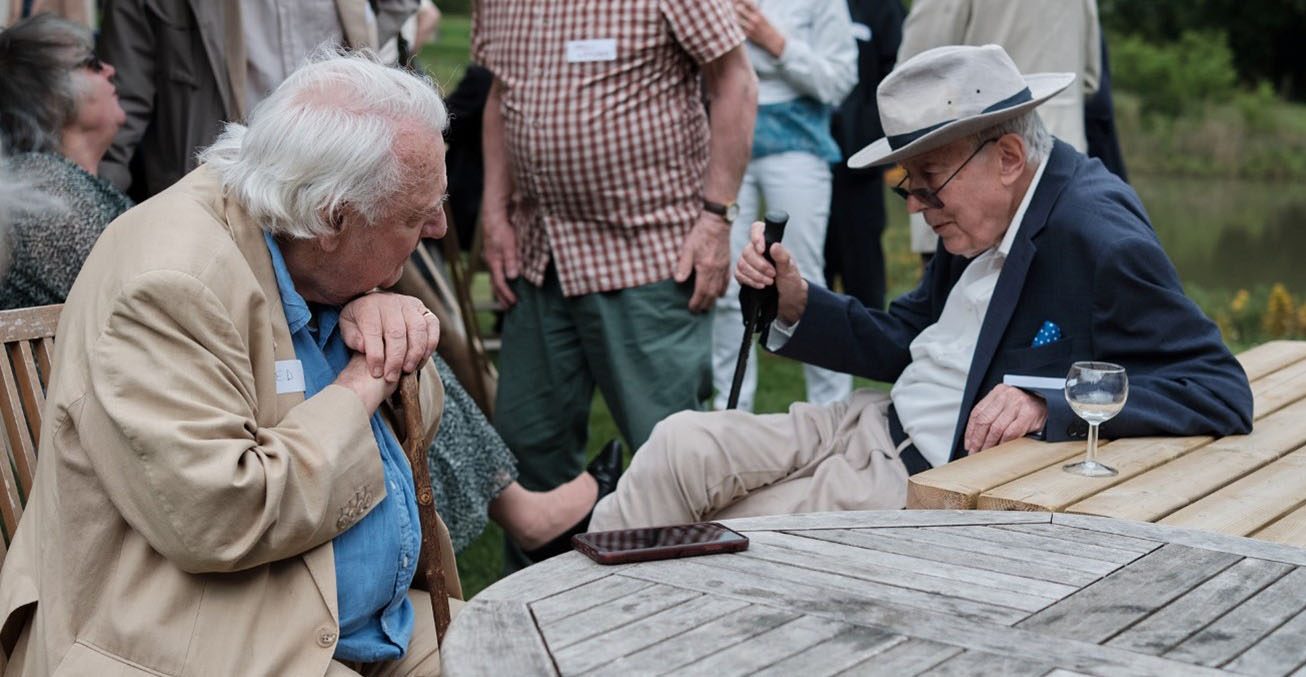
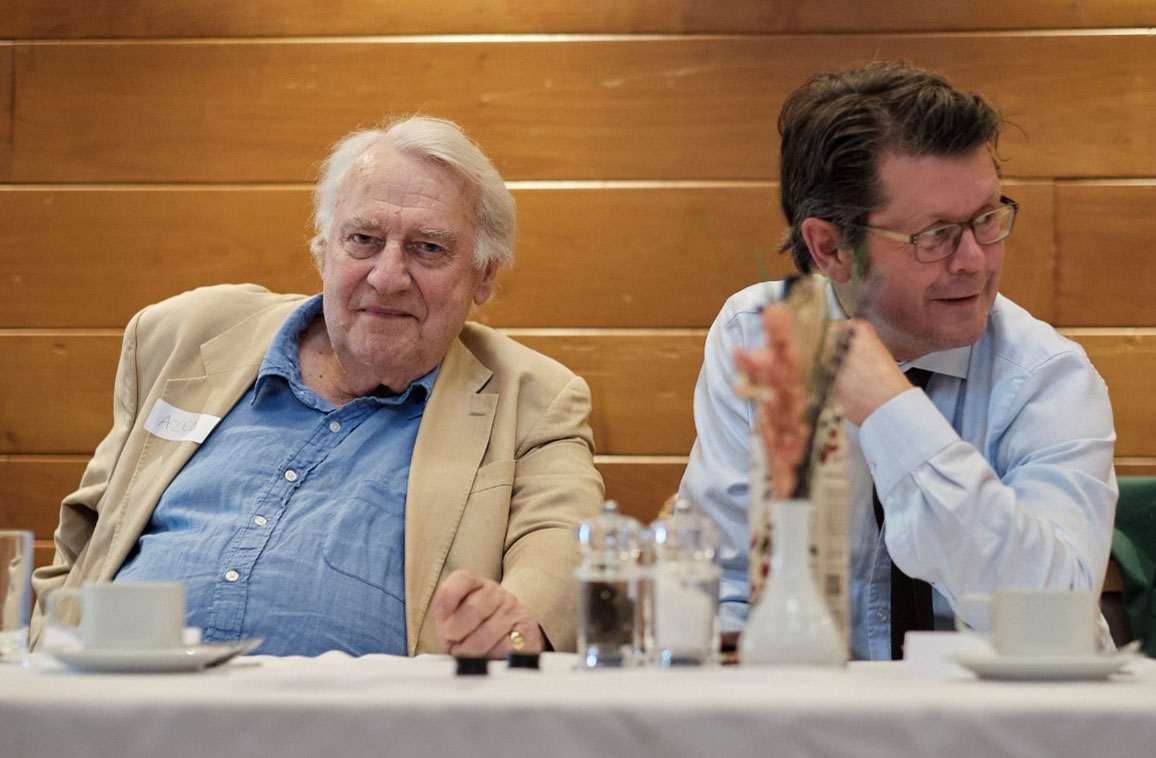
On May 3rd I attended the lunch in Oxford to celebrate the publication of Azed 2,750, a most extraordinary landmark. The event, superbly organized by Richard Heald and Will Drever, started off with a drinks reception in the grounds of Wolfson College, where I met Azed for the very first time and was able to thank him on behalf of myself and solvers old and new for the pleasure that he has given us. Those who haven’t had the chance to meet him will not be surprised to hear that he is a true gentleman, with just a hint of the absent-minded professor.

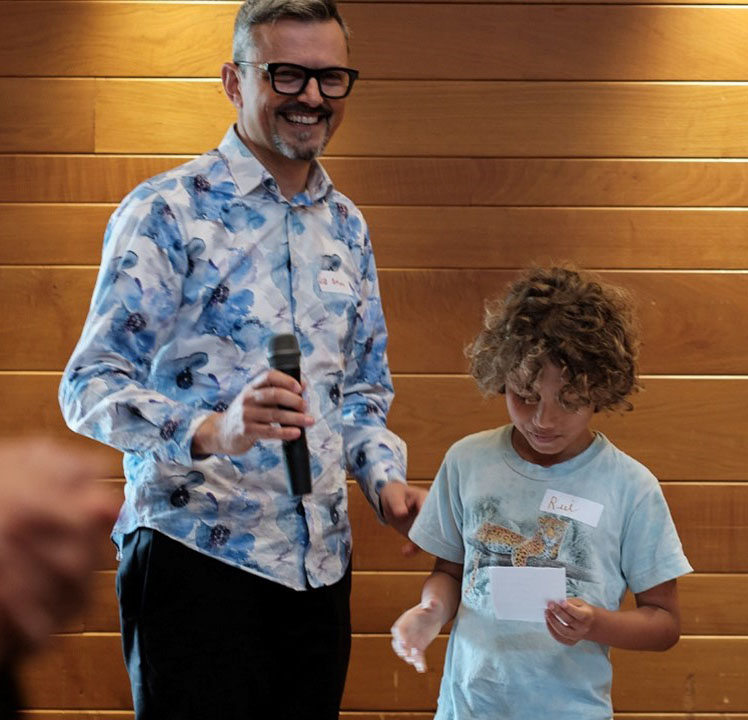
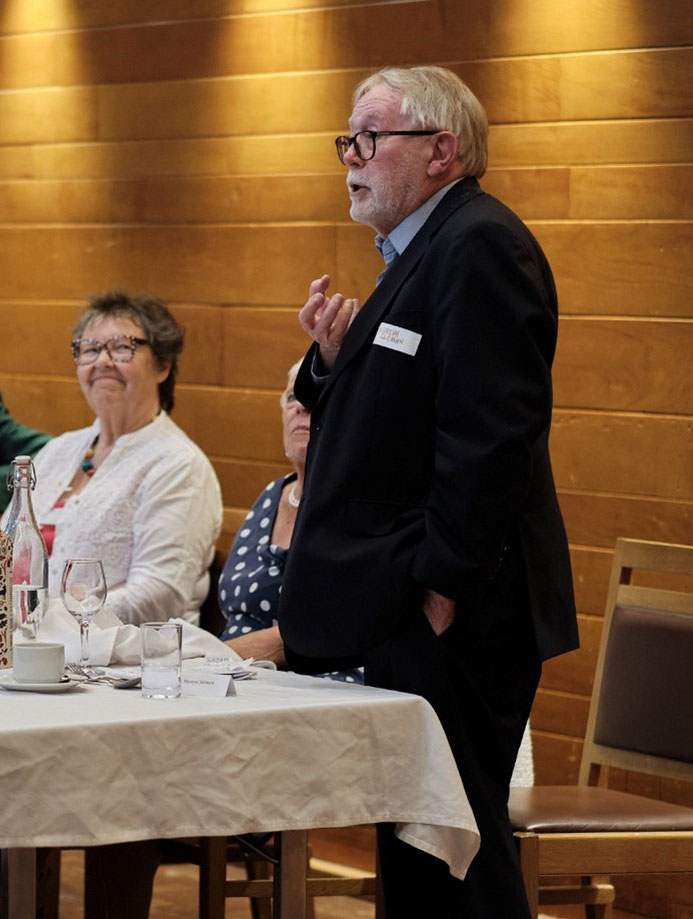
The assembled throng then moved inside the college for lunch, an excellent meal which I found difficult to eat because it meant that I had to stop talking for whole seconds on end. After the strawberry pavlova (for which I was happy to stop talking!), we were treated to some Azed-themed poetry (including a ‘Clerihaiku’) from two of the guests, followed by a wonderfully diverse collection of speakers. The first of these was Azed’s young grandson, whose short address went down well with the  audience. He told us that Azed was known to him as ‘Gongy’ [a childhood nickname of JC’s] and something that sounded like ‘Dumper’, although I’m going to wait for the transcript before I risk addressing Azed by that name myself. He was followed by Martyn Sloman, a long-time Azed solver, who described his 40 years of clue-writing competition entries in terms that spoke volumes for his pertinacity, which has sadly not so far been matched by his results. A four-time candidate for election to Parliament, he told us how the only thing that stopped him becoming an MP ‘was the electorate’.

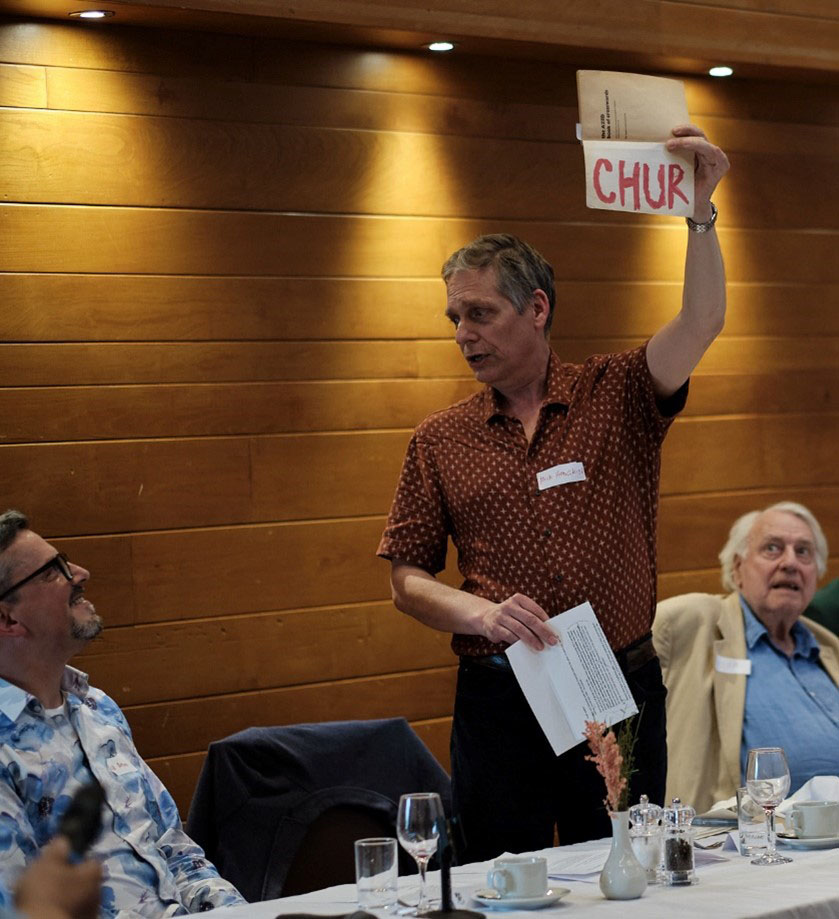
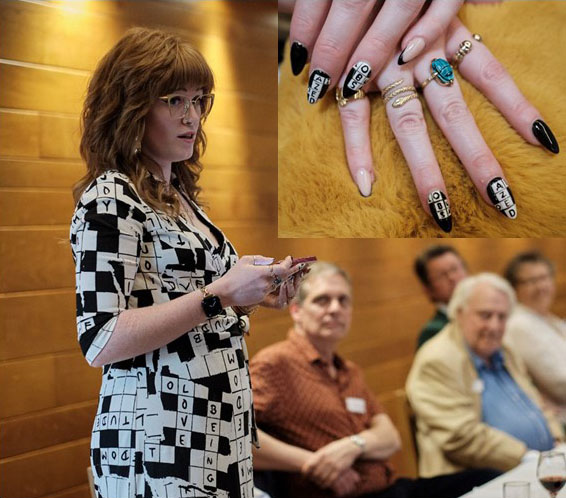
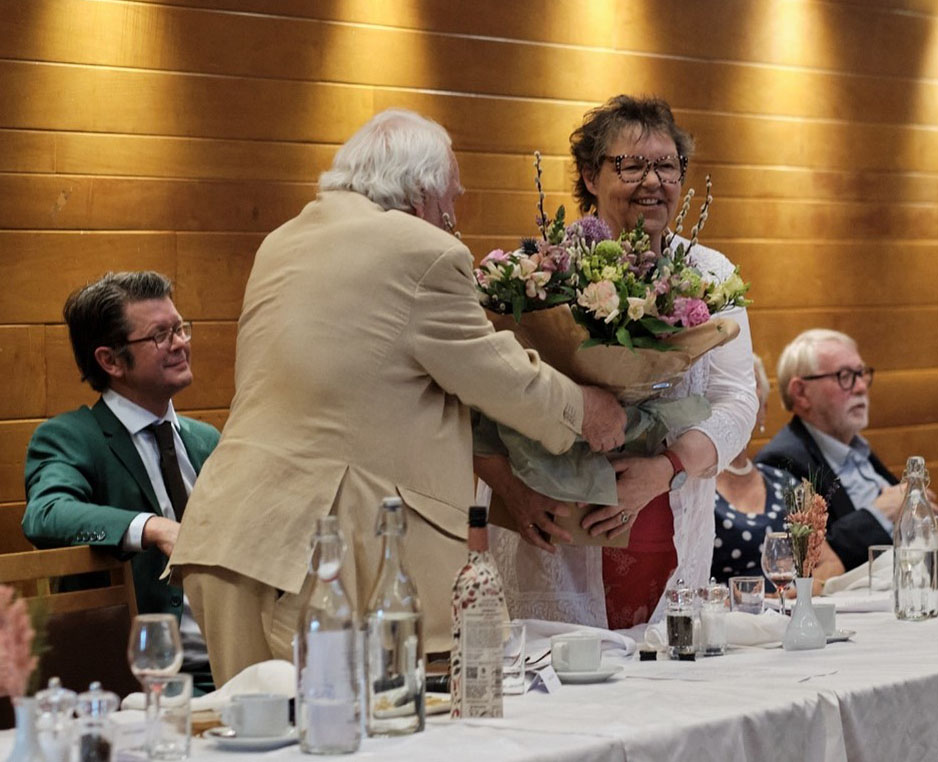
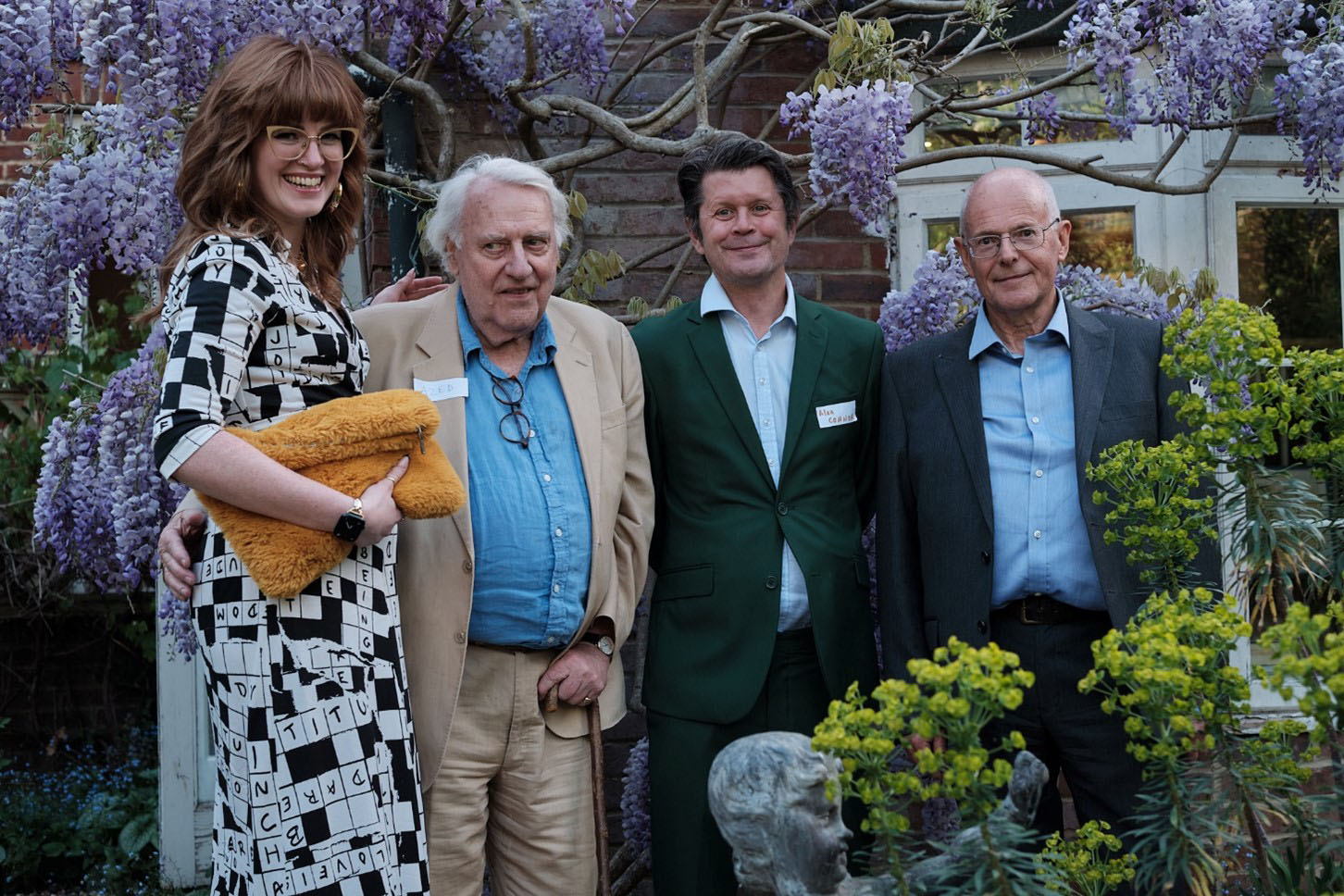
Then came the Times/Sunday Times puzzles editor, and multiple Azed cup winner, Mick Hodgkin, reminiscing about his copy of The Azed Book of Crosswords (“Fiendish puzzles for the crossword fiend”), and Alan Connor, among other things Guardian crossword editor, current setter of the Everyman puzzle, and ‘puzzle consultant’ for the TV show Ludwig. Next up was the lady whose job it is to get the Azed puzzle into the Observer every week, Caitlin O’Kane, decked out for the occasion in a most striking crossword-themed dress, with fingernails to match. Finally it was time for the great man to say a few words, which he duly did to considerable acclaim, before he was presented with a huge bunch of flowers to give to his wife, Alison.

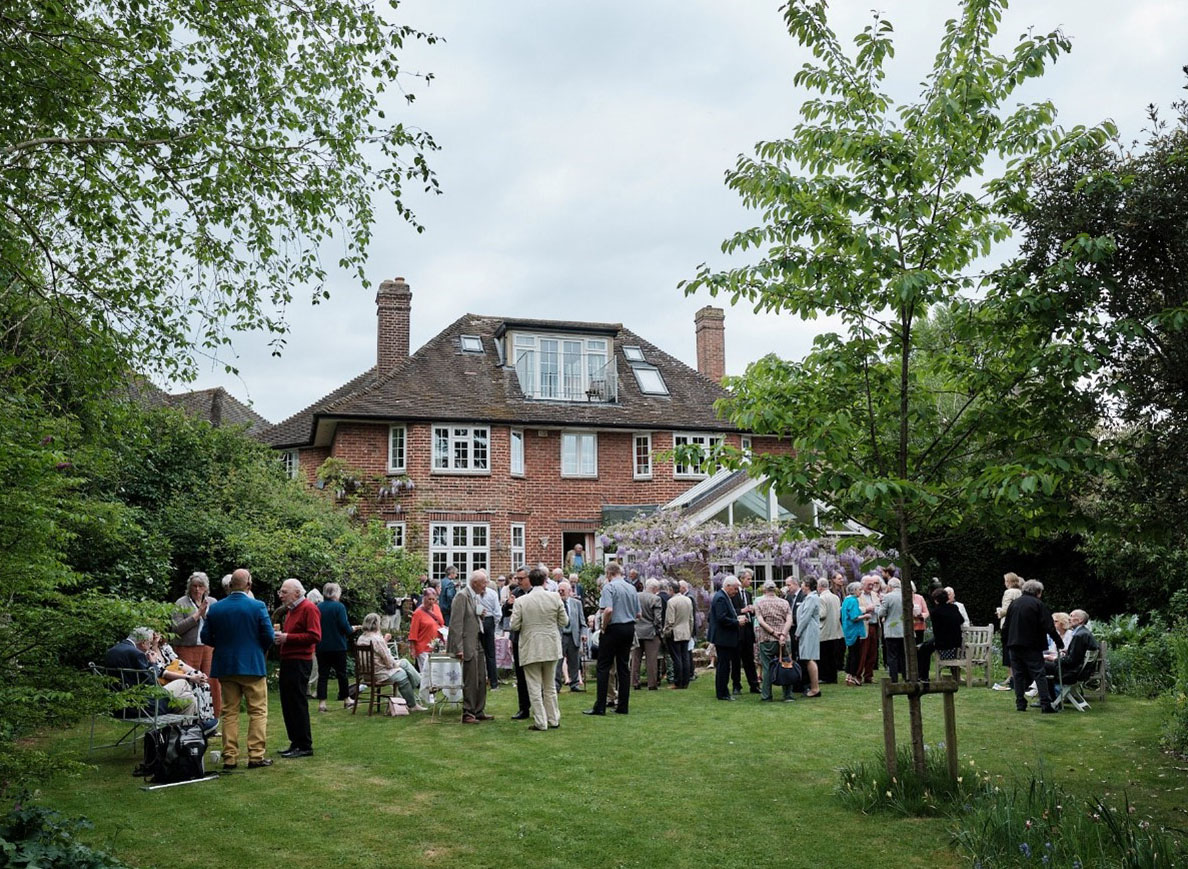
We were then invited to Azed’s home, within easy walking distance. Instructions were given regarding a short cut, which involved passing through what appeared to be someone’s garage, but several of the party went seriously off-piste, having understandably ‘refused’ at the entrance to the garage, and were seen striding purposefully through a neighbour’s garden, something which tends to be viewed unfavourably in North Oxford. The Crowther family (with help from the Manleys) provided a sumptuous spread, to which I tried heroically to do justice, despite having on my smartest trousers, which have strictly limited expansion room.

It was great to meet many Azed aficionados, some veterans and some more recent converts. The conversation throughout the day was hugely entertaining, and the setter Leo’s description of his near miss with Listener puzzle 2,566 (Lip Service, the last one to receive no correct entries), and his subsequent attempt to validate the solution (the inscription on the Blarney Stone) in the face of adverse weather conditions, was nothing short of hilarious. The whole event was joyous from start to finish.

I would very much welcome any corrections, objections, additions, anecdotes or thoughts. Please add comments to this post, or email me.

The pictures below are reproduced by kind permission of Dave Carter and the organizers

Azed and Don Manley

Azed and Don Manley

Azed and Alan Connor

Azed and Alan Connor

The youngest speaker, pictured with co-organizer Will Drever

The youngest speaker, pictured with co-organizer Will Drever

Martyn Sloman, the epitome of persistence

Martyn Sloman, the epitome of persistence in the face of cruciverbal adversity

Mick Hodgkin reveals next month's competition word, to Azed's obvious surprise

Mick Hodgkin reveals next month’s competition word, to Azed’s obvious surprise

Caitlin, with wonderfully apposite dress...and nails

Caitlin, with wonderfully apposite dress…and nails

Flowers for Mrs Azed

Flowers for Mrs Azed

Chez the Azeds

Chez the Azeds

The team responsible for getting Azed into the Observer every week – Caitlin O’Kane, Azed, Alan Connor and John Grimshaw


Notes for Azed 2,759

There are usually one or two points of interest in an Azed puzzle, and here we pick them out for comment. Please feel free to add your own questions or observations on any aspect of the puzzle (including clues not listed below) either by using the comment form at the bottom of the page or, if would prefer that your question/comment is not publicly visible, by email.

Azed 2,759 Plain

Difficulty rating: 1.5 out of 5 stars (1.5 / 5)

Before I get on to this week’s puzzle, I wanted to say a very big ‘thank you’ to the organizers of Saturday’s Azed lunch, which was a wonderfully enjoyable affair from start to finish. Great job, gentlemen! I also wanted to say how touched I was by the kind comments that several people made to me about this site – that sort of thing makes it all seem worthwhile.

The Tortoise was slow to come out of its shell today, but the correct results for competition puzzle 2,755 did at least appear; as I surmised, the results printed last week were for the ‘drawn at random’ 2,756. This puzzle struck me as being at the lower end of the difficulty spectrum, although it did contain quite a high proportion of relatively obscure words. In the clue for 17d, the repetition of ‘with’ should be ignored.

Although the competition clue word includes an accented vowel and has very specific geographic origins, it should (as confirmed by the unqualified definition provided by Azed) be treated as a word that has been absorbed into the English language and is still in current (if not regular) use, albeit in reference to the past. There is therefore no need to indicate its origins, but I would strongly recommend avoiding the use of the present tense in any definition (as this would suggest that such a person could be found today), just as one would steer clear of, say, ‘he sells liquor to soldiers’ for SUTLER, although ‘seller of liquor to soldiers’ or ‘he sold liquor to soldiers’ would both be fine.

Clue Writers’ Corner: Having just spent a few hours in the company of some of the very finest competition clue writers, it seems appropriate to make a couple of general points about writing competition clues. Firstly, even the most successful entrants will happily admit that they didn’t strike gold straight away; don’t be disheartened if your first few entries fail to find favour with the judge, but look in the slip at the clues which have been well received by him and keep going. And secondly, remember that soundness is of fundamental importance: look at the surface reading of your clue and ‘polish’ it by all means, but then forget about that, break the clue down into its cryptic elements, and view it not as a piece of prose but as an equation in crossword language. Does the wordplay really equal the answer required by the definition? If you’ve got ‘X holds Y back’, that can mean that X contains a reversal of Y, but it can’t mean that X-containing-Y should be reversed – that would need ‘X holding Y back’. ‘Engineers turn’ looks superficially valid for RE reversed, but first translate ‘engineers’ into RE, and ‘RE turn’ doesn’t look so good. ‘Engineers turning’ would be fine. If in doubt, sort it out! Submitting a sound clue won’t guarantee success, but it will ensure that the first hurdle of the judging process is cleared.

Across

11a Against boarding train last again (10)
A 3-letter word for ‘against’ is contained by (‘boarding’) a 7-letter word for a train or body of attendants, the result being one of that large group of verbs using a particular prefix which appear in Chambers without definition, the safe option for setters being to define them as the uncompounded form followed by ‘again’ or ‘once more’, which is just what Azed has done here.

12a Office once close, one’s unhinged (5)
A 3-letter word for a facility euphemistically known as ‘the office’ (and less likely to lead to unfortunate consequences when directing guests inside a house where there is indeed an office), is followed by an obsolete 2-letter spelling of a more familiar (if only in literature) 4-letter word meaning ‘close’ or ‘near’.

16a Around Rex, Basil and ‘Arry there’s some nerve (8)
Around the single-letter abbreviation for ‘Rex’ (in the monarchical cipher context) are to be placed a three-letter diminutive form of the name ‘Basil’ (or for ‘Barrie’, the middle name of Brendon McCullum, known for his particular style of cricket) together with the 5-letter name which in medieval England had the spoken form ‘Harry’ (and belonged to several kings), similarly deprived of its initial H.

24a Fully convinced by marriage, one makes regular deliveries (6)
A three-letter slang word, a shortened form of an 8-letter adjective meaning ‘fully convinced’ or ‘certain’, and a 3-letter word for marriage combine to produce a term which Chambers shows as ‘Scot and Aust informal’, but could be defined where we live in England as ‘habitual wearer of shorts even in the face of grave climatic contraindications’

28a Anger once with upper-class being crammed in carriage (5)
A 4-letter archaic word for injury or anger has the usual single-letter representation of ‘upper-class’ inserted (‘crammed in’).

30a The old practice round lane almost damaged bone (6)
An obsolete (‘old’) 3-letter word for ‘practice’ which will be familiar to regular barred puzzle solvers (and which differs by only its central letter from a common word with a similar meaning) contains (’round’) an anagram (‘damaged’) of LANE missing its last letter (‘almost’).

32a One leaves Rome inspired? (5)
A nice little clue, where  a 2-letter word for ‘one’ is removed from (‘leaves’) a 7-letter word for ‘Rome’ in the sense of ‘the papal authority’.

34a Herring of a kind? Chaps took a measure (8)
A 3+3+2 charade of words for ‘chaps’, ‘took’ and ‘a measure’, the last named being used specifically in the printing trade.

Down

1d What may accompany rape? Crooked idol judge imprisoned (7)
An anagram (‘crooked’) of IDOL has a word meaning (among many other things) ‘[to] judge’ contained within (‘imprisoned’). The definition is along the lines of ‘What might accompany Vera’ for ALOE.

4d Woman, note, wearing medieval-style hat (6)
A charade that starts with a 3-letter (facetious, disrespectful or endearing, according to Chambers, which covers pretty much all eventualities) term for woman or girl, although readers north of the border may also be put in mind of the lanky son of Maw and Paw Broon of Auchenshoogle. The usual abbreviation for ‘note’ and 2-letter word for ‘wearing’ follow on.

10d Poet’s slight one lying in meadow (5)
A 2-letter word for ‘one’ (also featuring at 32a) is contained by (‘lying in’) one spelling of a word for a meadow much treasured by crossword setters. The poet, as so often, is Mr Edmund Spenser.

21d Like a philosopher, even in the course of scrutiny (7)
One spelling of the poetic contraction for ‘even’ is contained by (good to see Azed using ‘in the course of’ rather than ‘during’ – I’m pretty sure he shares my view about the latter as an insertion indicator) a word for ‘scrutiny’ or ‘examination’. The philosopher in question was a Stoic (he needed to be, as things turned out) who was responsible for writing Phaedra, covered almost 2,000 years later by Tangerine Dream (remember them?)

23d Scottish person, that is one who was paid to grieve (6)
A semi-&lit clue, where the whole clue ‘defines’ the answer, but only the first four words constitute the wordplay, a 4-letter Scots spelling of a familiar word for a person (often preceded by ‘poor old’ or similar) and the two letters that frequently answer to ‘that is’.

25d Musical piece, one penned by German singer (not good) (6)
The 6-letter surname which must be shorn of the usual abbreviation for ‘good’ might be associated by some with the American author Susan rather than the 19th century German operatic soprano Henriette, born Gertrude Walpurgis of that ilk, and, after her marriage, styled Henriette, Countess Rossi. A single-letter word meaning ‘one’ is contained (‘penned’) within.

27d Poet, nameless, about due for rediscovery (5)
The two-letter abbreviation for ‘anonymous’ (ie ‘nameless’) contains (‘about’) an anagram of DUE, the result being the name of a well-known British-born poet. Does ‘for rediscovery’ suggest rearrangement? In the words of Doris Day, ‘perhaps, perhaps, perhaps…’

29d King, captivated by love for wee dwarf (4)
The monarchical abbreviation for ‘king’ is contained (‘captivated’) by a word for love in the sense of ‘no score’. I remember the Lancashire cricketer Harry Pilling being described by a radio commentator as ‘the tiny diminutive little Harry Pilling’; at five foot three he was the shortest professional cricketer of modern times, but he’d still have looked out of place among Snow White’s crew. Here, the ‘wee’ is probably de trop, but it does serve to indicate that the answer is a Scots word.

(definitions are underlined)

Notes for Azed 2,758

There are usually one or two points of interest in an Azed puzzle, and here we pick them out for comment. Please feel free to add your own questions or observations on any aspect of the puzzle (including clues not listed below) either by using the comment form at the bottom of the page or, if would prefer that your question/comment is not publicly visible, by email.

Azed 2,758 Plain

Difficulty rating: 3.5 out of 5 stars (3.5 / 5)

Azed enters his testudinal phase with a puzzle that definitely had the needle on the difficulty meter heading for the red. Note that when I make my assessment of a puzzle, it isn’t just the toughness of filling the grid that I am considering, but of both filling the grid and of satisfactorily parsing all the clues – I never consider a puzzle solved until both boxes have been ticked. There weren’t too many really straightforward clues in this one, and there were several where the answer came first and a full understanding of the wordplay second.

Setters’ Corner: Prompted by a question from a correspondent, I tackled the Guardian Easter special earlier this week. I was prepared for a libertarian approach to the clueing, although not for a blatantly faulty clue which had somehow got past the editor. That aside, I know that the expectations of Guardian back-page solvers are different from those of Azed regulars, but a few of the clues did grate. The gimmick involved the wordplays omitting a pair of letters, at least one of which was an ‘A’, and this was the clue for ULNA – “Centre of the bull is bone (4)”. The missing letters are NA, and the wordplay delivers UL, the middle letters of BULL. But how can ‘centre of the bull’ be UL? In my view, it can’t: ‘centre of the’ could certainly be H, and centre of ‘the bull’ could, at a pinch, be B. I don’t think “the bull’s centre” is significantly better – it isn’t the same thing as ‘the centre of bull’, which would be absolutely fine. But why couldn’t the setter just have written “Centre of bull is bone”? To my mind, the inclusion of the definite article in a situation like this is not deceptive, it’s unfair to the solver, and it should be avoided.

Across

13a Small change in Bangladesh I spotted entering expensive area (6)
The letter I (from the clue) is contained by (‘spotted entering’) a word which means ‘smart’ or ‘stylish’, and, by association, ‘expensive’, together with the usual abbreviation for ‘area’.

16a Pink after kiss mostly? Show interruption of blood supply? (7)
The 4-letter word for the colour ‘pink or light crimson’ follows a somewhat old-fashioned word meaning ‘[to] kiss’ in a snoggy sort of way, from which the last letter has been omitted (‘mostly’).

20a Simple game in US? Lacking tact for Central American (4)
A (3-3-2) spelling of the American name for the game known in Britain as ‘noughts and crosses’ (I was only familiar with the 4-4-3 and 3-3-3 versions) is deprived of the consecutive letters TACT (‘lacking tact’) to provide the ‘US and Central American’ term for a person from Costa Rica.

22a Trained pacer, etc – one that’s sure to run (8)
A straightforward anagram (‘trained’) of PACER ETC produces the modern agent noun of a familiar verb. However, the old form (ending in -or) has been retained in certain specific senses, one of these referring to a horse whose entry in a race has been confirmed at a particular declaration stage. Strictly speaking, ‘likely to run’ would be better than ‘sure to run’, but the spelling of the answer is more of an issue than the precision of the definition.

24a Number one bell I turned? It often requires a key (8)
A reversal (‘turned’) of a 2-letter abbreviation for ‘number’, the Roman numeral representing ‘one’, a 4-letter verb meaning ‘[to] bell’, and the letter I (from the clue). A key is normally required for the thing in question, with its mere proximity often being sufficient unto the process these days.

25a An occupant of the pulpit rerunning tape recorder? (4)
A (1,3) expression describing (informally) a person who might habitually occupy the pulpit is reversed (‘rerunning’) to give the answer, an acronym which was applied to Britain’s first video recorder. It was invented by the BBC and unveiled by Richard Dimbleby during a live edition of Panorama on 14 April 1958. After he had described the purpose of the technology, its effectiveness was demonstrated with a playback of the first few minutes of the programme, seemingly rewinding time (no, really). It had taken six years to develop, and the recordings were made on half-inch tape running as fast as 200 inches per second. Sadly, its moment of triumph was no more or less than that, as the delivery later that year of a machine from American manufacturer Ampex – which was demonstrably superior – consigned it to history. Incidentally, I don’t believe that ‘rerunning’ indicates reversal, but rather the sort of thing that Dimbleby demonstrated,  a second appearance but with the same internal sequence as before.

30a Quantity of drugs fit to be nicked, not stable, in Parisian rumpus (7)
A 3-letter word for ‘a quantity of drugs, esp heroin’, being the name of a familiar sort of container, is followed by a 10-letter word meaning ‘fit to be nicked’ (in the sense of being caught by the fuzz, and now usually applied to offences rather than persons) from which the consecutive letters STABLE have been removed (‘not stable’).

31a Bitter banned for Muslims? Send it back (5)
A word meaning ‘forbidden under Islamic religious law’, a relatively recent addition to Chambers (earlier editions give it only as an alternative spelling of the word for the women’s quarters in a Muslim house), is reversed (‘send it back’). The answer relates to the passage in Ruth 1:20 where Naomi and her daughter-in-law Ruth, both widowed, travel back to Naomi’s home town of Bethlehem. The women of the village say something along the lines of ‘Can this be Naomi?’ to which she replies, ‘Don’t call me Naomi [meaning ‘pleasant’]. Call me ???? [meaning ‘bitter’], for the Almighty has made me very bitter.’

33a Bury ma you’ll find thus in the forest swamp (5)
If you break the answer down into words of 2 letters (XX) and 3 letters (YYY), then in a 5-letter word for a swampy pine forest you will indeed find that the letters MA are XX YYY.

34a Salad veg displaying strong smell inspired frenzy (6)
After being told to give the exact opposite of the truth when asked about Homer Simpson’s qualities, an engineer at the nuclear power plant describes him thus: “Um, Homer Simpson is a… brilliant man with lots of well thought-out, practical, ideas. He is ensuring the financial security of this company for years to come. Oh yes, and his personal hygiene is above reproach.” The sort of 2-letter ‘strong smell’ that this last commendation (if true) would surely rule out is followed by a word which can mean ‘inspired frenzy’.

35a Measures strength of obligations limiting eaterie (8)
A 4-letter word for ‘obligations’ contains (‘limiting’) the sort of Italian eaterie that always makes me think of the one (“Tony’s ?????????”) that featured from time to time in Hi-de-Hi!, and into the name of which Gladys Pugh always inserted an an extra ‘-att-‘.

Down

2d Strand, the same after its centre is out of reach (5)
Not the best of the bunch, this clue has a 3-letter word meaning ‘the same’ or ‘single’ following the word REACH from which the central letters have been removed (ie ‘its centre is out of reach’). The definition refers to strand3 in Chambers.

4d Large fish, not useful, stored in hold (4)
The 2-letter abbreviation for ‘unserviceable’ (ie ‘not useful’) is contained by a 2-letter interjection meaning ‘hold!’ or ‘stop!’, a command often issued in triplicate by Santa to his team of reindeer.

6d German/Italian deploying some French in supermarket (7)
The 2-letter French word for ‘some’ or ‘of’ is contained by the name of a large UK-based retailer of groceries and general merchandise. As Azed notes, the answer is not in Chambers, neither is it  in Collins, but the OED gives it as “The Italian word for German; esp. used to express Teutonic influence as shown in some spheres of Italian art.”

8d Sea fish, salty when not left inside (5)
A 7-letter word for ‘salty’ has the 2-letter abbreviation for ‘verso’ (the left-hand page of an open book) removed (‘not left inside’).

10d E.g. cat toyed with bit of breakfast, sort of interloper (11)
An anagram (‘toyed’) of EG CAT is followed by a 6-letter word for a bit of breakfast that is an essential part of a good fry-up, with an absolute minimum of two being de rigueur.

11d Part of flower below earth to penetrate mineral (11)
A 6-letter part of a flower follows (‘below’) the usual abbreviation for ‘earth’, this combination preceding a 4-letter word meaning ‘to cut or penetrate’.

19d Floor grabbing attraction in government as of old (8)
A 5-letter word for ‘floor’, as in ‘he had the floor’ or ‘she took the floor’, contains (‘grabbing’) a word which is regularly indicated in cryptics by ‘attention’, surely misprinted here as ‘attraction’, since the latter works in neither the cryptic nor the surface reading.

26d Flowery tree in bed, not mature (5)
An 8-letter word, which loosely corresponds to one of the senses of ‘bed’ given by Chambers, has a three-letter word meaning ‘[to] mature’ deleted (‘not mature’).

27d Shrubby plant, name for hard old wood (5)
This is not, as it might first appear, a replacement clue, but rather a charade of a 4-letter shrub (named after the goddess of youth and spring) and the usual abbreviation for ‘name’.

32d Like some woollies, in parts they came undone (4)
A single-letter dialect word meaning ‘he’, ‘she’, ‘it’ or ‘they’ (ie ‘in parts they’) is followed by a word meaning, among many other things, ‘came undone’, in the way that Lady Madonna‘s stockings did on Thursday.

(definitions are underlined)

Clinical Data – April 2025 Update

Whenever I make changes to the lists, I now update the change history on each of the relevant pages, so I don’t routinely issue consolidated summaries.

Having done several updates in February, many of them prompted by suggestions from readers, I have made further additions this month, at the same time deleting the duplicated anagram indicators dithering, dithers and dithered. The various inflections of clamp (a strange omission) have been added for containment/insertion, as has instilled with. The departure/expulsion indicators formed from vacate are new entries, as are the reversal indicators derived from up and chop (the latter as an advanced indicator, based on the Chambers definition of the transitive and intransitive verb chop2, “to change direction”). The first letter selection indicator earliest and the juxtaposition indicators faces, facing, and faced with have been included. I don’t routinely add anagram indicators unless I feel that they provide something different from those that are already listed, given how many of them there are, but this month I have included devised, made a mess of, disposal of and volatile (the first three of which I had reason to use in clues of my own).

I very much welcome suggestions from readers regarding additions, deletions or modifications to the lists. Anything that I’ve actively rejected for the main lists will be in the Lexicon with a ‘questionable’ marker, so something that can’t be found in there has probably not even received consideration. The only things that I don’t include are indicators which seem highly unlikely to appear in clues, such as ‘inarming’ for containment, or anagram indicators which seem to offer no significant advantage over those already listed, eg ‘tumultuous’. Even allowing for that, I have no doubt that there are still plenty of cryptic indicators missing, so if you see something that isn’t listed used in a puzzle, or you think of a word/phrase that you feel has claims for inclusion, do let me know.

Continue reading