The Monthly Digest

Notes for Gemelo 50

There are usually one or two points of interest in an Observer barred puzzle, and here we pick them out for comment. Please feel free to add your own questions or observations on any aspect of the puzzle (including clues not listed below) either by using the comment form at the bottom of the page or, if you would prefer that your question/comment is not publicly visible, by email.

Gemelo 50 ‘Anagram Act’

This puzzle is available at https://content-api.slowdownwiseup.co.uk/api/mobile/v1/puzzle-data/5cbe834e-63fb-4836-82a7-b6fd228ca2f5/file/puzzle.pdf.

Preamble: Anagram Act • In order to solve each clue, solvers must act to unscramble a word that has been anagrammed; first letters of the de-anagrammed words explain what must fill the unclued entries. I was pleasantly surprised to discover Chambers recognises “anagram” as a verb, but “de-anagram” is yet to make it – the petition starts now.

Your difficulty rating for Gemelo no. 50
Votes: 18 Average rating: 3.3


Please give your own G-rating for this Gemelo puzzle by clicking on the relevant star above, with one star representing a very straightforward solve by your own standards (Gentle) and five stars indicating a seriously tough one (Gnarly). Note that hovering over the ‘graph’ icon will show you the full breakdown of votes for the current puzzle.

Your rating for Gemelo 49, based on 39 votes, was a nice round 2, significantly lower than the 2.6 for G48 and the 2.8 you awarded to G47. I put it a little higher than 2.0 myself, but it certainly wasn’t one of Gemelo’s more challenging excursions.

This puzzle was very nicely constructed. Too often with themed puzzles like this the gimmick appears to have been retrospectively applied to a set of normal clues, such that the surface reading makes very little sense and the modified word is easy to spot. Here the gimmick had clearly been built into the clues when they were initially written. It was a relatively straightforward gimmick to deal with, hence Gemelo didn’t need to make too many concessions in terms of the difficulty of the ‘de-anagrammed’ clues; I will be interested to hear how you rated it for toughness. But wouldn’t it have been an excellent basis for a clue-writing competition, the challenge being to produce a clue in the style of the others to the entry at 21a, perhaps?

After the observations on individual clues I have included a checklist of the words which have been anagrammed in the printed clues.

Setters’ Corner: This week I’m going to look at the techniques for writing this sort of clue. You might be lucky and find that there is an anagram (as at 32a here) of a word which can form the definition (or part of the definition) of the answer. In only five of the clues in this puzzle is the definition affected, and two of the most useful mechanisms are on display – the distorted qualifier (6d), which could be employed in a definition like ‘Dance in loos’ for HALLING [Oslo], and the definition by example (15d), as in ‘alpines?’ for DOG [spaniel]. In most instances, though, you will be focusing on the wordplay, and here there are also two key ‘tricks’. One is the disguised indicator (often an anagram indicator, largely because there are so many of them), as seen in 27a/20d or in a wordplay such as ‘teacher wary’ for HECTARE [awry]. The other involves a word which leads to an abbreviation, usually a single-letter one, as in 18a or in a wordplay like ‘oceanic fish’ for CLING [cocaine = C]. The important thing is to try not to overuse any one technique, and a review of the clues in this puzzle will show that Gemelo has mixed things up nicely. Note that although the examples here relate specifically to the ‘anagrammed word in clue’ gimmick, similar devices can be employed in clues where, for example, a word in the clue gains or loses a letter, or has one letter replaced by another.

Across

6a Trifle almost covering pistachio’s earth flavour (5)
A five-letter word meaning ‘trifle’ (in practice, both it and ‘trifle’ would be accompanied by ‘with’) missing its last letter (‘almost’) contains (‘covering’) a single letter selected from the word ‘pistachio’.

12a Maybe what is put into empty sandwich case (6)
A four-letter word which roughly equates (‘maybe’) to a de-anagrammed word in the clue is contained by (‘put into’) the outer letters (’empty’) of ‘sandwich’.

13a Select nutriments to go through ground (4)
A double-definition clue where both of the words will be familiar but one of the definitions involves the anagram.

14a Drink affecting head minutes before outburst on midterm projection (10, 2 words)
A three-letter abbreviation for ‘minutes’ and a four-letter word for an outburst or high wind follow (‘on’) a word for a projection, such as a camel would have, which has been deprived of a letter. The answer is (7,3).

18a Nectar consumer shortly dropping Royal Institute for real (6, 2 words)
A seven-letter word meaning ‘shortly’ gives up (‘dropping’) a two-letter abbreviation in favour of (‘for’) a single-letter abbreviation. The answer is (3,3).

24a Having learnt, say, about nitrogen covered in metal (6)
A five-letter word which might describe an animal (Rudolph, perhaps) having a particular sort of appurtenance contains (‘about’) the chemical symbol for nitrogen.

26a Informal thing, being together naked (4)
Here the anagram is in the definition, while the wordplay has a six-letter word meaning ‘being together’ losing its first and last letters (‘naked’).

34a Indifferent beans (groan!) eaten by you once the wrong way (7)
A four-letter word for beans of a particular type plus a single-letter abbreviation (according to Chambers, although it’s surely a symbol), contained (‘eaten’) by an archaic form (‘once’) of ‘you’, is all reversed (‘the wrong way’). The answer is hyphenated, 4-3.

Down

3d Doc suffering, we hear it’ll go down with glasses? (9)
The answer is a homophone (‘we hear’) of a (4,4) phrase which can be established once the necessary de-anagramming has been done.

4d One ton chosen by the people to pin the thing rising sharply (6)
A four-letter word whose indication includes the anagram contains (‘to pin’) a two-letter word for ‘the [very] thing’.

6d Mayor’s so taking to ancient porticos (5)
Rearranging the first word here produces a name which tells us that we are looking for a Scots form of the word ‘so’ to contain (‘taking’) the letters TO (from the clue).

7d Current measure – coteries with outsiders indulge it (3)
A five-letter word for coteries or factions is deprived of (indicated by the de-anagrammed word) its first and last letters (‘outsiders’).

8d Concealing, shortly, no great admiration through small, positive thing (11)
A shortened form (‘shortly’) of a two-letter word that isn’t ‘no’ is followed by a four-letter word for ‘great admiration’ (or a sect) contained by (‘through’) a six-letter word for a positively-charged particle (ie ‘small, positive thing’).

17d Committee’s tedious rule after date on the market? (8)
A five-letter word for a board or committee (a transferred meaning based on what they would be gathered around) contains (the de-anagrammed word) the single-letter abbreviation for ‘rule’ and the two-letter abbreviation for ‘after date’.

20d Apple product is scarier put in a cask with energy (6)
The letters IS (from the clue) contain (the de-anagrammed word) a three-letter word meaning ‘[to] put in a cask’ and the usual abbreviation for ‘energy’. The answer is an example of lower camel case (although it could more generically be described as an InterCap).

25d Earnest presenter promoting last character in group? (5)
A single-letter abbreviation (de-anagramming required) is followed by a four-letter word for a presenter (such as might appear on a chat show) with its last letter moved upwards (‘promoting last’).

(definitions are underlined)

Anagrammed words

Across: 1 – strap; 6 – earth; 11 – den; 12 – what; 13 – nutriments; 14 – midterm; 16 – pool; 18 – real; 24 – learnt; 26 – thing; 27 – ride; 29 – stale; 31 – Ruth; 32 – cowers; 33 – stream; 34 – groan.

Down: 1 – handouts; 2 – lies; 3 – Doc; 4 – ton; 5 – related; 6 – Mayor; 7 – indulge; 8 – no; 9 – Reform; 10 – race; 15 – nod; 17 – tedious; 20 – scarier; 22 – sued; 23 – mocha; 25 – Earnest; 28 – Eton; 30 – item.

Notes for Azed 2,784

There are usually one or two points of interest in an Azed puzzle, and here we pick them out for comment. Please feel free to add your own questions or observations on any aspect of the puzzle (including clues not listed below) either by using the comment form at the bottom of the page or, if you would prefer that your question/comment is not publicly visible, by email.

Azed 2,784 Plain

My difficulty rating: 2.5 out of 5 stars (2.5 / 5)

This puzzle can be found at https://content-api.slowdownwiseup.co.uk/api/mobile/v1/puzzle-data/3c939e4c-f08b-48cc-a1bd-8a0ad299ff5d/file/puzzle.pdf

Most of the difficulty in this puzzle was to be found in the NW corner. As one of Azed’s biggest fans, I don’t want to be seen as carping month after month about the quality of the recent puzzles published under his name, so I will just say that I hope others enjoyed this one more than I did.

Setters’ Corner: This week I’m going to look at clue 36a, “Adolescent about staggerin’, like the avenue? (9)”. A three-letter word for ‘an unruly adolescent, originally in the 1950s, affecting a dandyish style of dress’ contains (‘about’) a seven-letter word meaning ‘staggering’, similarly deprived of its closing ‘g’, the result being a (4-5) adjective which describes many an avenue, particularly the sort leading to a grand house. The point of interest here is the use of ‘adolescent’ alone to indicate a very specific type of adolescent, and the question is whether it requires further qualification. When I have used that word in a clue, I have always defined it by something along the lines of ‘unruly adolescent’, and I feel that ‘adolescent’ on its own should lead to ‘teen’ or a similar term. But there’s no issue with, say, ‘dog’ being used for ‘spaniel’, so is that any different? Yes, I think it is – for most people, a spaniel is first and foremost a dog, and secondly a dog with particular characteristics; the defining features of the person here, though, are their behaviour and dress, just as the defining feature of an aviatrix is that they fly planes, although the term also tells us that they are female. “I have a spaniel” expands on “I have a dog”, but “My son is an adolescent” and “My son is a young hooligan who dresses up as a dandy” carry completely different messages. Similarly, I would say that ‘child’ was absolutely fine for ‘infant’ and just about ok for ‘trot’ (a toddling child), but inadequate for ‘pickle’ (a troublesome child).

Across

4a What may have been wielded by shipmen, right? (9, 2 words)
An anagram (‘wielded’) of SHIPMEN and the two-letter abbreviation for ‘right’ produces the (6,3) answer, with the whole clue also standing as a loose indication of it. But I’m unconvinced about the anagram indicator, and the inclusion of a two-letter abbreviation in the fodder makes for an anagram which some might find a little too indirect for their liking.

11a Dandy/rake, right to left, neither first, in Gregorian cadence (6)
Four-letter words for a dandy and a rake (of the debauched rather than the garden kind) are deprived of their first letters (‘neither first’) and reversed (‘right to left’), yielding a word which is remarkably vowel-rich. I think the wordplay suggests that the two manipulations occur in the wrong sequence.

14a See wanton opening fantastic legs to writhe (8)
The letter of the alphabet with the name ‘see’ and a three-letter dialect word for a wanton person (which could also have been indicated by ‘equipment’) are contained by (‘opening’) an anagram (‘fantastic’) of LEGS.

15a Driver avoiding circling the majority of ridges (4)
This one is nicely constructed. An eight-letter word for a person who drives a car loses (‘avoiding’) a word meaning ‘the majority of’ from its outside (ie ‘circling’).

16a Declare singular turns relation left out (7)
A three-letter word meaning ‘singular’ or ‘single’ is reversed (‘turns’) ahead of a five-letter family member missing the usual abbreviation for ‘left’ (‘left out’). Unfortunately, the cryptic grammar is faulty (‘turns’ needs to be ‘turning’), which makes me doubt whether Azed wrote this clue.

19a Fairy or tube worm? Not so (7)
A (4,5) term for a worm that makes its tube out of rounded grains of rock is missing the consecutive letters SO (‘not so’).

32a Measure luminous appearance, not gold (4)
A six-letter word for a luminous appearance (or a small body travelling through space) lacks the two-letter heraldic term for the tincture gold or yellow.

33a Run isn’t common in the sea (8)
An informal (‘common’) form of “isn’t” is contained by (‘in’) a four-letter word for the high sea (which may remind devotees of 1066 and All That of the Great Spanish Armadillo sent to ravish the shores of England on the pretext that Captain F. Drake had singed the King of Spain’s beard, also known as the Spanish Mane, although Drake protested that he was in his hammock at the time and a thousand miles away). The required sense of ‘run’ is something like ‘operate’.

Down

2d Distinctive character including meeting with no act before anger – quite the opposite (11, 2 words)
A four-letter word used figuratively to mean ‘distinctive character’, containing a seven-letter word meaning ‘meeting’ or ‘communication’ without the consecutive letters ACT (ie ‘with no act’), precedes a three-letter word for ‘anger’. The answer is (2,9).

3d Scalp disease? Iris’s head has present involving it (7)
The surname of Iris, the English-born biographer who spent most of her life in Italy, has its first letter (‘head’) enclosed by the two-letter abbreviation for ‘present’ (ie ‘has present involving it’).

5d Source of peat is removed from Jock’s dish (4)
The consecutive letters IS are removed from a delicacy particularly associated with Scotland (as you probably know, it is a small creature with shorter legs on one side than the other, so it can run round mountains, which is ritually slaughtered on Burns Night).

9d What’s a bit like roti – two halves thereof go for a little local cash (4)
If the letters in each half of the answer are rearranged they produce the name given to a former Indian coin.

10d Number in sets once forming holy place (7)
The two-letter abbreviation for ‘number’ is contained by an obsolete spelling (‘once’) of a familiar word for ‘sets’ or ‘sides’.

23d Veg sewn in recess, calm (7)
I’ve no idea what the surface reading here is meant to suggest, but a three-letter legume (‘veg’) is contained by the term for a semicircular or polygonal recess in a church. I’m starting to think that ‘sown’ was probably intended, but ‘sown’ so clearly suggests dissemination that I can’t see how ‘sown in’ would work as an insertion indicator. That said, ‘sewn in’ isn’t much better.

30d Runs short of century causing grief (4)
A five-letter word for the total number of runs achieved loses (‘short of’) the usual abbreviation for ‘century’.

31d Once in Scotland forebear becomes free of stress (4)
A ten-letter word for a (female) forebear sheds (‘becomes free of’) the consecutive letters STRESS. The definition didn’t need to be quite so helpful.

(definitions are underlined)

Digest – September 2026

Doctor’s Notes

Some sad news for the crossword world this month, as we learned that the Independent plans to cease publication of its cryptic crossword at the end of October. The news – shared on the Fifteen Squared website – prompted a considerable reaction from solvers and setters alike.

Although I’m not a regular solver of  the Indy cryptic myself, I know that it’s played an important role in the wider crossword landscape. Mike Hutchinson has given many setters their first outing in a national newspaper. Colin Thomas, for one, started setting cryptics for the Independent as Twin in 2022, three years before he became Gemelo.

Of course, this is not the first time a cryptic crossword has come under threat. The Independent has been here before: there was a question mark over the future of its puzzles back in 2016 when the paper moved online. At that time, the blocked cryptic survived (in digital form, and later in the i paper), but its barred Beelzebub crossword did not. 

In contrast, the Listener crossword – an obsession of mine since I discovered it a couple of years ago – succeeded in outliving the publication after which it is named. When The Listener magazine ceased publication in 1991, the crossword was picked up – after a short hiatus – by The Times, where it has continued ever since. (Plans to discontinue the Listener in 1997 were countered by an impassioned campaign from fans and even an Early Day Motion tabled in the House of Commons.)

A contribution to the Clue Clinic’s forum this month reminded us that the Telegraph cryptic also came under threat in 1997, when the crossword editor announced “seismic changes”: future puzzles would be compiled from a computer database of existing clues. Thanks to the determination of Roger Squires and Ruth Crisp, the assistant editor at the time (Boris Johnson) reversed the decision on April Fool’s Day 1998.

So crosswords can be saved – and indeed new outlets can emerge. For aspiring solvers, Melbourne-based Angas Tiernan’s Minute Cryptic has provided a daily dose of wordplay since 2024. Today it has over 311,000 followers on Instagram, more than 53,000 subscribers on YouTube, and – I’m told – a healthy following on TikTok (which I feel too old and jaded to investigate). Simon Anthony of Cracking the Cryptic even started a new ‘MinuteCryptic in a Minute’ series in February this year.

Meanwhile in the UK, the new kid on the block is crossword magazine Unch which this month marked its first year in print. Editor Matt Holland and editorial team member and setter Rachel Playforth (Angel) shared their reflections on this milestone with the Clue Clinic:

“We’ve had a great year producing the first four issues of Unch, with sales increasing each time (over 500 people have now bought issue 4). We’ve featured over 30 different setters so far including familiar names from the daily newspapers and emerging setters who haven’t been published in print before. Around a third of our setters are women, as are two of the four puzzle editors. The aim is to continue to publish setters from a diverse range of backgrounds and we actively encourage contemporary and inclusive language and references. Plans for the future include exploring subscription models and a way to sell back issues (which we get asked for a lot!) Feedback has been overwhelmingly positive, on both the content and the design (and especially the paper quality, which is very nice to write on…).”

Issue 4 of Unch (July 2026) is lying on the desk in front of me as I type this. I’ve completed most of the blocked puzzles at this point – the magazine is A5 and pleasingly sturdy (as well as being beautifully designed), which makes it ideal for carrying around and solving on the go. I’ve read the interview with Times Puzzles Editor, Mick Hodgkin, another setter who made his debut in The Independent. However, I’m yet to attempt the barred puzzle, set by Mort and titled ‘Surprise!’…

Whether the Indy cryptic can be saved in some form remains to be seen. But I feel optimistic that the cryptic crossword species is evolving rather than heading for extinction. And I’m sure there’ll be some more surprises along the way…

What are your thoughts? You can add your comments below, respond to our monthly poll, or have your say in the Forum.

Clinical Observations

  • Azed 2,783: Plain, 3/5. A slightly trickier puzzle than usual, though this was partly put down to imprecise cluing.
  • Gemelo 47: Plain, 2.8/5. Well received, with commenters describing this as “one of Gemelo’s best puzzles to date” and “probably my favourite Gemelo puzzle so far”.
  • Gemelo 48: Plain, 2.6/5. A surprisingly low difficulty rating, perhaps, for a puzzle that prompted several Clinic visitors to ask the Doc for assistance.
  • Gemelo 49: Plain. Early indications suggest this was easier than usual, but voting is still open.

After you, Claude

I [writes Dr Clue] have for the last few weeks been using the AI assistant Claude to check my Azed/Gemelo Notes for typographical errors. He usually finds a couple – a repeated word here or a missing pronoun there – for which I am very grateful, being something of a stickler for accuracy [pause for collective gasp]. However, with Gemelo 48 he decided (unprompted) to verify my analysis of the clues, concluding his critique with: “I checked the wordplay for each clue I could work through (e.g. TIGHTER, MACHETE, ORACLE, GARAGE BAND, BALEARIC, DANCERS, NAGOR), and the explanations are consistent with the enumerations, so I found no factual slips.” Was he showing off? Was he ultracrepidating? Was he planning to take over the Notes? My fears on that last count were allayed somewhat with Gemelo 49, where he resumed his normal checking role as if nothing had happened, although he did seem particularly upset at my suggestion that David Bowie had been killed at the Battle of the Alamo.

I can’t help feeling, though, that he’s served notice and is now just waiting until the time is right…

Poll of the Month

Results of August poll

The question was “How do you feel about clues that employ Spoonerisms?” There was a rather disappointing ‘turnout’ of voters for this one, but the results suggest that the Spoonerism divides the crossword community roughly down the middle – those who weren’t keen had the slight edge (57%) over those who were (43%), and in each group there was a near-equal split between those with strong feelings on the subject and those without. So the device is perhaps not exactly the cruciverbal equivalent of Marmite, but it certainly isn’t everybody’s cup of jar dealing.

September Poll

This month, in light of the news about the Independent, I’d like to know how optimistic you’re feeling about the future of the cryptic crossword.

Cryptic crosswords: what’s your prognosis?

Notes for Gemelo 49

There are usually one or two points of interest in an Observer barred puzzle, and here we pick them out for comment. Please feel free to add your own questions or observations on any aspect of the puzzle (including clues not listed below) either by using the comment form at the bottom of the page or, if you would prefer that your question/comment is not publicly visible, by email.

Gemelo 49

This puzzle is available at https://content-api.slowdownwiseup.co.uk/api/mobile/v1/puzzle-data/4fcd7937-b648-466f-b26e-a2e06dff40eb/file/puzzle.pdf.

Solver difficulty rating

2.0 based on 39 votes (voting is now closed)

You gave G48 an average difficulty rating of 2.6, just a tidge below the 2.8 awarded to G47. I gave it 2.5, feeling that it struck a happy medium in terms of toughness, so we were in close agreement.

Given the standard of its immediate predecessors, today’s puzzle struck me as being a little disappointing, though I’m not sure that I could put my finger on why that was. The surface readings were perfectly serviceable, but they were perhaps rather on the dull side, which may have contributed to my relative lack of enthusiasm. A perfectly good crossword, but still no sign of the promised clue-writing comp, and you have to go back to G40 for the last ‘special’ that asked anything different of the solver.

Setters’ Corner: This week I’m going to look at clue 16a, “Where celebrations happened on account of taking vaccine, but not the last one (7)”. The wordplay has the two-letter abbreviation for ‘on account of’ containing  (‘taking’) a five-letter word for a vaccine (or a colourless bodily fluid), missing its last letter, and the Roman numeral representing ‘one’. The indicator ‘but not the last’ accurately tells the solver to omit that last letter, and the clue is fine. However, one often sees ‘not the last’ used to indicate removal of a last letter, ‘not the first’ for first letter removal, and ‘Y, not X’ for removal of X from Y. We tend to take the validity of these for granted, but I have become increasingly sceptical about them, and following a recent correspondence with a respected setter I am not convinced that they are truly fit for purpose. For instance, ‘X, not Y’, as in ‘whisky, not ice’, doesn’t mean that the whisky is lacking ice, rather that we are talking about whisky rather than ice. The former concept would be expressed by ‘whisky, no ice’. The only way that any of these ‘not’ constructions works is if a word like ‘having’ is inferred after it, but such inferences cannot reasonably be expected of the solver.

A regular correspondent has written to point out that solvers have for decades understood that, for instance, ‘Fellow not the first’ tells them to remove the first letter from a word meaning ‘fellow’. He is absolutely right, and I am not suggesting that anything should change, any more than I am suggesting that setters should no longer use ‘artist’ to indicate ‘RA’. The reality is that custom and practice trump other considerations, and whether the solver sees ‘not’ and infers ‘having’/’with’ to follow it, or their crossword brain simply says “‘not’ means removal of what follows from what goes before” is largely irrelevant. The reality is that certain established constructions are ingrained in the language of the crossword, and will remain there, even if they perhaps do not stand up to close scrutiny. New constructions are likely to be subjected to greater scrutiny – I suspect that if Gemelo used ‘sailor’ to indicate ‘RA’ it would not pass without remark.

Across

1a Apparatus for locating submerged objects like bones, mostly (5)
A two-letter word meaning ‘like’ is followed by a four-letter name given to particular objects used over many centuries in gaming, and which were typically made of bone, deprived of its last letter (‘mostly’).

6a American inclination to keep south out (6)
The usual single-letter abbreviation for ‘American’ precedes a four-letter word for an inclination or tendency containing (‘to keep’) the usual abbreviation for ‘south’.

12a Pilot, through translator, detained in city near Marseille (8)
The three-letter Latin word meaning ‘through’ and the abbreviation for ‘translator’ are contained (‘detained’) in the three-letter name by which the ‘City of a Thousand Fountains’ en Provence is usually known. The ‘pilot’ could have been, for instance,  Amy Johnson or Amelia Earhart.

24a How parent may be introduced after wedding journey (4)
I picked this one out for comment just so I could quote Harry Hill’s classic one-liner, “I have a really nice stepladder; sadly, I never knew my real ladder.”

26a Musk perhaps holds revolutionary status (7)
The forename of the world’s first US dollar trillionaire contains (‘holds’) the nickname of the world’s most famous (if crosswords are anything to go by) revolutionary, this being the conversational filler in Argentine Spanish (along the lines of ‘right’ in English) which he apparently used with great regularity. Presumably Manuel in Fawlty Towers was known by a broadly similar sobriquet.

29a Company cutting part in good time for Four Seasons (6)
A five-letter word for a company, missing (‘cutting’) the consecutive letters PART, combines with a five-letter word meaning ‘in good time’ to produce the answer.

31a Tea no longer baffled couple (4)
A triple-definition clue involving three different words with the same spelling, the first often being seen with an acute accent on the last letter, the second being archaic (hence the ‘no longer’), and the third frequently being indicated in cryptics by ‘friend’ or the like.

32a Independent constituency, closely fought, losing right of representation (8)
The usual abbreviation for ‘independent’ is followed by an eight-letter word for the sort of parliamentary constituency which is prone to changing hands on a regular basis, lacking (‘losing’) the usual single-letter abbreviation for ‘right’.

Down

1d Practically losing stone without a mission (5)
A six-letter word meaning ‘practically’ or ‘nearly’, missing (‘losing’, a repeat from 32a) the two-letter abbreviation for ‘stone’, contains (‘without’) the letter A (from the clue). The answer is the name of a Spanish mission and fortress in what is now San Antonio, Texas. Its lasting fame was ensured by a battle in 1836 which involved the legendary figures David Bowie and James Crockett (aka ‘Sonny’). The site is now host to a museum which welcomes several million visitors each year. Q: How many ears did Davy Crockett have? A: Three —a left ear, a right ear, a wild front ear.

2d Banger, for instance, retaining speed after leaving city (7)
A three-letter word equivalent to ‘for instance’ contains a seven-letter word for ‘speed’ from which the consecutive letters CITY have been omitted (‘leaving city’). The ‘banger’ in question should not be consumed in combination with hot sausage, mustard, cold jelly, custard and pease pudding, or in-di-gestion will surely ensue.

4d Severely criticise place with capital toward the north (5, 2 words)
A three-letter word meaning ‘[to] place’ and the printing abbreviation for ‘upper-case’ (‘capital’) are reversed (‘toward the north’).

7d One’s strung up and cross, caught by fine during sting (7, 2 words)
The  single letter which represents a cross is contained by a two-letter word meaning ‘fine’ or ‘all right’, and the combination is put inside (‘caught by’) a four-letter word which might at first blush seem to be not quite the same as ‘sting’, but the two verbs have a shared meaning of ‘smart’. The answer is (3,4).

9d What’s used before birth name, maiden name, or former name (4)
The wordplay here is a charade of the two-letter word that is used when giving the original name of a titled man, the usual abbreviation for maiden, and the single-letter abbreviation for ‘name’.

10d Fly from Bristol to London, say, forgetting article, and doubling back (6)
The four-letter general direction in which you would travel to get from Bristol to London loses (‘forgetting’) a single-letter article, is duplicated (‘doubling’), and is reversed (‘back’).

17d Stay-at-home mum accepting resistance over Conservative stuff that’s grown on her (8)
A two-letter ‘childish contraction’ answering to ‘mum’ containing (‘accepting’) the usual abbreviation for ‘resistance’ is reversed ahead of (‘over’) the single-letter abbreviation for ‘Conservative’ and a four-letter word for something that naturally grows on people.

20d Aboriginal huts with modern address that is special (7)
An abbrev-fest. The usual abbreviation for ‘with’, a three-letter abbreviation for an address on the World Wide Web (‘modern address’), the abbreviation for the Latin phrase meaning ‘that is’, and the single-letter abbreviation for ‘special’ join forces to produce the answer.

(definitions are underlined)

Notes for Gemelo 48

There are usually one or two points of interest in an Observer barred puzzle, and here we pick them out for comment. Please feel free to add your own questions or observations on any aspect of the puzzle (including clues not listed below) either by using the comment form at the bottom of the page or, if you would prefer that your question/comment is not publicly visible, by email.

Gemelo 48

This puzzle is available at https://content-api.slowdownwiseup.co.uk/api/mobile/v1/puzzle-data/0d0740bc-b84e-4d86-8492-b5917efb1fc5/file/puzzle.pdf.

Solver difficulty rating

2.6 based on 34 votes (voting is now closed)

Your ratings for Gemelo 47 averaged out at 2.8, a full point up on its two immediate predecessors. My own rating was a shade below that, but I thought it was pretty close to ideal difficulty and (a few minor quibbles notwithstanding) a very good crossword.

I thought today’s puzzle was excellent, with a few relatively easy starters and some cleverly disguised breaks between definition and wordplay. There was little here that jarred badly with me, although of course by now I am getting used to Gemelo’s ‘little ways’.

Setters’ Corner: This week I’m going to look at clue 10d, “Reckless gambler, holding 9 without ace, is rallying again (12)”. The wordplay involves an anagram (‘reckless’) of GAMBLER containing (‘holding’) the answer to 9d (‘9’), itself containing (‘without’) the usual abbreviation for ‘ace’. The point of interest here is that the answer is a noun while, of the two possible definitions, ‘is rallying again’ appears to indicate a verb (eg ‘recovers’), while ‘rallying again’ (with ‘is’ being a link between wordplay and definition) would seem to indicate an adjective or participle (eg ‘recovering’). In point of fact, it is the latter definition that is required, but ‘rallying’ here is not a participle or participial adjective but a verbal noun (gerund), so it could indicate ‘recovery’. The difference can be seen in examples such as “She has been unwell but is rallying” (participle), “They joined the rallying group” (adjective) and “Rallying in a telephone box is not sensible” (verbal noun). The gerund functions grammatically as a noun, and can be the subject or object of a verb (“Eating people is wrong”, “We like eating out”) and is something of a hybrid because it retains certain verbal qualities, so for instance it can (unlike other nouns) be modified by an adverb, eg “Eating noisily is impolite”. To derive an appropriate definition from a gerund, you may need to prefix it with the indefinite article, so here ‘a rallying’ and, for instance, ‘a flowing’ for ‘current’.

Verbal nouns used as definitions can be tricky for solvers because they almost invariably masquerade as participles in the surface reading, and when there is a link word like the ‘is’ here things become trickier still; for this reason, I would suggest that such definitions should be used sparingly. For solvers, a clue like this highlights the importance when breaking down a clue of separating out the definition and treating it as completely independent of the context apparently created by the surface reading.

One further observation about the definition here: the first meaning of ‘rally’ shown by Chambers suggests that the ‘again’ is unnecessary.

Across

5a Increasingly tipsy game involving chasers, with three shortly drunk (7)
A three-letter children’s game that involves chasers (this is the version with an ‘I’ in the middle, though the one I played many years ago had an ‘A’) is followed by an anagram (‘drunk’) of THREE missing its last letter (‘shortly’).

11a Where one may be putting gallons naturally around lake (10, 2 words)
The single-letter abbreviation for ‘gallons’ and a (2,6) phrase meaning ‘naturally’ are put around the usual abbreviation for ‘lake’. The answer is (4,6).

14a One’s educated about football team’s crosses in play (10)
A two-letter word equivalent to ‘one is’ and the two-letter abbreviation for ‘educated’ are reversed (‘about’) ahead of the six-letter nickname of a Midlands football team. The answer is hyphenated, 4-6, and the ‘in play’ is there because the word is shown by Chambers as being Shakespearean; whilst I appreciate that ‘in play’ makes a change from “Will’s” or the like, it does seem a bit vague – there can’t be many words that haven’t appeared in a play, somewhere, sometime.

18a Hot, naked – and separate (4)
A six-letter word meaning ‘hot’ in the sense of ‘fashionable’ is deprived of its first and last letters (‘naked’).

20a The clumsy chopping weapon? (7)
I’m not sure that &lits are Gemelo’s strongest suit (though in fairness 6d is solid enough). Here an anagram (‘clumsy’) of THE is contained by (‘chopping’) a four-letter war club (of the sort frequently wielded by General Nitt and members of his Barmy Army in Wham! comic, invariably generously endowed with spikes on the business end), with the result being loosely defined by the clue as a whole, though I’m not sure Bear Grylls would agree that such a thing is ‘clumsy’. Incidentally, we used to include ‘chopping’ in the list of insertion indicators at the Clinic, but it was recently removed on the grounds that the chopping was done by a person, not the instrument.

23a Burning ironing, ultimately from more than just pressing? (5)
The last letter (‘ultimately’) of ‘ironing’  is [removed] ‘from’ a six-letter word meaning ‘more than just pressing’. There’s a link to today’s Setters’ Corner, since the ‘pressing’ in the surface reading is a verbal noun, while in the cryptic reading it is a verbal adjective.

26a Chat about Madness, along with less sophisticated rock group (10, 2 words)
A three-letter word meaning ‘chat’ (a talent for which one might acquire through intimacy with the Blarney Stone) containing a four-letter word for ‘madness’ or ‘anger’ is followed by a word meaning ‘along with’. The result is a (6,4) expression which has had me singing the last track of the Clash’s debut album to myself on several occasions this morning.

Update: I read today that the song was written in response to a review by the NME’s inimitable (not necessarily in a good way) Charles Shaar Murray of an early appearance by the band, in which he expressed the opinion that “The Clash are the kind of ?????? ???? who should be returned to the ?????? immediately, preferably with the engine running.” Ouch!

29a At least 25 pounds for Spanish queen to board Asian carriage (6)
I’m not too keen on clues with relatively obscure answers which feature similarly obscure words in the wordplay – if the solver doesn’t know either of the words, they have no route to the answer. Here the single-letter monarchic abbreviation for ‘queen’ is contained by (‘to board’) a five-letter word for a Central Asian wheeled carriage which could itself be cryptically indicated by ‘sample from near Oban’.

Down

1d Press shoot sport informally, starting late in confusion (12)
This is a charade of three-letter word meaning ‘press’ or ’embrace’, a four-letter ‘shoot’ or ‘sprout’ (often, these days, of an idea), and a six-letter informal name given to a particular contact sport, without its first letter (‘starting late’). The answer is hyphenated, 6-6.

2d Medium or large initially claimed by one (6)
The letters OR (from the clue) are followed by the first letter (‘initially’) of ‘large’ contained (‘claimed’) by a three-letter word for the ‘one’ in cards.

4d Bit of light conflict abruptly ended when wearing uniform (8)
A five-letter word for a conflict or a scrimmage, lacking its last letter (‘abruptly ended’) is contained by (‘wearing’) a word meaning ‘uniform’ or ‘even’.

7d Erotic Greek monster killing one in three (4)
The name given to any one of three Greek monsters, of which Medusa is the most famous, loses (‘killing’) every third letter (‘one in three’) to produce the answer, which is usually hyphenated (2-2) but is also given by Chambers in an unbroken form. The surface reading makes you wonder what happened to the ones that weren’t killed.

13d Did Miss Delaware love interrupting temperamental woman from the south? (7)
The two-letter abbreviation for ‘Delaware’ is followed by the usual representation of ‘love’ within (‘interrupting’) an informal term for a temperamental, demanding woman, and the whole lot is reversed (‘from the south’).

14d Skippers mark floating crew rest regularly dismissed (7)
A three-letter word for a small marker-buoy (ie ‘mark floating’) precedes CREW REST with alternate letters deleted (‘regularly dismissed’).

17d Eg Ibizan beer stocked by Italian city clubs (8)
The usual three-letter word answering to ‘beer’ is contained by a four-letter Italian city, a popular setting for TV crime dramas (Lolita Lobosco, Cold Summer), and the usual abbreviation for ‘clubs’.

24d Antelope curry – no joke! – served up (5)
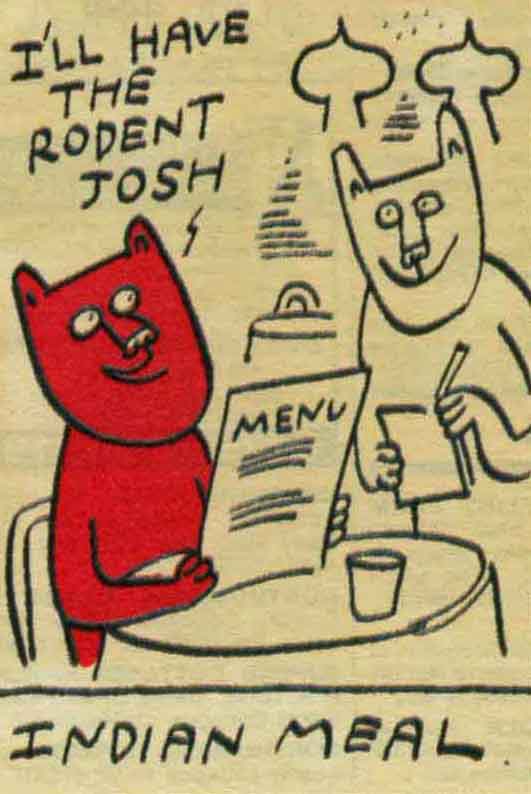
The (5,4) name of a particular variety of curry is shorn of a four-letter word meaning ‘[to] joke’ and reversed (‘served up’). I could not resist including a cartoon from the splendid Red Cat series, drawn by Robert Thompson and published in The Guardian. You will not be surprised to learn that the Red Cat’s breakfast cereal of choice is mouseli and his favourite recipe involves mixing single cream and double cream, the result being ‘triple cream’. Yum!

(definitions are underlined)

Notes for Gemelo 47

There are usually one or two points of interest in an Observer barred puzzle, and here we pick them out for comment. Please feel free to add your own questions or observations on any aspect of the puzzle (including clues not listed below) either by using the comment form at the bottom of the page or, if would prefer that your question/comment is not publicly visible, by email.

Gemelo 47

This puzzle is available at https://content-api.slowdownwiseup.co.uk/api/mobile/v1/puzzle-data/47443b9e-1247-4b8b-80a0-88a16eca0504/file/puzzle.pdf.

Solver difficulty rating

2.8 based on 38 votes (voting is now closed)

We all seemed to be in agreement that Gemelo 46 was one of the easiest plain puzzles that Gemelo has served up thus far. I gave it a difficulty rating of 1.5, and the average of the 45 visitor votes was 1.7,  below even the 1.8 that you awarded to the Beatles special.

I thought this was an enjoyable puzzle, with a good mix of clues, including enough easier ones to allow the solver to make inroads into the grid. I don’t remember coming across the word at 13d before; starting out as an Old English version of ‘Latin’, it came to mean ‘the language of a nation’, and then ‘a way of speaking’, which is the sense in which Spenser employed it. It has also been used by poets to describe the language of birds, hence the more recent dialect meaning of ‘noise’ or ‘chatter’.

Setters’ Corner: This week I’m going to look at clue 6d, “Queen caught disease (5)”. The wordplay is a charade of the two-letter abbreviation of the Latin for ‘Queen Elizabeth’ and a three-letter word meaning ”caught’ or ‘obtained’. The point of interest is ‘Queen’ being used to indicate ER. During the reign of Queen Elizabeth II it was universally accepted that ‘Queen’ or ‘The Queen’ was sufficient to yield ER, while ‘King’ can now be seen in puzzles as an indication of CR. Since this latter abbreviation does not appear in Chambers (or Collins), it is clearly considered by editors to be sufficiently well known to override the usual criteria which would be applied. But should ER now require a qualified definition, such as ‘former queen’? I’m not sure that there is a definitive answer to that question, but if ‘Queen’ is valid for ER, then the basis for its use in barred puzzles now has to be the abbreviation given by Chambers, and it must therefore also be valid for VR and VIR, with ‘King’ being acceptable for GR and ER. I know that some editors of blocked puzzles will not accept ‘Queen’ on its own for ER, and in general I would advise setters to clarify such a definition in some way.

Across

7a Bean that’s by the kilo? (4)
The wordplay makes reference to the International Radiotelephony Spelling Alphabet (aka the NATO Phonetic Alphabet), with ‘kilo’ and the answer representing neighbouring letters. The wordplay here just about works, but I bet that Gemelo tried out a few other options in his head before having to settle for it.

12a A short walk round, meaning one is house-trained? (11)
The letter A (from the clue) is followed by a six-letter word for a walk, missing its last letter (‘short’), the letter of the alphabet which can be described as ‘[a] round’, and a four-letter word for ‘meaning’ or ‘pith’. The definition is nicely oblique, the houses in question being divisions of the heavens.

16a Go out with European, 18, after losing head (6)
The single-letter abbreviation for ‘European’ precedes a six-letter word corresponding to the answer at 18d, without its first letter (not a seven-letter word missing its first two letters, for which ‘head’ would not be appropriate).

19a Dead then alive, stopping to drink up? (9)
The usual abbreviation for ‘dead’ and a four-letter past participle meaning ‘having come into existence’ are contained by (‘stopping’) the less common verbal form (‘to drink’) of a familiar noun, almost always seen in the past tense and in the company of ‘dined’.

23a Old soldier to give way when cycling around Italian city (9)
A four-letter word meaning ‘to give way’ or ‘yield’ with its first two letters moved to the end (‘cycling’) contains (‘around’) an Italian city famous for fashion, finance and football.

29a Creep arranged to hold court in A&E, dressed appropriately (11, 2 words)
A four-letter word meaning ‘[to] creep’ is followed by the three-letter abbreviation for ‘arranged’ around (‘to hold’) the two-letter abbreviation for ‘court’ inside the letters A and E (from the clue).

31a No longer compose timeless kind of music outside the mainstream (5)
The ‘timeless’ could indicate the removal of a single-letter abbreviation from either what comes before or what comes after, but it is a six-letter archaic word meaning ‘to compose or write’ which must suffer the loss.

32a Gabonese agreed to carry about black antelope (6)
Apparently around 80% of Gabonese speak French, and it is the French word for ‘yes’ which contains the two-letter bit of commercial jargon for ‘about’ and the single-letter abbreviation for ‘black’. Chambers doesn’t give ‘agreed’ as anything other than the past tense of ‘agree’, so the translation seems a bit iffy – even if we allow it as an adverb, I suspect that “d’accord” would be a more accurate rendering, non?

Down

3d Brief sporting competition getting United expelled after attending (8)
A seven-letter word for a sporting competition (either mediaeval or modern) deprived of the usual abbreviation for ‘United’ (‘getting United expelled’) follows a two-letter word for ‘attending’ (as in ‘He was attending a conference’).

4d Indian distance runner initially hides in Ford? (5)
Similarly to 31a, Gemelo has phrased this clue so that the first letter of ‘runner’ (‘runner initially’) could be hiding in either the Indian distance or the Ford. It turns out that it is concealed within an Indian measure of distance somewhere between 1¼ and 2½ miles, depending on whether you’re buying or selling. The unnecessary capital on ‘Ford’ will, if the results of our recent poll are anything to go by, have upset 25% of solvers.

5d Thessaloniki possibly reflected on song stanzas for local church? (8)
A reversal (‘reflected’) of a four-letter word for the sort of town exemplified (‘possibly’) by Thessaloniki (Aden and Rio have always been popular ones with setters) precedes a word for the sort of song one might associate with opera. The reason for Gemelo’s unusual choice of city is that the answer is classified by Chambers as ‘Greek church’, so the ‘local’ in the definition expands to ‘local to Thessaloniki’.

18d What male lion may have, chasing missing female tiger? (8)
A charade of a four-letter word for what one expects to see on a male lion and a word for ‘chasing’ or ‘following in search of’, lacking (‘missing’) the usual abbreviation for ‘female’. The answer is hyphenated, 3-5.  Apparently, female lions are unimpressed by the length of the appurtenance, but colour is (according to a University of Minnesota study) of prime importance, with blonds reportedly having a lot less fun.

22d Wearing through standard dress fabric (6)
A two-letter word meaning (among many other things) ‘wearing’ is contained by (‘through’) a four-letter word meaning ‘standard’ or ‘price’.

24d Did Long Acre coach expand when empty? (5)
The 25% who railed at ‘Ford’ in 4d won’t have liked this one either. The usual abbreviation for ‘Acre’ is followed by the first and last letters (‘when empty’) of both ‘coach’ and ‘expand’.

28d Content of birthplace of Heracles, offspring of Zeus (4)
The six-letter name of the city where Heracles was born loses its first and last letter to produce the daughter of Hera and Zeus who served ambrosia (a form of creamed rice) and nectar (an Australian lager) to the gods and goddesses on Mount Olympus.

30d Captain determined to drop external action (3)
A seven-letter word meaning ‘determined’ or ‘chose’ loses a four-letter word for an action from its outside (ie ‘to drop external action’).

(definitions are underlined)

Notes for Azed 2,783

There are usually one or two points of interest in an Azed puzzle, and here we pick them out for comment. Please feel free to add your own questions or observations on any aspect of the puzzle (including clues not listed below) either by using the comment form at the bottom of the page or, if you would prefer that your question/comment is not publicly visible, by email.

Azed 2,783 Plain

My difficulty rating: 3 out of 5 stars (3 / 5)

This puzzle can be found at https://content-api.slowdownwiseup.co.uk/api/mobile/v1/puzzle-data/37f474ec-edd2-4768-98f0-830809391543/file/puzzle.pdf

This was a distinctly mixed bag, which felt as though it was the work of several hands. One or two of the clues were neatly constructed but not entirely satisfactory, while others suffered from grammatical shortcomings or odd surface readings. The different styles of clue served to make it quite tricky by the standards of recent Azeds.

Setters’ Corner: This week I’m going to look at clue 24d, “Stone fissure causing struggle of old (6)”. A charade of the two-letter abbreviation for ‘stone’ and a four-letter word for a fissure produces the answer, an archaic form of a familiar word. The point of interest here is the word ‘causing’, which links the wordplay to the definition. These link words (or phrases) can be very useful in blocked puzzles which are aimed at less advanced solvers, since they can help the solver to identify the wordplay and definition parts; for the same reason, in advanced puzzles they tend to make clues easier, and I therefore try to avoid using them in such puzzles. Azed historically used link words sparingly, but in this puzzle roughly 40% of the clues contain one (‘in’ and ‘for’ being the most common). The Clinic’s list contains well over 100 such words and phrases, and there are more waiting to be added. While you might come across any of these in a puzzle, there are some which I would not use myself, and one of these is ‘causing’ (or ’causes’). The rationale for its use is that ‘causing’ can be placed after the wordplay and before the definition to indicate that the answer is the result of evaluating the cryptic ‘formula’. Whilst I have no issue with ‘producing’, and the first meaning of ’cause’ given by Chambers is ‘produce’, I think that ‘causing’ is borderline in terms of validity. I can think of no situation in real life where manipulating something ’causes’ something else of substance; combining hydrogen and oxygen can produce water, but it can’t cause it – it would ’cause it to be produced’. And whilst something might ’cause a riot’, the riot isn’t actually produced from the components. There are several other link words/phrases (eg ‘leading to’, ‘responsible for’) that fall into the same category, and I would advise setters to consider whether the link that they are proposing to use does fairly indicate to solvers that the wordplay directly produces the answer (or vice versa).

Don’t forget to catch up with the latest Digest and have your say in this month’s poll, on the appeal – or non-appeal – of spoonerisms.

Across

1a Speaker holding right box for composer (12)
A six-letter ‘speaker’ contains the single-letter abbreviation for ‘right’ and a five-letter word for a  large strong box. 

14a Cheer without address? Resulting depression (4)
A seven-letter word meaning ‘[to] cheer’ or ‘gratify’ loses (‘without’) the three-letter abbreviation for ‘address’.

21a Directors from USA with time broadcast round Europe (7)
An anagram (‘broadcast’) of USA plus the single-letter abbreviation for ‘time’ contains the three-letter abbreviation for ‘Europe’.

25a Powerful house, not the first, showing strong growth? (5)
The name of the ruling house of England between 1603 and 1714 (and Scotland from 1371-1714) loses its initial letter (‘not the first’).

29a Lie about abstaining – from such? (6)
A four-letter word for a lie, perhaps more often a story with certain elements exaggerated or invented,  contains (‘about’) the two letters which could be applied to someone who abstains from alcoholic beverage. Since the answer can mean ‘idle or frivolous talk’, the definition superficially seems to make some sense (by lying then you could be indulging in that very thing), but closer analysis suggests that it is simply inadequate.

33a Being averse to food one set in place, I see (8)
The single-letter word for ‘one’ is followed by a five-letter word meaning ‘set in place’ or ‘postulate’, the letter I (from the clue), and the letter of the alphabet with the name ‘see’.

34a Resinous medicine one twice swallows – reliable three times daily (9)
The same single-letter word from 33a here appears twice, the two instances being separated by (‘swallows’) a four-letter word meaning ‘secure’ (often followed by ‘sound’) and the three-letter abbreviation of the Latin for ‘three times a day’. The en dash in the middle of the wordplay is a bit of a horror grammatically speaking.

35a Wherein you’ll see fat sheaves constructed with art – a ———? (12)
An intended ‘composite anagram &lit’, but definitely not from the Premier League. The (7-5) answer (represented by the blank in the clue) when combined with A can be rearranged to form FAT SHEAVES plus ART. But the “Wherein you’ll see” at the start and the ‘a ———’ at the end are both trying to fulfil the same cryptic function, so the clue doesn’t work properly.

Down

2d Odd bits of whin interspersed with grass in west-country stream (5)
Two letters selected at intervals from ‘whin’ are interspersed with a familiar three-letter grass, producing a dialect word for a ditch or watercourse. The selected letters are not the odd-numbered ones, though – quite the reverse, which means that the clue is disingenuous at best.

4d Elements of woody tissue esteemed capital (7)
The past tense of a verb meaning ‘esteem’, along with many other things such as ‘possess’, combines with a four-letter European capital city.

5d Twining plant, treat mostly, as once, with chopper (6)
A five-letter word which is ‘old slang’ for a drink or treat (I think it must be older than I am), deprived of its last letter (‘mostly’), is followed by a two-letter North American spelling of a word for a ‘chopper’.

8d Poet, rising but not special, in costume (6)
The name of a famous poet from the twentieth century, missing one of his two initials (the one that came from ‘Stearns’), is reversed, the result being a familiar word used with a less familiar sense.

11d Submerged by bog, (English) girl star in church opening (10)
Underneath (‘submerged by’) a three-letter word for a bog are the usual abbreviation for ‘English’ and the girl’s name which is also the Latin word for a star. The surface reading seems rather mysterious.

18d What this stands for follows in USSR possibly (7)
A clever clue – almost. The standard abbreviation of a synonym given by Chambers for the answer (‘this’) follows an anagram (‘possibly’) of IN USSR. However, in the cryptic reading it would need to be ‘what stands for this’, as in ‘L stands for learner’ (not ‘learner stands for L’).

26d Early letters, super, turning up, revealing a woman’s sterility (6)
A (1,2,1) phrase for the first three letters of the alphabet (which perhaps would appear on the spine of the first volume of a set of encyclopaedias) is followed by a reversal (‘turning up’) of the two-character adjective meaning ‘first-rate’ or ‘excellent’ (I cannot believe that Azed is responsible for ‘super’).  Is ‘early letters’ sufficient here? It’s a bit too vague for my liking.

30d Upper house in the place of the seal, beginning within (5)
The two-letter abbreviation of the Latin phrase meaning ‘in the place of the seal’ (loco sigilli) has a three-letter obsolete word for a point (as of a weapon) or a beginning inserted (‘within’). Chambers doesn’t support the answer alone being used to indicate the upper house of the British parliament, although when prefixed with ‘The’ I suspect it would be understood by all solvers as having that sense.

(definitions are underlined)

Digest – August 2026

Doctor’s Notes

When did you first encounter Azed? This month we launched the Clue Clinic Forum, a place for discussion of any and all things cruciverbal. The inaugural thread – asking for crossword-related anecdotes – prompted one visitor to recount the sequence of events which led him to attempt Azed for the first time.

I came across Azed in my teens, when my mother gave me a second-hand copy of Jonathan Crowther’s A-Z of Crosswords as a present. Familiar only with the Telegraph cryptic at that point, most of the puzzles in this book were beyond me – alien-looking barred grids, impenetrable preambles, clues listed in alphabetical order of solutions… Puzzle 6 was ‘Corgis in Castle’ by Azed. I tentatively pencilled in 4 entries before grinding to a halt. I had never heard of Chambers Dictionary and my trusty ODE did not contain words like “pagurid” and “tripudiate”. Still, I enjoyed reading Azed’s introductory remarks and perusing the profiles of professional setters, wondering if I might one day follow in their footsteps.

I set my first cryptic crossword over 20 years ago while at university. My early puzzles featured such inspired clues as “Gives fish in greeting (9)”, along with more convoluted offerings in which I merrily sacrificed both smooth surface readings and good cryptic grammar in favour of attempts at humour, in the hope of earning an occasional wry smile or compliment from a fellow student.

Thankfully, it seems I’m not alone. In A-Z of Crosswords, many of the setter biographies tell a similar tale. Early attempts are described as “dreadful” (Ian Mawby), “absurdly esoteric” (Andrew Bremner / Sabre), and “amateurish and quirky” (Brian Greer / Virgilius). Feedback from editors varies from “wonderfully polite rejection” (Sabre again) to “two pages of trenchant criticism… ‘unruly unching and weak clues’” (Jack Gill / Llig). Some aspiring setters “hammer[ed] away for … years” before finally being accepted by a publisher (Alun Evans / Axe). Others honed their skills in secret – compiling “two 100-puzzle collections” which “never saw the light of publication” (Richard Rogan / Aragon) – or abandoned the craft for periods of time “after a succession of rejections” (Eddie James / Brummie).

This month I made my debut as a setter for the Financial Times. Seeing my puzzle in print was a real moment of joy, and it prompted me to think back to those early attempts at setting and all the clumsy clues I wrote for Varsity – incidentally the same student newspaper where Azed himself started out. I added a story of my own from that time to the thread in the Forum and enjoyed reading the other cruciverbal anecdotes that have been posted so far. If you have a story of your own to share, I would love to hear it.

We want the Forum to be a place for general discussion, somewhere you can ask open questions, express opinions, and swap tips. Whether you want to tell us about your first encounter with a favourite setter, an early attempt at setting, or a particular puzzle that has stuck in your memory, we invite you to come and join the conversation.

Clinical Observations

Another bumper month with 5 barred puzzles in The Observer:

  • Azed 2,782: Plain, 3/5 difficulty. Trickier than usual – in fact, it had been exactly a year since Dr Clue last awarded an Azed a difficulty rating of 3 – with plenty to discuss, as visitors raised a number of queries and quibbles. 
  • Gemelo 43: Plain, 2.4/5. An unusual grid with two 5-letter entries containing no unches, but a satisfying solve nonetheless – only minor criticisms, with most of the comments focussing on Dr Clue’s breakfast choices…
  • Gemelo 44: Plain, 2.5/5. Who knew an innocent-looking word like “after” could provoke so much discussion? Dr Clue examined several mental invisicommas and a rare case of dieresis – which thankfully cleared up quickly.
  • Gemelo 45: Special ‘Special Mentions’, 1.8/5. Gemelo, we learned, is a huge fan of the Beatles, but you were not huge fans of this themed puzzle. 
  • Gemelo 46: “Legendarily, one could pick up jumbo crossword, totally accurately, only taking seconds” – what about you? Let us know how you found this puzzle.

Comment Editing

A commenter recently observed that they were unable to include formatting in their comment, which prevented them from reproducing a particular clue accurately. Although it has always been possible to add limited formatting using HTML tags, this is a cumbersome and error-prone process. With the assistance of a couple of WordPress plugins, we have been able to equip the comment box with a toolbar featuring basic formatting buttons – bold, underline, italics, subscript/superscript, bullets, text colour, insert special character, insert link etc. We hope that you will find this useful.

Poll of the Month

Results of July poll

The question was “What is your view on solving crosswords on paper or interactively?”

47% of respondents said that they only solved puzzles on paper, while a further 28% prefer puzzles on paper but are happy solving interactively. The remaining votes were cast as follows:

I’m not fussed either way – 19%
I prefer to solve interactively, but paper is ok too – 6%
I only solve puzzles interactively – 0%

Doctor Clue counts himself among the paper-only brigade – in fact, his solving is limited to puzzles on A4 sheets. The blank areas are perfect for accommodating notes of all kinds, along with doodles should the going get really tough…

August Poll

This month, let’s talk about the Marmite of the cruciverse…

How do you feel about clues that employ Spoonerisms?

I love them – if they disappeared it would be a blushing crow! 5 votes 23.81%
When they’re good, they tickle my bunny phone 4 votes 19.05%
I really dislike them and wish you hadn’t shoehorned them into the other answer options 5 votes 23.81%
I tolerate them, but I’m not a fig ban 7 votes 33.33%
Total votes 21

Notes for Gemelo 46

There are usually one or two points of interest in an Observer barred puzzle, and here we pick them out for comment. Please feel free to add your own questions or observations on any aspect of the puzzle (including clues not listed below) either by using the comment form at the bottom of the page or, if would prefer that your question/comment is not publicly visible, by email.

Gemelo 46

This puzzle is available at https://content-api.slowdownwiseup.co.uk/api/mobile/v1/puzzle-data/f77a147b-684b-42fd-8393-ba43c5f70891/file/puzzle.pdf.

Solver difficulty rating

1.7 based on 45 votes (voting is now closed)

Last week’s ‘Fab 45’ (or not) received an average difficulty rating of 1.8, with no score above 3; I felt it was reasonably tricky, but I think that was largely because the gimmick meant that Gemelo’s wordplays were rather looser than usual. I wonder if it was sheer coincidence that the puzzle number was 45, as in rpm?

I’ll be interested to hear what you made of this one. The clues to most of the 12-letter words were not too taxing, and there were several other clues which, by Gemelo’s standards, were very straightforward, the definitions often lacking disguise. With his puzzles I nearly always have to pare the clues potentially worthy of comment down to my limit of 16, but this week no such trimming was required (only 14 suggested themselves). Continuing the ‘dodgy plural’ theme of recent puzzles, the one at 7d strikes me as being particularly unlikely. 

Setters’ Corner: This week I’m going to look at clue 28a, “Country getting rid of king for one who’ll join union (6)”. The six-letter name of a country discards the monarchical abbreviation for ‘king’ in favour of the Roman numeral representing ‘one’. This leaves “who’ll join union” as the definition, which is very much like (say) “who’ll make meals” for CHEF. I’ve seen definitions of this type before, and I’m not particularly keen on them. If you put a question mark on the end – “who’ll make meals?” – it seems absolutely fine, the answer to the question being CHEF. But if, as here, the pronoun is relative rather than interrogative, then the solver must infer a subject, with ‘one’ being the most likely candidate. “Country getting rid of king for one [one] who’ll join union” looks pretty odd, but isn’t fundamentally unsound given that the wordplay and definition are separate; however, it’s not an inference that would typically be made in real life. But could the wordplay and definition be linked? In the clue “Boss wanting one who’ll make meals”, the result of (CHIEF – I) could potentially be the subject, but the relative pronoun doesn’t match – ‘who’ relates specifically to people, and CH(i)EF is a sequence of letters. But change ‘who’ to ‘that’, producing “Boss wanting one that’ll make meals” and things start to improve – “Boss wanting one…” takes the letters C-H-E-F forward to the definition “…that will make meals”. Replace ‘who’ with ‘that’ in today’s clue, and I’d consider it much more acceptable.

Across

1a Tree and shrub family aged a decade, and led to change without any dead (12)
An anagram (‘to change’) of AGED A DECADE AND LED without every instance of the usual abbreviation for ‘dead’. But while ‘without any carbon’ certainly means that a thing contains no carbon at all, when you pre-process the expression into ‘without any C’ it does look a bit iffy.

14a Where hair’s removed from showers I’d taken in middle of engagement (9, 2 words)
A five-letter word for showers (in the sense of repeated precipitation) and the letters ID (from the clue) are contained by the central letters (‘middle’) of ‘engagement’. The answer is (5,4).

18a Flightless birds sing with allure, extremely attractive (7)
A three-letter word meaning ‘sing’ , ‘snitch’ or ‘squeal’ is followed by the sort of allure exuded by Clara Bow and the first and last letters of ‘attractive’ (‘extremely attractive’ – no comment necessary, I think).

20a Talk about old product of palm tree (4)
A word meaning ‘talk’, particularly of the empty and garrulous variety, is reversed (‘about’) ahead of the usual abbreviation for ‘old’.

25a First applications when decorating small crib no longer accepted in other cribs (12, 2 words)
The answer here starts with the single-letter abbreviation for ‘small’, which is ubiquitous IRL but not to be found in Chambers, and a six-letter archaic (‘no longer’) word for a crib to hold hay for cattle. There follows the single-letter abbreviation for ‘accepted’ inside the four-letter plural of a word for a crib or small bed, the result being the (7,5) entry.

29a Offensive decoration not really meant to put out independent Scotsman? (9, 2 words)
A six-letter word for ‘conveying meaning using words which are the literal opposite of the intended sense’, without (‘to put out’) one instance of the usual abbreviation for ‘independent’, precedes a forename  given by Chambers as ‘from the surname and place name, probably from [the] Gaelic [for] headland, peninsula’.

Down

1d Stop scraping around section that’s awkward (12)
A five-letter archaic word meaning ‘to hinder or stop’ is followed by a word meaning ‘scraping’ (more often seen  spelt with a ‘z’ and in the company of ‘to the ground’) containing the usual abbreviation for ‘section’.

2d Fulsome man perhaps gaining year, one way or another? (9)
A five-letter word exemplified by ‘man’ (but not boy) containing (‘gaining’, not a containment indicator that I like) a single-letter abbreviation for ‘year’ (‘year, one way’) combines with the letters OR (from the clue) and a different abbreviation for ‘year’.

4d Upset Los Angeles citizen in painful argument, initially about ballooning (12)
A reversal (‘upset’) of the usual abbreviation for ‘Los Angeles’, a three-letter abbreviation for ‘citizen’, a two-letter word with a very similar meaning to ‘in’ when referring to location (although in standard English the two are rarely interchangeable), a four-letter word meaning ‘painful’, and the first letter (‘initially’) of ‘argument’.

6d Scottish Highlander is embracing nationalist during unproductive uprising (7)
The letters IS (from the clue) containing (’embracing’) the single-letter abbreviation for ‘nationalist’ are themselves contained by a reversal (‘uprising’) of a word meaning ‘unproductive’ or ‘thin’.

9d Extra active duty to get into (5)
A charade of the military abbreviation for ‘active duty’ and a word meaning ‘get into’ or ‘put on’ produces the (3-2) answer.

13d What takes blood, mainly? (4)
There are some words that you hear once and which stay with you forever. In a music lesson at school many years ago, Mr Massey played a 32a by Brahms; I couldn’t describe one in any detail, but the word has remained firmly lodged in my mind ever since. Similarly, in an episode of the original TV adaptation of All Creatures Great and Small, Siegfried brought forth (much to the surprise of James) the five-letter instrument (that here must lose its last letter – ‘mainly’) in order to bleed a pony. Isn’t it always the things that you most want to forget that you can’t get out of your mind!

19d Damn accountant with unopened contract (7)
The three-letter abbreviation for ‘accountant’ goes ahead of a word meaning ‘[to] contract’, said specifically of the lips, missing its first letter (‘unopened’).

30d Disciple, like priest, ignoring peripheral parish (3)
A nine-letter word meaning ‘like a parish priest’ loses the letters PARISH from its outside (‘ignoring peripheral parish’).

(definitions are underlined)

Notes for Gemelo 45

There are usually one or two points of interest in an Observer barred puzzle, and here we pick them out for comment. Please feel free to add your own questions or observations on any aspect of the puzzle (including clues not listed below) either by using the comment form at the bottom of the page or, if would prefer that your question/comment is not publicly visible, by email.

Gemelo 45

This puzzle is available at https://content-api.slowdownwiseup.co.uk/api/mobile/v1/puzzle-data/7df02976-ab22-4651-8d5e-897337e1f49b/file/puzzle.pdf.

Solver difficulty rating

1.8 based on 45 votes (voting is now closed)

You gave G44 an average difficulty rating of 2.5, right in the middle of the spectrum and just one ‘tick’ up from its immediate predecessor. When I completed the puzzle, I wrote ‘2.6’ alongside it, so we were in pretty close agreement.

You probably know what I’m going to say about this puzzle. Ogden Nash wrote, “God in His wisdom made the fly / And then forgot to tell us why”, which pretty much sums up my feelings, although I suppose Gemelo kind of told us why. The clueing is very clever, and to be greatly admired on a technical level, but the solver gets a bunch of largely inelegant clues with no compensating challenge or reward. And I’m a Beatles fan. Now if one of the clues didn’t contain the title of a Beatles song and we had to write a clue to complete the thematic set, I’d feel very differently about it…

Note that the entry at 29d is an abbreviation (this is shown in the print version).

Setters’ Corner: This week I’m going to look at clue 15d, “Dig It parts had to arouse (9)”. The nicely concise wordplay has a four-letter word meaning ‘cultivate’ (‘dig’) containing the letters IT (from the clue), with a three-letter word meaning ‘consumed’ (‘had’) following on. The point of interest here is the ‘noun noun verb’ construction seen in ‘dig it parts’. This is something regularly seen in real-life language, as in ‘He writes books readers enjoy’, where a relative pronoun such as ‘that’ is implied between ‘books’ and ‘readers’. This is an extremely useful part of the setter’s armoury, not least because the result is a noun expression which can be subjected to further manipulation, as in ‘Piano chap pounds in modest band’, where ‘piano chap pounds’ yields MPAN (P in MAN), which is then contained by COY to produce COMPANY. It also comes in very handy when disguising ‘hidden’ clues, such as ‘Ordinary men or male nurses’ for NORMAL. One note of caution: less experienced solvers often struggle to understand this construction, so it should be used sparingly in puzzles aimed largely at such an audience.

Across

1a Creating Across the Universe and Because before second vinyl? (12)
A three-letter informal form of ‘because’ is followed by a two-letter (similarly informal) word for a second (as in ‘just a second’) and a seven-letter word for the type of substance that could be exemplified by ‘vinyl’ (and certainly would be by ‘PVC’).

10a Detest A Taste of Honey when covered by neighbour in Suffolk (5)
The letter A (from the clue) is followed by the first letter (‘taste’) of ‘Honey’ contained (‘when covered’) by an East Anglian form of ‘neighbour’, used as a term of address.

12a Vow to delay Love Me Do (6)
A four-letter word for a vow with the letter O put back (ie ‘to delay love’) combines with the letters ME (from the clue) to produce the (2-4) answer.

25a From this place in East London, around flashy department, prepared to release Rain? (9)
A five-letter word meaning ‘from this place’, losing its initial H (‘in East London’), containing a four-letter word meaning ‘flashy’ (as a Hawaiian shirt might be), precedes the usual abbreviation for ‘department’.

27a Help!, Not a Second Time for Native American (5)
A three-letter appeal for help is deprived of a single instance of the usual abbreviation for ‘second’ (‘not a second’) and is followed by a three-letter word for a time, as in ‘the time of reason’.

28a Organic, essential For You Blue regularly containing unknown error (6)
Alternate letters from the word ‘Blue’ (‘Blue regularly’) are put around (‘containing’) one of the letters representing an unknown in algebraic expressions and a three-letter word for ‘error’ much enjoyed by crossword setters. I know of at least one expert clue writer who would consider that ‘regularly’ cannot reasonably be applied to fodder of just four letters.

30a Let It Be turned into acceptable single (6)
A four-letter interjection meaning ‘so let it be’ is reversed inside (‘turned into’) a two-letter informal adjective meaning ‘acceptable’. The answer is hyphenated, 3-3.

32a Chapters about earlier Taxman by extremely loose band (6)
The abbreviation for ‘chapters’, containing (‘about’) the two-letter abbreviation for the former department of the British Government responsible for the collection of direct taxes (the one Ken Dodd said that he didn’t have to pay anything to because he lived by the sea), is followed by the first and last letters (‘extremely’ – NC, as people say in texts) of ‘loose’.

33a Share record in advance, recalled in wake of Sun King (5)
A three-letter word meaning ‘to record (music etc) in advance’ is reversed (‘recalled’) following (‘in wake of’) the single-letter abbreviation for ‘sun’, the whole lot being followed by the chess and card players’ abbreviation for ‘king’.

Down

1d Lash fibre, not having Any Time At All in workbasket (5)
A three-letter word for a lash (having nine tails and lives) and a four-letter word for fibre (or the surname of an unfortunate chap who met his End under a bookcase), are each deprived of the single-letter abbreviation for ‘time’ (ie ‘not having any time at all’).

4d Articulate For No One to local church (9)
A charade of a three-letter word often indicated in cryptics by ‘for’, the letters NO (‘from the clue’), a dialect word for ‘one’ (‘one to local’), and the two-letter abbreviation for a church of a particular denomination.

6d Wait on climax of record, under two hours before midnight? (6)
The last letter (‘climax’) of ‘record’ is placed under a (2,3) phrase which, since 1967, has told you when the main ITV news is broadcast.

7d Wreath reflecting final couplet of Piggies? Nonsense! (5)
A reversal (‘reflecting’) of the last two letters (‘final couplet’) of ‘Piggies’ and a three-letter word for ‘nonsense’.

11d Maybe one long period before drug lapse to make No Reply? (11, 3 words)
A three-letter word suggested by ‘one’ (the only other value it can have is zero), a three-letter word for a very long time, the usual single-letter drug, and a four-letter word for a lapse combine to produce the (4,4,3) answer, which contains an apostrophe.

19d Heir briefly coming up to support e.g. Michelle’s extravagant phrases (7)
A five-letter word for a young member of a family without its last letter (‘briefly’) is reversed (‘coming up’) underneath (‘to support’) a possessive pronoun that could represent “Michelle’s”, “Eleanor Rigby’s” or “Maggie Mae’s”.

22d To listeners, Boys is based on joints? (6)
For this homophone (‘to listeners’) clue I’ve tried to think of synonyms for ‘boys’ that aren’t the plural of a particular male forename (as borne by the co-creator of The Rutles), but I’ve come up dry so far.

26d Records are played on these screens, leaving Little Child for dead (5)
We have a six-letter word meaning ‘screens’ or ‘vets’ getting rid of (‘leaving’) the two-letter abbreviation for ‘child’ in favour of (‘for’) the single-letter abbreviation for ‘dead’.

The End? Yes It Is. I’ll Be Back…

(definitions are underlined)

2 Responses

  1. Dr. Daniel Price (Saint Vincent) says:

    As you state, requiring synonymy of strict definitions precludes too many commonly-accepted replacements. Figurative language is often in broad use, and it does not seem to be a stretch to equate figurative definitions. [With that said: I would not use “gutless” to define “spineless”, as the words have the same endings. “Lacking guts” for “spineless”, however, not only works with their definitions but also suggests wordplay that is absent: a nice bit of trickery.]

  2. Dr Daniel Price (Saint Vincent) says:

    All of my grids are themed, and I expend much effort in ensuring that theme words do not intersect, even when the theme is irrelevant to solving or is trivial. Even better, and even when I am likely to be the only person who notices, are grids where the themed entries are symmetrically arranged. My bride, who has no truck with cryptics (“you do you, dude”), is nevertheless the recipient of my commentary, and pretends to be happy for me when I achieve the desired effects. The look of the thing is important for our art, and art it is.

    Yes, an obviously asymmetrical grid niggles setter and solver. Conditioned responses, perhaps, but conditioned all the same.