The Monthly Digest

Clinical Data – February 2026 Update

Rather than making piecemeal changes to the lists, I now keep a spreadsheet of candidates for inclusion or removal which I then process periodically. A significant update has been done this month involving around fifty candidates (a few of which had their applications rejected).

Among the new arrivals are homophone indicators such as ‘on record’ and ‘in podcast’; containment/insertion indicators based on ‘snatch’, ‘defend’, ‘hoard’ and ‘invade’; anagram indicators such as ‘wound’, ‘spoils’, ‘mislaid’ and ‘sabotaged’; and reversal indicators such as ‘reverse’ (adjective), ‘in review’, ‘on the rebound’, ‘receiving a tip’ and ‘going uphill’.

Other changes rectified the accidental omission of indicators such as ‘abandoned by’ for departure/expulsion and ‘denied to’ for departure.

Rejections included ‘misheard’ as a homophone indicator (it doesn’t really make sense), ‘rim’ and ‘hem’ for first/last letter selection, and ‘fretted’ to indicate an anagram. These have all been added to the cryptic lexicon.

We also said goodbye to three entries: the first/last letter selection indicators ‘banks’ and ‘coasts’, and the anagram indicator ‘fiddling/fiddles’. I couldn’t see any justification for their continued inclusion, although they remain in the Lexicon.

As always, the change history on each page has been updated to reflect the latest updates.

I very much welcome suggestions from readers regarding additions, deletions or modifications to the lists. Anything that I’ve actively rejected for the main lists will be in the Lexicon with a ‘questionable’ marker, so something that can’t be found in there has probably not even received consideration. The only things that I don’t include are indicators which seem highly unlikely to appear in clues, such as ‘inarming’ for containment, or anagram indicators which seem to offer no significant advantage over those already listed, eg ‘tumultuous’. Even allowing for that, I have no doubt that there are still plenty of cryptic indicators missing, so if you see something that isn’t listed used in a puzzle, or you think of a word/phrase that you feel has claims for inclusion, do let me know.

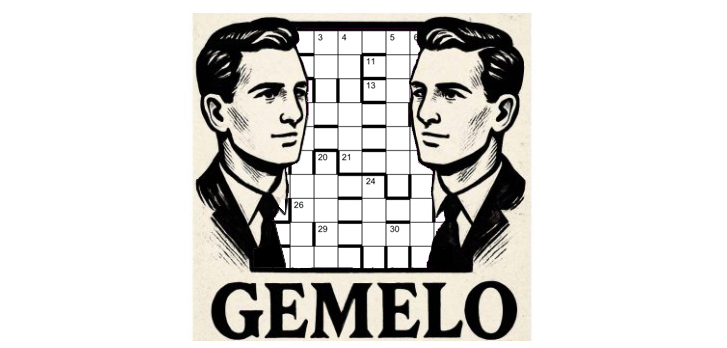
Notes for Gemelo 24

There are usually one or two points of interest in an Observer barred puzzle, and here we pick them out for comment. Please feel free to add your own questions or observations on any aspect of the puzzle (including clues not listed below) either by using the comment form at the bottom of the page or, if would prefer that your question/comment is not publicly visible, by email.

Gemelo 24

This puzzle is available at https://cdn.slowdownwiseup.co.uk/media/documents/obs.GEMELO.20260215.pdf.

Solver difficulty rating

3.8 based on 49 votes (voting is now closed)

Just when I thought that Gemelo had settled into a nice rhythm, with puzzles that were well clued and pitched at what seemed an appropriate level of difficulty, we have this one. Azed has always been very clear that a ‘special’ should present a different challenge for the solver as well as the setter, since otherwise…well, what’s the point? The end result here was a puzzle with clues which for the most part made very little sense and, because anagrams and ‘hiddens’ were effectively ruled out, offered very few easy toeholds. I’m reluctant to criticize a construction which demonstrated considerable skill given the constraints that the setter had placed upon himself, but admiration and enjoyment are horses of rather different colours as far as I’m concerned. I guess there was at least something for us to discover in the completed grid, though Gemelo had rather spoiled that surprise in the preamble.

Setters’ Corner: This week I’m going to look at clue 22d, “Bow’s cut into two, lifted into hem of knicker’s synthetic fibre (6)”. One of the hardest clues in the puzzle to parse, a five-letter word meaning ‘[to] cut into two’ loses the H at the start (“Bow’s”, ie as a Cockney might say it) before being reversed (‘raised’) inside (‘into’) the first and last letters (‘hem’) of ‘knicker’. This clue raises no less than four points. Firstly, the aitch-dropping: I don’t think there could be any quibble with, say, “Cockney’s locks” for AIR, but what about “Cockney’s elevation” for EIGHT? It jars a little, since pronouncing the resultant letters certainly doesn’t suggest a Cockney version of ‘height’, but I think when decoding this device we must consider how, say, Magersfontein Lugg’s words are reported in Margery Allingham’s Campion novels: ‘hair’ would appear as “‘air”, and ‘height’ as “‘eight'” – so no problem there. Next, ‘into’ indicating containment: in general, I don’t think that ‘X into Y’ is valid to indicate containment of X by Y, since it needs a verb such as ‘put’; here, however, the ‘lifted’ performs the verbal function, with the phrase ‘lifted into’ telling us to perform two manipulations on the target string, reversal followed by insertion – all ok there. Third, the use of ‘hem’ to indicate both the first and last letters of a word: I can’t accept this – a hem is an ‘edge’ or a ‘border’, and to indicate the two ends of a word I believe that ‘edges’, ‘borders’ or ‘hems’ would be required (the hem of a garment doesn’t contain the garment). Finally, “knicker’s”: Gemelo was clearly struggling here, and the apostrophe has to come before the S if the correct letters are to be delivered. But ‘knicker’ isn’t a garment, it’s a clay marble, which doesn’t make any sense.

Across

1a Voice filled with very loud energy of emotion (9)
A six-letter ‘voice’ that isn’t ‘passive’ or ‘middle’ contains the two-letter musical abbreviation for ‘very loud’ and the usual abbreviation for ‘energy’.

12a Lily, runner-up, dropping sport in distress – I’m surprised to go into it (8)
An anagram (‘in distress’) of RUNNER-UP without (‘dropping’) the two-letter abbreviation for one form of rugby football (‘sport’) contains (‘to go into it’) a two-letter interjection ‘denoting various emotions or responses, eg surprise, joy, exultation, dismay, enquiry, scepticism, encouragement, hesitation, and when repeated, laughter’ (ie “I’m surprised”).

14a Scott’s to do tense plot (5)
My first thought was that this would be a charade of the usual abbreviation for ‘tense’ and a four-letter word for plot, but in fact it is Walter Scott’s word meaning ‘to do’ (often indicated in non-lipogrammatic cryptics by ‘daily’) which is followed by the abbreviation, with ‘plot’ being the definition.

20a Lingo circling before someone phoned ME reformer (8)
A three-letter Hindi word for ‘the informal speech of a foreign language’ contains (‘circling’) both the usual single-letter abbreviation for ‘before’ and a four-letter pronoun used when identifying yourself on the telephone – pop fans might associate it with Bryan Ferry’s ‘Tomorrow’ or Paul Evans’ ‘Joannie’; on the evidence of ‘Hello’, appropriate telephone protocol was foreign to Lionel Richie.

21a Bushmen winning three points, drinking one Joburg home-brew (8)
A three-letter word for a group of huntsmen in South Africa (a string of letters sometimes indicated by ‘hospital’) contains (‘winning’) a judo score of three points (introduced in 1974, and done away with in 2009 ) which itself contains (‘drinking’) the Roman numeral representing ‘one’.

30a Silly to vent with difficulty on betel flower (5)
The word SILLY (from the clue) deprived of (‘to vent’) a three-letter word meaning ‘with difficulty’ follows (‘on’) a word for betel.

34a Fed executioner (but not Chinese) (4)
A seven-letter executioner loses (‘but not’) a three-letter word for a member of the native Chinese people. The answer is hyphenated, 1-3.

35a Love cycling off from evening primrose (9)
The single character representing ‘love’ in games such as tennis is followed by a (3,4) phrase meaning ‘off’ or ‘elsewhere’ which is ‘cycling’, the last letter being moved to the beginning. At the end is a single-letter accented preposition meaning ‘from’ or ‘of’, without which the Augustinian canon would have been plain old Tom Kempis.

Down

3d Vision of the future from Liechtenstein, so hot with respect to defensive position (12, 2 words)
The two-letter IVR code for Liechtenstein is followed by a two-letter word meaning ‘so far’ (but the ‘far’ had to be left out for obvious reasons), the usual abbreviation for ‘hot’, a three-letter word meaning ‘in respect of’ (or ‘in favour of’), and a four-letter word for a defensive motion or position in fencing (as in the expression ‘to ???? off’, meaning to parry or keep away).

4d Begin retrospective Gemelo report (6)
A reversal (‘retrospective’) of how Gemelo might be described objectively is followed by a four-letter word for a report in the sense of a gunshot (or a cough).

6d Old block of buildings put down, not quite the best of its kind (6)
A six-letter word meaning ‘[to] put down’ or ‘treat with contempt’ missing its last letter (‘not quite’) precedes the single letter which denotes an item of the highest class (albeit not necessarily the very best of its kind).

8d Thingummy with e.g. trilby is tested in Northern Soul (12)
The usual abbreviation for ‘with’ is followed by the term for something of which a trilby is an example, a four-letter word meaning ‘is tested in’ (as one might be tested in an examination), the usual abbreviation for ‘Northern’, and the French word for a soul. The answer is hyphenated, 5-3-4, and contains an apostrophe.

9d Police officer not finishing one’s fish (6)
A five-letter informal term for a police officer of a specific rank without its last letter (‘not finishing’) combines with an objective pronoun ‘in editorial and royal use’ for ‘one’.

17d More or less blow up rest (6)
A two-letter abbreviation for the Latin word meaning ‘around’ (ie ‘more or less’) is followed by a reversal (‘up’) of a word meaning ‘blow’ in the way that I might after ascending a long flight of steps following an inadequate breakfast.

24d Queen covering lid of sunken drinking cup in Holyrood (6)
The two-letter abbreviation for ‘Queen’ replaces (‘covering’) the first letter (‘lid’, hmm) of a five-letter word meaning ‘sunken’, a Scots form of ‘low’.

25d Possibly put EU emblem on shoulder when crossing street (6)
A four-letter word meaning ‘[to] shoulder’, as one might do to a burden, contains (‘crossing’) the usual abbreviation for ‘street’.

(definitions are underlined)

Notes for Gemelo 23

There are usually one or two points of interest in an Observer barred puzzle, and here we pick them out for comment. Please feel free to add your own questions or observations on any aspect of the puzzle (including clues not listed below) either by using the comment form at the bottom of the page or, if would prefer that your question/comment is not publicly visible, by email.

Gemelo 23

This puzzle is available at https://cdn.slowdownwiseup.co.uk/media/documents/obs.GEMELO.20260208.pdf.

Solver difficulty rating

3.2 based on 38 votes (voting is now closed)

In the last few weeks I’ve felt that Gemelo was starting to pitch his puzzles well, the tricky wordplays and devious definitions which we have come to associate with him being balanced out by a  good helping of accessible clues for entries spread around the grid. This one seemed to me to present a significant but fair challenge. 

Setters’ Corner: This week I’m going to look at clue 17a, “Cycling garment that’s wrapped around scratch (5)”. The wordplay here employs two devices which I don’t remember seeing in combination before – a five-letter word for a ‘garment that’s wrapped [around the waist and passed over the shoulder and head]’ has its last letter moved to the beginning (‘cycling’) before being reversed (‘around’). It’s not that unusual to see multiple manipulations applied to a single word that doesn’t itself appear in the clue, with deletion plus reversal being the most common, but this is something of a rarity. Is it unfair? No, as long as each successive manipulation is clearly signalled and the fabric of the source remains intact (so there are no random rearrangements, for instance), then it is reasonable to expect the solver to be able to work through to the answer; the number of manipulations does not in itself affect the validity of a clue.

Across

1a Lean muscles, we hear, cover for a multitude of sins (6)
A three-letter word meaning ‘[to] lean’ or ’tilt’ is followed by a homophone (‘we hear’) for a four-letter word informally applied to certain muscles in the chestal area. The answer is sometimes seen without punctuation marks, but is properly hyphenated, 4-2.

9a Eastern tailless moth, one that’s creamy-white? (8)
The usual abbreviation for ‘Eastern’ is followed by a six-letter moth missing its last letter (‘tailless’) and a two-letter word meaning ‘one’.

12a More work for religious in spun gold (6)
A two-letter word meaning (among many other things) ‘for’ and a two-letter informal word meaning ‘obtrusively religious’ (often indicated back in the day by ‘sanctimonious’) are contained by a reversal (‘spun’) of the chemical symbol for gold. The definition is of the crafty sort which we have come to expect from Gemelo.

19a One watches young son laughing internally (8)
The usual abbreviation for ‘son’ is followed by a nine-letter word meaning ‘laughing’ from which the first and last letters have been removed (‘internally’). The answer is hyphenated, 6-2.

21a Make mention of advance, after penny drops (5)
A six-letter word meaning ‘[to] advance’ (in terms of status, rank or fortune) loses the usual abbreviation for penny (‘after penny drops’).

25a Festival of gods just finishing early (6)
The two-letter plural form of the Latin word for ‘god’ precedes a word meaning ‘just’ or ‘sound’ without its last letter (‘finishing early’).

27a Priest dedicated 75% of dance (6)
The position of ‘dedicated’ makes this one tricky to parse. The first six letters of the eight-letter name of a wild dance which originated in Andalusia (‘75% of dance’) yield a term for a Roman priest who was devoted to a particular deity. I can’t help feeling that “Priest that’s dedicated” would be a little more sporting.

29a Star players initially dismissed touch of Eden Hazard (8)
One for the Chelsea fans, where a four-letter word for a group of actors (ie ‘players’) lacking its first letter (‘initially dismissed’) is followed by the first letter (‘touch’) of ‘Eden’ and a word meaning ‘hazard’.

Down

1d RIP – something often seen at funerals (4)
We know from past experience that Gemelo is no respecter of capital letters when it comes to the cryptic readings of his clues, and here he has disguised the first definition in this double-definition clue by making the whole word upper-case. The second definition is fairly broad, but the solver is left in little doubt about the correct answer.

3d Perhaps overcharge for sex, which former spouse accepts (9)
A three-letter word meaning ‘for’ or ‘in favour of’ precedes a two-letter euphemistic term for ‘sex’ contained by one four-letter spelling of an archaic word for a spouse or companion (ie ‘which former spouse accepts’).

4d Record from Scottish comedian on the way up (5)
The surname of a Scottish comedian is reversed (‘on the way up’) to produce the answer. The entertainer in question was born Hugh Corcoran in 1890; after performing as part of a dancing duo, he developed a style all his own for his solo act. This involved accentuating his tall gaunt figure by wearing white make-up, boots which were too large, a jacket which was too short, a glengarry, and a strikingly abbreviated kilt. Add to this a high-pitched voice, and you can see why people didn’t forget him in a hurry. Perhaps unsurprisingly, many who saw his act opined that it was not what he said but the way he said it that made him the funniest man of his day. His catchphrase “in the name of the wee man” entered the local vernacular, and is the title of a song by Scottish ban Biffy Clyro. Chambers suggests a derivational connection between the name of the entertainer and a  square of sausage meat, but in reality they are both named after an ancient province of Scotland.

5d Took risks to support tour, mostly unhealthy (9)
A five-letter word meaning ‘took risks’ (often with death) comes after (‘to support’) a five-letter word for a tour or excursion missing its last letter (‘mostly’).

7d Musical ultimately lost money, a burden for those on board (9, 2 words)
The (3,3) title of a musical based on the 1935 Fred Astaire/Ginger Rogers film of the same name, without its last letter (‘ultimately lost’), is followed by the usual abbreviation for ‘money’ and the three-letter word often indicated in cryptics by ‘a’, in the sense of ‘for each’. The result is a (3,6) phrase.

13d Condition of bird’s tail, mounted on vegetables stuffed with cheese (9, 2 words)
A reversal (‘mounted’) of that familiar two-letter bit of commercial jargon for ‘concerning’ or ‘on’ and the three-letter informal shortening of ‘vegetables’ containing (‘stuffed with’) a crumbly cheese associated with Greece. The definition, which perhaps treads the thin line between the innovative and the unduly complex, refers to a condition associated with (‘of’) the imminent end of a long stint in prison, ie “[being at] bird’s tail”. The answer is (4,5).

14d Northerner’s chest gaining A grade – she can defend herself! (9)
A four-letter ‘Scot and N Eng’ word for a chest contains (‘gaining’) the letter A (from the clue) and a four-letter word for a grade. The ‘She’ could equally well be a ‘He’.

18d Unprotected below head, with not so much beneath top of shield (8)
A three-letter word for a headland (‘head’) which I associate particularly with Plymouth and a word meaning ‘not so much’ follow (‘beneath’) the first letter (‘top’) of ‘shield’.

(definitions are underlined)

Notes for Azed 2,776

There are usually one or two points of interest in an Azed puzzle, and here we pick them out for comment. Please feel free to add your own questions or observations on any aspect of the puzzle (including clues not listed below) either by using the comment form at the bottom of the page or, if would prefer that your question/comment is not publicly visible, by email.

Azed 2,776 Plain

Difficulty rating: 2 out of 5 stars (2 / 5)

This puzzle can be found at https://cdn.slowdownwiseup.co.uk/media/documents/obs.AZED.20260201.pdf

A pretty gentle offering from Azed, who I would like to think is relieved to no longer have the responsibility of judging the clue-writing competition (and producing a monthly Slip) on his shoulders. I did feel that some of the clues (eg 19a) may not have been entirely the work of the master, but no matter, it was an entertaining solve.

There is also an article on the Observer site today (behind the paywall) about Azed stepping down from the clue-writing comp and the forthcoming celebration of 100 years of the Observer tough cryptic (provided by just four setters – Torquemada, Ximenes, Azed, and now Gemelo).

A quick plug – the February puzzle over at the Crossword Centre (Cover Stories by Phylax) comes highly recommended by its author!

Setters’ Corner: This week I’m going to look at clue 6d, “Time for start of struggle grated awfully (6)”. An anagram (‘awfully’) of GRATED leads to the (3,3) solution, but it is the definition that is of interest here. Chambers includes many words which have been imported directly from other modern languages, but have been assimilated into English over time; examples would be ‘outré’ (French) and ‘kitsch’ (German). However, Chambers also lists a number of other words which the editors consider to be ‘regarded as foreign words, rather than naturalized English words’, such as ‘abattu’ (French) and ‘Empfindung’ (German). These are shown with a qualifier such as ‘(Fr)’ or ‘(Ger)’ directly following the headword. The convention in barred puzzles is that such words, whether French, German or Scots, must have the language to which they belong indicated, or at least suggested, in some way. Hence the definition here needs to be more like “when Germans’ struggle begins” or “start of Kulturkampf, perhaps”.

Across

10a English king in public to exercise too much? (9)
The usual abbreviation for ‘English’ and a three-letter word for ‘king’ that comes directly from Latin are contained by a word meaning ‘public’ or ‘open’.

11a Bishop always replacing line in quiet? It was waste (12)
The two-letter abbreviation for the standard form of address to a bishop (or a Moderator of the Church of Scotland, should you happen upon one) and a four-letter word for ‘always’ replace the usual abbreviation for ‘line’ in a seven-letter word for ‘quiet’. The (3-9) answer is shown by Chambers as ‘obsolete’; this is not explicitly indicated in the definition, but implied by the words ‘it was’.

12a Exercises rolling over yielding a chortle from Mac (5)
There is a lot of exercising going on in the early across clues, not something I really want to contemplate on a Sunday morning (or at any time, if we’re being honest). Here a six-letter word meaning ‘exercises’ or ‘practises’ is reversed (‘rolling over’) before giving up (‘yielding’) the letter A (from the clue). The ‘Mac’ is there to tell us that the answer is a Scots word.

13a Easy? Not half, to touch up inside forthwith (6)
A six-letter word for ‘easy’ missing its second half (‘not half’) has a word meaning ‘to touch up’ (or ‘pretentious bits and bobs’) inside.

15a Incandescent cake decoration (6)
A double definition clue, where the first definition leads to an adjective and the second to a noun, both being listed under the same subhead in Chambers. I’m not sure about the first of these – I like hot food to be good and hot, but I think I might draw the line at incandescence.

18a Univ officer broadcast on TV? (4)
Another double definition, the first word being ‘university slang’ and the second ‘informal’ (a shortened form of a nine-letter word). I am reminded of the ‘young student from Oriel, who flouted the rulings proctorial’, but I think we’ll leave it there.

19a Player, by the sound of it secretary’s responsibility (4)
A slightly iffy homophone, where the answer sounds approximately (but not exactly) like the sort of player that struts and frets his hour upon the stage.

29a If old-fashioned schedule about over, here’s a rhetorical device (12)
A two-letter archaic form of ‘if’ (ie ‘if old’) is followed by a word for a schedule which contains the usual cricketing abbreviation for ‘over’.

Down

4d Army mostly found accepting religious instruction repellent (6)
A five-letter word for an army, in the sense of a multitude, deprived of its last letter (‘mostly’) contains (‘found accepting’) the usual abbreviation for ‘religious instruction’.

7d Permission for e.g. bishop outside to dine (5)
A charade of the two-letter prefix meaning ‘outside’ and a word meaning ‘to dine’ produces a word which can refer to permission from a bishop to a priest to leave the diocese, not permission for a bishop to take his leave.

16d Making runs in sport locally (cricket) (4)
The usual abbreviation for ‘runs’ is contained by a dialect (‘locally’) term for ‘sport’ or ‘fun’ (also a word these days often seen followed by ‘economy’), the answer being another dialect word (not indicated) for a cricket or grasshopper.

17d Spenser’s learned by heart – forgive one let off (4)
A seven-letter word for ‘forgive’ has the consecutive letters ONE omitted (‘let off’)

21d This one’s put in to drive ‘quicky’ aiming high (6)
I originally thought that the first part of this clue was a definition of a word which originated in the motorcycle world, where the BSA bike was known as a ‘Beezer’ while the name here was applied to a machine from their major German competitor. However, as Robert Zara has gently pointed out, it is in fact a simple wordplay involving a two-letter term for the setter (‘this one’) being put inside a word meaning ‘to drive’ . The definition really ought to be “result of ‘quicky’ aiming high?” – although if the bowler actually admitted to aiming high, they would be very unpopular indeed.

22d Might she have beguiled Pascal? (6)
An indirect anagram of the acceptable (in my view) kind. The letters in the first name of the only famous person with the surname ‘Pascal’ that I can think of are rearranged (‘beguiled’) to form a common feminine forename.

23d Scottish border – it divides one such heading north (5)
The word IT (from the clue) is contained by (‘divides’) a term for a border (‘one such’) which has been reversed (‘heading north’).

26d An eighth day, or half a seventh, counting up (4)
Half of the name given to the seventh day of the week is reversed (‘up’). I’m not keen on the ‘counting’, as that suggests that we should be counting the half backwards from the end of the word, which isn’t going to give the right result.

(definitions are underlined)

Azed Clue Writing Competition – Update

The Slip for Azed comp 2,733 has been published, and is available at:

http://www.crossword.org.uk/Azed2773.pdf

This is the last, and surely the most poignant, Slip of them all, since Azed communicates in it his decision to step down from his duties in respect of the clue-writing competition and reflects on his 54-year tenure. His wife, Ali, adds some further thoughts.

His is an extraordinary achievement, which I can say with complete confidence will never be matched (incidentally, I reckon he must have judged around a quarter of a million clues). My sincere thanks to him, not least for the cruciverbal wisdom that has been packed into the Slips over the years – as readers will know, I frequently refer back to them when discussing the art of clue writing.

We look forward to continuing to receive our monthly Azed puzzles for as long as he wishes to produce them.

The final Azed Competition Annual Honours List is also published:

http://www.crossword.org.uk/AZAH2526.pdf

Notes for Gemelo 22

There are usually one or two points of interest in an Observer barred puzzle, and here we pick them out for comment. Please feel free to add your own questions or observations on any aspect of the puzzle (including clues not listed below) either by using the comment form at the bottom of the page or, if would prefer that your question/comment is not publicly visible, by email.

Gemelo 22

This puzzle is available at https://cdn.slowdownwiseup.co.uk/media/documents/obs.GEMELO.20260125.pdf.

Solver difficulty rating

2.5 based on 37 votes (voting is now closed)

I felt that this was an excellent puzzle, with some imaginative and deceptive clueing which never crossed the line into unfairness. There were some tricky clues, but these were balanced out by a number of very accessible ones, and I felt that the finished product would by no means have disgraced Azed. Had it been set by the master, the emphasis would surely have been more on classical music and cricket than on films and religion, and there certainly wouldn’t have been that ‘without’ in 4d, but I think that Gemelo is now showing himself to be a successor as worthy as there can be, given that there will never be another Azed.

Setters’ Corner: This week I’m going to look at clue 13a, “Cliff Richard’s foolishly ignoring HR, I’d suspect (4)”. The answer here is an anagram (‘foolishly’) of RICHARDS  following the removal (‘ignoring’) of an anagram (‘suspect’) of HR ID. This clue illustrates a de facto rule of subtractive anagrams: if the letters to be removed (here HRID) do not appear in the correct order in the initial fodder (here RICHARDS), then there must be a second anagram indicator, effectively telling the solver to rearrange the subtrahend (here as RIHD) prior to extracting it (here to leave CARS) and rearranging the result. I’ve never fully understood the reasoning behind this – in this clue, why should we not rearrange RICHARDS to XXXXHRID and then remove the HRID? The answer, I’m sure, is that fairness to the solver demands an extra pointer, even if it is technically superfluous. If the clue were “Cliff Richard’s foolishly ignoring rubbish in his dustbin to start with” there would be no need for the second anagram indicator, but in the clue “Vehicles Richard’s foolishly denied HR, I’d suspect” for CARS, although the letters of the answer are in the correct order within the initial fodder (RICHARDS), convention dictates that two anagram indicators are still required, again in the interests of fairness.

Across

1a Repeatedly covered emergency, dropping one Gemelo, perhaps to save news editor (12)
A six-letter word for the sort of emergency that Commercial Union would never have turned into a drama loses (‘dropping’) a single instance of the Roman numeral representing one. The result is followed by a nine-letter word for what might appear on Sunday under the name ‘Gemelo’ (or ‘Azed’) without (‘to save’) a four-letter term for ‘news’ (as in “Have we had news from the front?”); the usual abbreviation for ‘editor’ concludes the entertainment.

12a Representative of Delhi peeled fruit (4)
You might, like me, find yourself working back from the solution to the six-letter ‘Indian agent, representative, or pleader’ which must be stripped of its first and last letters (‘peeled’) – the first letter is a V.

15a Skin disease specialist ultimately wears uniforms from the front line? (9)
The last letter (‘ultimately’) of ‘specialist’ is contained by (‘wears’) the eight-letter name for a disease ‘characterized by the presence of a rash resembling measles, the spots of which exhibit in their centres minute vesicles of the form of millet-seed.’ Yeuch.

17a Pile of rubbish cut from small-screen movie such as Ben-Hur (4)
A three-letter word for ‘a hill or ancient mound formed from the accumulated debris from earlier mud or wattle habitations’ (ie ‘pile of rubbish’) is removed (‘cut’) from a  seven-letter term for a film made specifically to be shown on television (‘small-screen movie’). It might appear at first blush that ‘movie’ is required by both the wordplay and the definition, but Chambers gives one meaning of the pronoun ‘such’ as ‘such a thing’, so the definition is effectively  ‘such a thing as Ben-Hur‘.

22a Outpouring shifting New Hampshire’s capital, almost (8)
A seven-letter word for ‘outpouring’ (as water or tears might be doing, at least when followed by ‘up’), having the usual abbreviation for ‘new’ relocated within it (‘shifting New’), precedes the capital letter found in ‘Hampshire’. The answer is hyphenated, 4-4.

25a Mountains and plains in southwest France overlooked at first (5)
A six-letter word used by English writers to describe the heathy plains of south-west France is shorn of its first letter (‘overlooked at first’) to produce the name of a famous range of mountains.

29a Female upended Ministry of Defence with Hong Kong, Italy, and UAE? (9)
A three-letter word for a female (or for a particular female) is followed by a reversal (‘upended’) of the abbreviation for the Ministry of Defence and the IVR codes for Hong Kong and Italy, producing a word for something of which the UAE is an example. I would take a lot of convincing that ‘upended’ is valid as a reversal indicator in an across clue (the ‘up-‘ bit is something of a giveaway).

30a Two months in Italian places of worship (6)
A word for ‘two persons, etc, associated in some way’ combines with a three-letter abbreviation for ‘months’.

Down

1d Half of field covered by lettuce plant from America (6)
It would be easy to biff in an answer with the wrong two letters at the end. The first half of a six-letter word for a field or tract of grassland comes after (‘covered by’) a three-letter lettuce.

2d Getting late to engage independent detective (9)
A six-letter word for ‘late’ or ‘occurring not long ago’ contains (‘to engage’) the single-letter abbreviation for ‘independent’ and the abbreviation for a type of detective associated with the US (and Tom Selleck, although in my experience the best sort of Magnum comes from an ice cream display chest).

3d Head of security filmed taxi driver avoiding Avis B level (8)
A clever one, where the first letter (‘head’) of ‘security’ is followed by the (6,6) name of the cabbie  played by Robert De Niro in the film Taxi Driver (ie ‘filmed taxi driver’) missing (‘avoiding’) the consecutive letters ‘Avis B’.

9d Losing badly, take expertise from bureau? (4)
A seven-letter word for ‘take [the element of] expertise from’ loses a three-letter word meaning ‘badly’ or ‘unwell’.

19d When volume is constant, curve is ordinary and routine (8)
At first I thought that a V was going to change into a C somewhere along the line, but the wordplay turns out to involve just the letters IS (from the clue), the usual abbreviation for ‘ordinary’, and a five-letter word for a routine task.

20d Tone to maintain for Eastenders, repeatedly holding good (7, 2 words)
A four-letter word for ‘maintain’, having dropped its initial aitch (ie ‘for Eastenders’), is repeated around (‘holding’ – I’m sure Gemelo would have preferred to use a different containment indicator if he could have) the usual abbreviation for ‘good’.

23d Increasingly contrived fine that is accepted by Croatia (6)
A two-letter informal word meaning ‘fine’ or ‘all right’ and the two-letter abbreviation of the Latin phrase meaning ‘that is’ are contained (‘accepted’) by the IVR code for Croatia (Hrvatska).

26d Almost fired Jade for flavouring sauce (5)
A four-letter word meaning ‘fired’ (as a gun might be) missing its last letter (‘almost’) is followed by a two-letter word for precious jade.

(definitions are underlined)

Notes for Gemelo 21

There are usually one or two points of interest in an Observer barred puzzle, and here we pick them out for comment. Please feel free to add your own questions or observations on any aspect of the puzzle (including clues not listed below) either by using the comment form at the bottom of the page or, if would prefer that your question/comment is not publicly visible, by email.

Previous Puzzle – Gemelo 20

Average Rating - 3.8, based on 49 votes


A substantial majority of voters (21) put the difficulty of Gemelo 20 at 3, with seven solvers rating it as a 4 and the remaining four as a 2. I thought that it contained plenty of accessible clues, and the rating – one of the lowest so far – seemed just about right.

Gemelo 21 – Half & Half

This puzzle is available at https://cdn.slowdownwiseup.co.uk/media/documents/obs.GEMELO.20260118.pdf.

Solver difficulty rating

3.9 based on 29 votes (voting is now closed)

In summary: after drinking spiked tea, Gemelo has become slewed in Seattle and has started dividing answers between two grid entries, one across and one down. The across clue in these instances contains a definition, plus wordplay for the across entry only; the down clue has just the wordplay for the down entry (no definition). Nine across and nine down entries are affected, and there is no requirement for the individual entries to be real words. So if the clue to 18a were “Very liberal answer (3)” and that for 24d were “One enthralled by upper-class fashion (5)”, the entry for 18 would be SOL [SO L] and that for 24 would be UTION [I in (U TON)]; the definition ‘answer’ for SOLUTION  spans the two. We would not expect to see links between definition and wordplay in the partial across clues, because the answer and the string yielded by the wordplay are different. A good pair to start with would be 30a and 27d, where five two-letter abbreviations in sequence produce the (4,6) answer which is split across the two lights.

We have the novelty of a 21-letter answer, which I suspect may have been Gemelo’s starting point. Below the notes on individual clues I have added a checklist showing the nine pairs of ‘half & half’ clues.

Setters’ Corner: This week I’m going to look at clue 2d, “Extremely wordy dance music almost edged carnival”. The wordplay is covered below, but the aspect I want to focus on here is the definition, ‘extremely wordy’, and for the purposes of this causerie I’ll change it to ‘extremely large’, with the answer being BIGGEST. Setters often find themselves having to clue superlatives like BIGGEST and comparatives like BIGGER, and will usually try to avoid using like-for-like definitions, such as ‘largest’ and ‘larger’. For superlatives, the standard options are ‘most’ and ‘extremely’, along with a few approximate synonyms of the latter such as ‘supremely’ or ‘superlatively’. Since ‘extremely’ can mean ‘in the highest degree’, it seems to me entirely fit for purpose, as do the others; I would not accept ‘very’ or ‘remarkably’, which carry no suggestion of being unparalleled, although ‘exceedingly’ might be considered valid.

When it comes to comparatives, the setter has less choice, with ‘more’ and ‘rather’ typically being selected over the rather dull ‘comparatively’; there aren’t many other single-word possibilities. However, whilst I have no wish to reduce the options available to setters (think turkeys voting for Christmas), I am not at all keen on ‘rather’. None of the definitions in Chambers seem to support its use to turn an adjective into a comparative. If we say “the pile became rather large”, there may be a clear implication that the pile became larger than it was before, but the meaning is that the resultant pile was really quite large, and “the pile was rather large” suggests nothing more than this.  “The pile became larger” or “the pile was larger” on the other hand, simply mean that the pile had grown, without telling us how it now compared size-wise to other piles. Hence I won’t use ‘rather’ to indicate a comparative in my own clues. An alternative phrasing such as ‘increased in size’ would be acceptable, being equivalent to ‘larger’ but not ‘rather large’.

Across

1a Really early to adopt alternative technology after phase one (12)
A six-letter word meaning ‘early’ or ‘at an appropriate point’ containing (‘to adopt’) the abbreviation for ‘alternative technology’ follows (‘after’) a three-letter word for a phase, as of a journey or a triathlon, plus the Roman numeral representing one.

9a Unit in army base divides cellar contents (4)
A three-letter abbreviation for the regiment of the British Army which shares its motto with Derek Trotter contains the letter which represents the base of natural logarithms (ie ‘[which] base divides’). Thinking about cellars which aren’t below ground should enable identification of the missing segment. Note that the enumeration should read (4, 2 words).

10a Make steel that is following current standard (8)
The two-letter abbreviation of the Latin phrase for ‘that is’ follows the abbreviation of the same length for a particular type of electric current, the combination preceding a four-letter word for ‘standard’ or ‘speed’.

17a Judge watercolourists over group of flowers (6)
A four-letter term for a magistrate in Muslim countries (not the version beginning with K) and the two-letter abbreviation for the Royal Institute of Painters in Water Colours are reversed (‘over’) to form the first part of a nine-letter word.

18a Develop too much content for novel (3)
The word ‘novel’ deprived of its first and last letters (ie ‘content for novel’, although I think that ‘contents’ is the correct word in a cryptic context) forms the grid entry; the remaining six letters constitute a strange down entry which begins with the abbreviation for a ‘superior make of car’. The note continues at 22d.

23a Small amount of east London covering different districts (3)
The Cockney version of a four-letter word for a small amount or an insinuation is to be entered here. For the rest, see 14d.

25a I cheer speaker overcoming resistance with volume (6)
A six-letter word for a speaker has the usual abbreviation for ‘volume’ replacing (‘overcoming’) one instance of the usual abbreviation for ‘resistance’.

26a Intention of game that separates two kinds of American (6)
The game which separates a single-letter abbreviation for ‘American’ from a two-letter abbreviation with similar meaning is not RU, RL or GO but a three-letter ‘old and widespread game, perhaps originally Chinese, in which two players take alternately from heaps or rows of objects (now usu matches).’

33a Belief in State Assembly ultimately lost in the broadcast (12)
An anagram (‘broadcast’) of ASSEMBLY without its last letter (‘ultimately lost’) and IN THE yields just the first part of a very long word, if not quite as long as the 28-letter one which describes the movement opposed to its antithesis.

Down

2d Extremely wordy dance music almost edged carnival (8)
A five-letter style of electronic dance music (and also the name by which an iconic stadium in Brisbane is commonly known) without its last letter (‘almost’) is followed by a six-letter word for a carnival (or a Ford car) from which the outer letters have been removed (‘edged’).

5d Moroccan house surrounding garden one’s raised above the ground (6)
I had to work back from the answer on this one, where a four-letter word for ‘a traditional Moroccan house or palace, built round an interior garden’ (a relatively recent addition to Chambers) and a two-letter word equating to “one’s”, in its sense of ‘one is’, are reversed (‘over’).

8d Local spat certainly nuisance for flock (6)
A three-letter word meaning ‘certainly’ (technically an adverb, though sometimes termed a ‘sentence substitute’) and a three-letter word for a wingless fly that infests sheep (‘nuisance for flock’) produce a dialect (‘local’) word meaning ‘spat’.

13d Stuff lost at sea rarely reached without birds (7)
A three-letter word meaning ‘reached’ or ‘gained in contest’ contains (‘without’ – I still don’t like it, but at least I’m ready for it now) the term for birds as a class of vertebrates.

14d Layer next to skin not needed in Lanzarote, anyhow (7)
If the ‘skin’ of a word refers to its outer letters, then the layer next to the skin comprises the second and penultimate letters, and it is these letters which must be removed from (‘not needed in’) LaNZAROtE prior to its rearrangement (‘anyhow’). This completes the clue that began at 23a.

18d Statisticians set to accept rule in the pipeline (8)
The abbreviation for the Office for National Statistics is followed by a four-letter word for a set of people working together, into which the usual abbreviation for ‘rule’ has been inserted (ie ‘set to accept rule’). The answer is hyphenated, 2-6.

21d Religious figure carrying round Anglo-Latin of part of speech (6)
A three-letter ‘religious figure’ of the sort that might readily be spotted in Call the Midwife, containing the letter indicated in cryptic clues by ’round’, precedes the abbreviation for ‘Anglo-Latin’.

22d Standard charge to retain independent nurse (6)
In this continuation wordplay for 18a, the abbreviation for ‘recommended retail price’ (‘standard charge’) containing (‘to retain’) the usual abbreviation for ‘independent’ is followed by the abbreviation for ‘Enrolled Nurse’.

(definitions are underlined)

Checklist of paired clues

9 across is paired with 29 down; 11 with 3; 17 with 7; 18 with 22; 20 with 6; 23 with 14; 30 with 27; 32 with 1; 33 with 4.

Notes for Gemelo 20

There are usually one or two points of interest in an Observer barred puzzle, and here we pick them out for comment. Please feel free to add your own questions or observations on any aspect of the puzzle (including clues not listed below) either by using the comment form at the bottom of the page or, if would prefer that your question/comment is not publicly visible, by email.

Previous Puzzle – Gemelo 19 First Things First

Average Rating - 3.8, based on 49 votes

The necessarily unnatural phrasing of many clues clearly made things trickier for solvers; I did, though, feel that this was counterbalanced by a reduced misdirection factor, so my own rating for the puzzle was 3.

Gemelo 20 Plain

This puzzle is available at https://cdn.slowdownwiseup.co.uk/media/documents/obs.GEMELO.20260111.pdf.

Solver difficulty rating

3.1 based on 32 votes (voting is now closed)

Please give your own G-rating for this Gemelo puzzle by clicking on the relevant star above, with one star representing a very straightforward solve by your own standards (Gentle) and five stars indicating a seriously tough one (Ghastly). Note that hovering over the ‘graph’ icon will show you the full breakdown of votes for the current puzzle.

Good to see Gemelo ‘unconstrained’, albeit it would still be nice before too long to see a ‘special’ which provides us with a different challenge. That said, this was a puzzle of high quality with some very nice clues and an excellent level of soundness.

Setters’ Corner: This week I’m going to look at clue 27d, “Difficulty with sailors below deck”. This is not a complex clue, the abbreviation for ‘Royal Navy’ following a familiar word for ‘difficulty’, but it highlights two key weapons in the setter’s armoury which Gemelo frequently uses to good effect. The first is disguising the break between the wordplay and the definition – the surface reading makes it appear that ‘below deck’ is a single phrase and the break is between ‘sailors’ and below’, when in fact it comes between ‘below’ and ‘deck’. The second is the deceptive use of different parts of speech in the surface and cryptic readings – here most obviously with reference to the role of ‘deck’, which is a noun in the former and a verb in the latter, but also that of ‘with’, which is a preposition in the surface reading (hence it appears to be ‘bound’ to deck) and an adverb in the cryptic reading. The clue “Dress sailors following difficulty” would come to much the same thing, but would be greatly inferior.

Across

5a Latin adopted in smart joint (6)
The usual abbreviation for Latin is contained by (‘adopted in’) a dialect word for ‘smart’ or ‘spruce’, producing the sort of joint that would be smoked rather than roasted on a Sunday.

10a Provider of fruit course dropping one after argument (9, 2 words)
I spent a minute trying to work out how ‘entreé’ fitted into the wordplay, before I twigged that it is the name of an English racecourse which must lose (‘dropping’) the Roman numeral representing ‘one’ and be placed after a three-letter word for an argument, the resulting answer being divided (5,4).

11a It can represent college experience (3)
The first part of this double definition clue relates to the name of the letter which is an abbreviation for ‘college’, ie ‘it can represent college’.

13a New material abridged in wake of language tool (7)
The usual abbreviation for ‘new’ and the name of a fibre produced by moth larvae, when deprived of its last letter (‘abridged’), follow (‘in the wake of’) the three-letter language of a particular Native American people – or an antipodean pick-up truck.

17a Drink brought back general knowledge at first (5)
A four-letter word for ‘general’ or ‘prevalent’ and the first letter of ‘knowledge’ are reversed (‘brought back’) to yield ‘a tangy, fermented milk drink, similar to thin yogurt but with a wider range of beneficial bacteria and yeasts, known for supporting gut health and immunity.’ Sounds yummy.

20a Elon Musk’s party cups put on Grok? (5)
The three-letter foundation garment often indicated in cryptics by ‘cups’ (with ‘at least four cups’ being an Azed favourite for the plural form) is joined by the abbreviated name for the technology exemplified by Grok. When used as a geographical qualifier, Elon Musk is pretty flexible, given that he holds South African, Canadian and American citizenship (unless of course Grok has recently stripped him of them), but it is the first of these which Gemelo is referencing here.

23a Dead cat bounce, ultimately with successes going west (4)
Another cleverly-constructed clue, the last letter (‘ultimately’) of ‘bounce’ and a three-letter word for ‘successes’ being reversed (‘going west’) to deliver an archaic (‘dead’) spelling of a word meaning ‘vomit’ (‘cat’).

31a Thick noblemen eschewing books (7)
A nine-letter word for noblemen who are a single rung down the aristocratic ladder from earls is shorn of one of that pair of two-letters abbreviations frequently indicated in cryptic clues by ‘books’; I can’t say that I much like this usage (the abbreviations seem far removed from ‘books’), but  they are deeply rooted in the cruciverbal language.

33a What might tempt better class of people sounded harsh (9)
A crafty definition of an answer which is produced from a four-letter word for a class of people (or a group of descendants of a common ancestor) followed by a homophone for a word meaning ‘harsh’ or ‘throaty’.

35a Indian army planting northern and southern shrubs (6)
A four-letter Indian word for “an army, especially used of paramilitary political organizations representing various castes”, containing (‘planting’) the usual abbreviation for ‘northern’, precedes the usual abbreviation for ‘southern’. The shrubs in question produce pods which can bring relief to the costive.

Down

1d Canned salad, or…? (12, 4 words)
A self-referencing answer where the first word of the (5, 2, 1, 4) solution, when interpreted as an anagram indicator, can turn the remaining words into SALAD OR. Given the number of synonyms for the state described, the setter was unlucky that nothing which fitted better with ‘salad’ than ‘canned’ was available (‘stewed’, ‘pickled’, ‘bottled’ being no better) – if I were him, I would have felt very disappointed.

2d One bound to work around weak and faint in Holyrood (5)
A four-letter word for “a person in modified slavery, especially one bound to work on the land” contains (‘around’) the usual abbreviation for ‘weak’. The ‘Holyrood’ is there to indicate that the answer is Scottish.

3d Brisk northern language repeated in auction (4)
Three definitions for the price of two, referring to the fourth, first and third headwords in Chambers for the entry. I wonder what the second one has done to upset Gemelo?

4d At hail Mary, unwise people recalled sign of the cross? (8)
The letters AT (from the clue), the two-letter abbreviation of the Latin for ‘hail Mary’, and a four-letter word for people who are foolish (or just plain unpleasant) are reversed (‘recalled’). Since Gemelo also sets for the Church Times, I feel confident that his definition is accurate.

7d Short lesson about lake with extra craft (7)
An uncommon four-letter word (one of four available flavours) for a lesson, missing its last letter (‘short’), contains (‘about’) the four-letter name of a lake which could (see 20a) reasonably be described as “Elon Musk’s”. The particular craft here is cunning of the low variety.

8d Badly directed Inside Man? (4)
A six-letter word for ‘badly directed’ is stripped of its outer letters (ie ‘inside’) to produce a term for the sort of thing whereof ‘Man’ is an example.

21d About to embrace sinister member? (7)
That two-letter piece of commercial jargon meaning ‘concerning’ or ‘about’ is followed by a word meaning ‘to embrace’, the result being a (4-3) equestrian term.

(definitions are underlined)

Notes for Azed 2,775

There are usually one or two points of interest in an Azed puzzle, and here we pick them out for comment. Please feel free to add your own questions or observations on any aspect of the puzzle (including clues not listed below) either by using the comment form at the bottom of the page or, if would prefer that your question/comment is not publicly visible, by email.

Azed 2,775 Plain

This puzzle can be found at https://cdn.slowdownwiseup.co.uk/media/documents/obs.AZED.20260104.pdf

Difficulty rating: 2.5 out of 5 stars (2.5 / 5)

A plain competition puzzle which was tricky in places and contained a number of clues which I’m afraid did no credit to the Azed ‘brand’. Whether Azed actually wrote these clues or not is largely irrelevant, the sadness lying in the fact that they have appeared under his name. Those who tackled the 1976 Azed Christmas special that I made available here will have been reminded just how good Azed was for so many years; let us hope that he will shortly be allowed to draw down the curtain on his career and receive the magnificent send-off that he so richly deserves.

That said, in terms of difficulty it felt just about right, and the clues in general were accessible, even if some of the surface readings didn’t make much sense. I certainly enjoyed solving it more than last week’s Gemelo.

Setters’ Corner: This week I’m going to look at clue 10a, “Felony involving ethnicity, i.e. b––– racism in a way (9, 2 words)”. An anagram (‘in a way’) of IE B RACISM produces the (4,5) answer, but the point of interest here is the definition. The answer is shown by Chambers as ‘US’, but there is no indication of this in the clue. The term ‘felony’ is not an Americanism, so the definition should have been suitably qualified, whether directly (eg ‘US felony’) or by association (eg ‘Felony in Washington’). But how easy it would have been to replace ‘felony’ with ‘misdemeanor’ – the American spelling tells the solver everything they need to know.

Across

1a End of a lecture given prominence? It involves a mole (5)
A (1,4) expression meaning ‘a lecture’ has its last letter moved to the beginning (‘End…given prominence’), the result being the name of an SI unit for which ‘It involves a mole’ is a decidedly vague definition; that said, it’s a horrible word to define succinctly, particularly without using the noun or adjective to which it is directly related.

13a Sailor or his vessel – it’s in the market (6)
The letters IT (from the clue) are contained by the four-letter ‘chiefly Scottish’ word for a market-place (originally the word for a public weighing apparatus, then contextually applied to the place where it was set up). 

14a Wavy? Soak, not fashionable (6)
An eight-letter word meaning ‘[to] soak’ or ‘flood’ is deprived of (‘not’) a two-letter word which I should think accounts for over 90% of the occurrences of ‘fashionable’ in cryptic clues.

17a Spanish cash in property ownership, no small portion (6)
A (4,6) US term for property ownership loses a four-letter Scots word for a small portion. I would have liked to see the Spanish cash qualified by something like ‘formerly’.

24a Following fashion, regret backing dullness of hue (6)
A three-letter word for the sort of fashion that is in one minute and out the other is followed by a reversal (‘backing’) of a three-letter verb meaning ‘regret’.

28a Young girl maybe, Dolores, full of what she’s known for (6)
A weak clue, since the ‘model’ for the young girl in the answer is Dolores Haze, known variously in the novel wherein she appears as ‘Dolly’ and ‘Lo’, as the answer to the clue, and by a four-letter diminutive which here contains (‘full of’) the two-letter word for sex appeal associated originally with Clara Bow but, as far as Humbert Humbert is concerned, Dolores (ie “what she’s known for”). Having reappraised the clue, I wonder if it’s meant to be an &lit, the ‘Young girl maybe, Dolores’ yielding the four-letter diminutive which contains IT. This improves the indication of the wordplay components, but results in a definition which is simply a repeat of the first of them. Not for me.

31a A journey in a container – such as ticks! (9)
The letter A (from the clue) and a four-letter word for a journey (by horse, car, or the like) are contained by the letter A (again, from the clue) and a three-letter container which might hold beans or worms (in my opinion, neither should ever be opened, but I acknowledge that others may disagree…anglers, for instance).

33a Pierre’s love, including bit of sex given new life? (5)
The four-letter French (“Pierre’s”) word for ‘nothing’ contains (‘including’) the first letter (‘bit of’) ‘sex’; Chambers doesn’t give the resultant past participle as an adjective, but the OED does, so I think ‘given new life’ is ok as the definition. However, when the arbitre calls the scores at Roland Garros, the equivalent of ‘love’ is not the word here, it is ‘zéro’.

Down

2d Such as magnolias nameless champion fed with running water (9)
A four-letter abbreviation for ‘anonymous’ (‘nameless’) is followed  by a three-letter informal term meaning ‘excellent’ containing the two-letter dialect word for a river or running water. I don’t like ‘nameless’ here – an abbreviation like this should in my view be indicated by the word of which it is the shortened form (similarly the ‘government administrator’ in 5a).

6d Spy sparse beard trimmed (4)
A seven-letter word meaning ‘sparse’ or ‘unhealthily thin’ has a three-letter word for the beard of barley removed (‘trimmed’).

7d Racial, mostly mean after time (6)
A six-letter word for ‘mean’, more often used nowadays with the sense of ‘coarse’ or ‘smutty’, is shorn of its last letter (‘mostly’) and follows the usual abbreviation for ‘time’.

9d What sounds like understanding money (5)
An attempted homophone that should have blushed unseen. Chambers makes it clear that the answer does not sound like a five-letter word for understanding or feeling; if it did, the expression “He’s got more money than ?????” would be extremely confusing. But what’s wrong with “Money trails picked up by auditors” or “Reportedly sniffs out money”?

11d Party person with tons opening liquor store, we hear? He may not be trustworthy (11)
A four-letter term for a member of a particular British political party (‘party person’) and the usual abbreviation for ‘tons’ are contained by (‘opening’) a homophone for a place where liquor is stored.

19d Short tense argument? It may be petty (7)
The usual abbreviation for ‘tense’ (‘short tense’) is followed by a word meaning ‘argument’ or ‘logic’. The answer is shown by Chambers as ‘historical’, so the definition should have read ‘It may have been petty’.

21d Engineers put up with work on cylinder? (6)
The usual two-letter abbreviation answering to ‘engineers’ is followed by the past tense of a verb meaning ‘put up with’ or ‘suffer’.

24d Central point’s colt regarding pregnant mare? (5)
A nice idea that doesn’t really work. The usual abbreviation for ‘colt’ must be cryptically treated in line with the (2,4) expression that would describe a pregnant mare (in the same way that ‘having retired’ could indicate that it should be placed IN BED). Unfortunately, the word ‘regarding’ doesn’t give the necessary direction – something along the lines of ‘like’ is needed.

(definitions are underlined)

Notes for Gemelo 19

There are usually one or two points of interest in an Observer barred puzzle, and here we pick them out for comment. Please feel free to add your own questions or observations on any aspect of the puzzle (including clues not listed below) either by using the comment form at the bottom of the page or, if would prefer that your question/comment is not publicly visible, by email.

Previous Puzzle – Gemelo 18

Average Rating - 3.8, based on 49 votes

The general consensus was that Gemelo 18 was pitched at difficulty level 3 – which, indeed, was the rating that I gave it. I felt that if Gemelo could regularly produce crosswords of that quality and level of difficulty, he’d be hitting the sweet spot as far as plain Observer barred puzzles are concerned.

Gemelo 19 First Things First

This puzzle is available at https://cdn.slowdownwiseup.co.uk/media/documents/obs.GEMELO.20251228.pdf.

Solver difficulty rating

3.7 based on 36 votes (voting is now closed)

For me, this one is a matter less of ‘If’ and more of ‘So?’ It’s an exceptional achievement to produce a crossword where the initial letter of every word in every clue is predetermined (I can assure you of that!), but then so is building a working model of Tower Bridge out of matchsticks.  But after we’ve admired the feat, what’s in it for us? The preamble leaves nothing unsaid, and all that remains for the solver is to deal with a series of inevitably ‘stretched’ clues. Far too many times the same word featured in both parts of the wordplay (eg 18a) or in wordplay and answer (eg 8d), and soundness was occasionally sacrificed as well (eg 22d), but given the task which the setter had given himself I’m not going to focus on such aspects in these notes.

I certainly appreciated the puzzle more as a setter than as a solver. I’ll be interested to hear what you made of it, and of course whether you found it Rudyard Solving…

Setters’ Corner: This week I’m going to look at clue 32a, “Fog whizz holds each (6, 2 words)”. The wordplay has a three-letter word for ‘confusion’ (‘fog’), originally the mishmash that resulted from breaking up a body of printing type, contained by a three-letter word for an expert or ‘whizz’ (ie ‘whizz holds’). The point of interest here, though, is the enumeration – the six letters to be entered in the grid can make either one word or two words (a 1,5 expression); both terms are in Chambers, and both mean ‘each’, but they would be used in subtly different ways – in a sentence such as “Chocolate éclairs cost a pound each”, the (1,5) version would be appropriate, but in “He gave his grandchildren a thousand pounds each” it would be the six-letter form. Hence the setter could legitimately have chosen to enumerate the answer as “(6)” or “(6, 2 words)”. Most unusually, he was faced with exactly the same options when it came to 23d – for some reason, he chose to show that one as a single word.

Across

1a Indian-born fabulist’s YHA offering unopened catapult (7)
A 3+4 charade of an informal word for a bed (more commonly a nap) and the sort of catapult that did for Goliath, without its first letter (‘unopened’).

7a Animal: nothing King Eugene’s ending (4)
The usual single-letter representation of ‘nothing’ is followed by the cypher of King George (particularly associated with versions V and VI, due to its appearance on postboxes) and the last letter (‘ending’) of ‘Eugene’.

14a Basis of uterine treatment: year off unwise, affected rake, essentially ludicrous (5, 3 words)
A five-letter word a ‘foppish, silly fellow’ (‘unwise, affected rake’) losing the usual abbreviation for ‘year’ (‘year off’) precedes the middle letter (‘essentially’) of ‘ludicrous’. The (1,3,1) answer is shown by Chambers as an abbreviation – the instructions in the newspaper version correctly state that ‘One entry is an abbreviation’, but this sentence is missing from the PDF available online.

17a “Only Shakespeare’s imprisoned, not gone” triumphantly howled (8)
A charade of a two-letter word which could be interpreted as ‘not gone’ (certainly as ‘not out’) and a six-letter word for ‘triumphantly howled’ which is more frequently spelt with a W tacked on the front.

24a Officers needing yarn overturned (4)
The ‘yarn’ which must be reversed (‘overturned’) is the sort that might be related at great length, perhaps by an ageing Norseman.

29a America nail timeless routine (5)
The three-letter abbreviation for America combines with a three-letter word meaning ‘[to] nail’ or ‘secure’ from which the usual abbreviation for ‘time’ has been omitted (‘timeless’).

31a Strokes embryonic laws (5)
A double definition clue, where the first word, meaning  ‘caresses’, is almost invariably seen in association with ‘coos’ (not the Hieland variety).

34a Matched effect – note – does occupy unruly boy (7)
The combination of a three-letter word meaning ‘achieve’ or ‘effect’ and the single-letter abbreviation for ‘note’ is contained by (‘does occupy’) the name originally given in the 1950s to an unruly adolescent – of either sex – who dressed in a way which evoked the Edwardian style.

Down

1d Thing Yale offers unintroduced, being under token major’s attestation? (12, 2 words)
The answer starts with a three-letter word for something Yale (the security firm) have ‘offered’ a heck of a lot of over the years. After that, a six-letter word for ‘being’ (or the qualities of something which make it what it is) lacking its initial letter (‘unintroduced’) follows a four-letter word for a token or indication. The (3,9) answer takes me well out of my comfort zone, but I’m willing to believe that it has something to do with major scales.

4d Retired things housing egg-laying? I refuse, dropping ordinary “uh-huh” (4)
A late contender for the accolade of ‘most convoluted clue of the year’. A two-letter adverb (often used as an interjection) meaning ‘I refuse’ is deprived of the abbreviation for ‘ordinary’ and followed by its exact opposite, an adverb or interjection meaning ‘I agree’ (ie ‘uh-huh’). The ‘retired’ in the definition is there because Chambers gives the answer as a variant spelling of a word shown as ‘archaic’.

6d Fertilise yams? Order! (9)
If this was your first one in, kudos! ‘Yams?’ is there to indicate a four-letter word which can describe a dish which is supplementary to a main course, but (i) neither Chambers nor Collins give this word in the required sense, and (ii) it’s a heck of a stretch. ‘Order’ yields a five-letter word meaning ‘to set in order’, and the answer is (4-5), simply being a combination of the two words produced by the wordplay.

8d All-embracing information to announce naked (7)
A three-letter slang word for ‘information’ (itself a contraction of the answer) is followed by a six-letter word meaning ‘announce’, which could describe the sort of angels that sing around this time of year, lacking its first and last letters (‘naked’).

13d Establishments’ decorated boards you’ll want, audibly, in trigonometric items (8, 2 words)
A homophone (‘audibly’) for ‘in’ plus a term for specific trigonometric functions (think opp over hyp) delivers a (3,5) answer.

15d Numb going over rabbit-chaser, but eccentricity’s inventive (8)
A four-letter word for ‘numb’ is reversed (‘going over’) ahead of the five-letter name of someone who rather rashly followed a waistcoated bunny down a rabbit hole, minus (‘but’) the abbreviation for ‘eccentricity’ (in a conic section). The answer may bring back memories of David EH Jones for New Scientist readers of a certain age (I remember going to see a talk that he gave).

19d Indonesian endless dish available (7, 3 words)
A five-letter word for ‘a member of a people inhabiting Malaysia, Singapore and Indonesia’ without its first and last letters (‘endless’, although I can only accept this as indicating the loss of the last letter) goes before a four-letter ‘dish’ which might be accompanied by those yams in 6d (again, neither Chambers nor Collins give this sense). The answer is (1,2,4) and includes an accented vowel.

23d Noted technician developing etudes alongside Liszt – interrupt! (6)
A (4,2) phrasal verb meaning ‘interrupt’ provides the six-letter surname of a composer who is closely associated with Liszt – so closely, indeed, that when his surname is placed before that of Liszt, the result is something which even now is a must-have when making the weekly trip to the supermarket.

(definitions are underlined)

2 Responses

  1. Dr. Daniel Price (Saint Vincent) says:

    As you state, requiring synonymy of strict definitions precludes too many commonly-accepted replacements. Figurative language is often in broad use, and it does not seem to be a stretch to equate figurative definitions. [With that said: I would not use “gutless” to define “spineless”, as the words have the same endings. “Lacking guts” for “spineless”, however, not only works with their definitions but also suggests wordplay that is absent: a nice bit of trickery.]

  2. Dr Daniel Price (Saint Vincent) says:

    All of my grids are themed, and I expend much effort in ensuring that theme words do not intersect, even when the theme is irrelevant to solving or is trivial. Even better, and even when I am likely to be the only person who notices, are grids where the themed entries are symmetrically arranged. My bride, who has no truck with cryptics (“you do you, dude”), is nevertheless the recipient of my commentary, and pretends to be happy for me when I achieve the desired effects. The look of the thing is important for our art, and art it is.

    Yes, an obviously asymmetrical grid niggles setter and solver. Conditioned responses, perhaps, but conditioned all the same.