The Monthly Digest

Digest – June

In this last month we’ve done a bunch more stuff. Again.


Some things have been added to the Clinical Data section.


Poll of the Month

There was some recent discussion on the blog for a recent Gemelo puzzle about the enumerations used in most barred puzzles for answers shown by Chambers as being hyphenated or comprising multiple words. Currently the answer DOUBLE BASS would be enumerated as (6,4) in a blocked puzzle, but (10, 2 words) in a barred puzzle; ONE-SIDED would be shown as (3-5) in a blocked puzzle but (8) in a barred puzzle. Over to you.

How should multi-word and hyphenated answers be enumerated in barred puzzles?

Continue reading

Digest – May

In the last month we’ve done a bunch more stuff.


Some things have been added to the Clinical Data section.


We’ll soon be doing even more stuff.

Gesg, anyone?

The famous clue ‘Gesg? (9,4)’ for SCRAMBLED EGGS is frequently quoted on crossword forums. There are those who believe that it’s the finest clue ever written, while there are others who feel that it isn’t a crossword clue at all. Here I offer my thoughts on its credentials for inclusion in the hall of fame.

There are three specific aspects of a candidate clue to consider – originality, literary merit and accuracy.

Originality

Is there something uniquely clever about this clue? Not as far as I’m concerned – there’s a formula that will enable anyone to quickly produce a similar clue:

1. Choose an anagram indicator from the many available, say ‘mobile’
2. Think of a short phrase which includes the chosen indicator, eg ‘mobile phone’
3. Rearrange the letters of the other words in random fashion, so ‘henpo’
4. Add a question mark, just to tell the solver that something a bit unusual’s going on

And there we are. ‘Henpo? (6,5). Or ‘Tiruf?’ for FRUIT BATS, ‘Merac?’ for CREAM CRACKERS, ‘Cma?’ for PLASTIC MAC, etc.

Literary Merit

Azed once wrote that clues “are small pieces of English prose, and as such they should convey something with a reasonable degree of ‘surface meaning’…I really do not like clues which concentrate so much on the cryptic treatment that they lose touch with reality and end up as gobbledegook.” Well, I think we can assume that it isn’t one of Azed’s favourite clues, then. But in reality Azed is as partial as the next person to a super-succinct clue – otherwise he wouldn’t have given first prizes to competition entries such as ‘Ire-lander?’ for PADDY-WHACK and ‘B-r-ag?’ for CROW. That said, a clue which contains not a single English word can surely lay no claim to being even a very ‘small piece  of English prose’.

To rectify that issue, we simply have to change step 3 above to ‘Rearrange the letters of the other words so that they form another word or words‘. So we can have ‘And?’ for DESPERATE DAN, ‘Stapler?’ for PLASTER CAST, and ‘Gin trap?’ for PARTING SHOT.

Accuracy

This is surely the real sticking-point. While there may be a measure of debate about whether some form of subsidiary indication (aka wordplay) is required in a clue, with the ‘cryptic definition only’ clue being acceptable in many blocked puzzles, the lack of a definition runs contrary to the fundamental principles of clueing. If we are to get around this issue, we have to use the letter mixture in step 3 to provide at least some sort of definition, even if (in normal ‘&lit’ style) it’s a little looser than the definition in a conventional ‘definition + wordplay’ clue. So how about:

A despair? (8,4)
Artists? (4,7)

I think that these are both close to being acceptable: Chambers gives ‘despair’ as ‘anything that causes despair’, and ‘artist’ as ‘a performer, esp in music’.

Conclusion

The only thing that ‘Gesg?’ has in its favour is that ‘scrambled’ is a word that someone even unfamiliar with crosswords will recognize as meaning ‘jumbled up’, which would certainly not be true of ‘bats’ or ‘cast’. So the mechanics of the clue (such as they are) are readily understood by anyone. However, I think it should be clear from the analysis above that it isn’t a crossword clue in any accepted sense. But is it ‘a word puzzle from which a well-known phrase or saying has to be identified’? Indeed it is – so it’s a dingbat.

The foregoing discussion doesn’t leave much room for manoeuvre in my final judgement. Is ‘Gesg?’ a memorable crossword clue? Indisputably, yes. Is it a great crossword clue? In my opinion, no. Should it be considered as a crossword clue at all? As with any clue, that is something which each individual solver must decide for themselves.

Notes for Azed 2,517

There are usually one or two points of interest in an Azed puzzle, and here we pick them out for comment. Please feel free to add your own questions or observations.

Azed 2,517 Plain

Difficulty rating: 3 out of 10 stars (3 / 10)

Nothing too challenging in this puzzle, but at the same time not a single ‘hidden’, so overall I’d place this pretty much in the middle of the difficulty spectrum for plain Azed puzzles (if you were wondering, I would give a really tough ‘plain’ a difficulty rating of 5; higher ratings are reserved for the harder specials). I thought this puzzle showed Azed on fine form, with a good variety of clue types and plenty of playfulness.

12a Measures, once artist has knocked back his last two (6)
The definition here is ‘Measures, once’, and the wordplay involves a CUBIST (‘artist’) getting the closing pair of letters reversed (‘has knocked back his last two’). I’m not sure that the syntax of the wordplay stands up to close scrutiny, so I’m going to look away now.

13a Officer briefly interrupting enemy wave as of old (5)
I was surprised that Azed gave no indication that the letters LT (‘Officer briefly’, ie lieutenant) were to be separated prior to insertion into (‘interrupting’) FOE (‘enemy’). I would have expected something more along the lines of ‘In short, officer regularly interrupting…’

16a Bring round cages i.e. in Germany for kestrel (9)
The abbreviation DH (das heisst, ‘i.e. in Germany’) sometimes comes in handy for setters, as here where it is ‘caged’ by WIN OVER in a neat clue for the name of a bird that, in the words of Gerald Manley Hopkins, ‘rung upon the rein of a wimpling wing’.

20a Sauce coming in a river? The opposite – single lump perhaps (4)
Rather than HP (‘sauce’) coming in EA (‘a river’), the latter is contained by the former.

29a Who’s ticked off about a bit of lying? (5)
A nice, if unspectacular, &lit. The candidate for castigation is formed by placing CHID (‘ticked off’) around (‘about’) L (‘a bit of lying’).

33a Prospect for Scots assured – English missed out twice (4)
SECURE (‘assured’) with both Es removed (‘English missed out twice’),the whole being a Scottish verb meaning to scour or search.

7d Deerhound? Not crazy about matted fur, unkempt (6)
The wordplay here indicates an anagram (‘unkempt’) of MATTED, without the outer letters MA…D (‘not crazy about’), together with FUR.

8d Lowly freeman, boss of company hands? (5)
The ‘boss of company’ is the Chief Executive Officer, and the ‘hands’ are R and L (right and left).

17a Tabby cat, legs going in rear mostly (8)
PINS (‘legs’) in STER(n) (‘rear mostly’), but the interest for me here was the definition – I can’t remember ever seeing ‘tabby cat’ used to describe an old maid, although since it’s the sort of term that would appeal to Azed I wouldn’t be surprised to find that it had appeared before.

24a Bully for you, making tons of gold!(6)
A fanciful definition here, ‘Bully’ being used to suggest ‘like a bull’. The only indication of whimsy is the exclamation mark, although that is as far distant from the definition as it could be without placing it after the enumeration.

25a Weight reduced, one is going in here? (5)
Another &lit, A IS (‘one is’) going in WT (‘Weight reduced’, ie an abbreviation of weight) to identify an area where one who’s weight has reduced might now be ‘going in’ (rather than out!)

28a Il Trovatore, to whit singular opera (4)
A crisp little clue to end with, SC (scilicet, ‘to whit’)  plus OP (opus, the singular of opera), the whole being an Anglo-Saxon troubadour.


Notes for Azed 2,516

There are usually one or two points of interest in an Azed puzzle, and here we pick them out for comment. Please feel free to add your own questions or observations.

Azed 2,516 Plain

Difficulty rating: 3.5 out of 10 stars (3.5 / 10)

I thought this was a relatively tricky plain puzzle – although there was no particular clue (or clues) which stood out as unusually tough, several of the wordplays were deceptively constructed, with one or two teetering on the brink of fairness. Several ‘hiddens’ together with the usual generous helping of anagrams served to keep the difficulty rating to just a tad above average.

15a Actor’s muddled about line – clappers fallen silent? (7)
An anagram of ACTORS containing L, with the ‘fallen silent’ intended not to indicate that the word is no longer in use but that the sound of these clappers being deployed in religious dances would have been heard only in the ancient world.

24a Greek governor decreeing this reduces calendar by a month (7)
Neatly worded to ensure that the wordplay stands alone from the definition: decreeing NO MARCH does indeed reduce the calendar by a month.

30a Falling sick, pegged out, having toured most of the earth? (8)
‘Pegged out’ is DIED, and ‘most of the earth’ is SEAS. There are those among us who do not consider ‘touring’ as indicating containment – ‘to tour’ can certainly be used interchangeably with ‘to go round’, but not in the sense of ‘to go round the outside of‘.

32a Since old needs to put in means of draining fluid (6)
A crafty clue, both in terms of wordplay and definition. An obsolete word for ‘since’ (‘Since old’) requires the insertion of the word TO (‘needs to put in’), to produce a plural when one might have expected a singular from the definition (I know I did!)

35a Yank ate hen? That’s not the gas they treat it with over there! (6)
An imperative anagram indicator (‘Yank’) which Azed is quite fond of. If a gas had been used on the hen, it would have been carbon dioxide rather than ethane. There has been considerable publicity in recent times about the Americans giving their chicken a ‘chlorine wash’ to remove bacteria prior to sale, but this does not involve chlorine gas, rather a solution of chlorine dioxide.

2d Little old bag, last abandoned by string of characters (5)
This is SCRIPT (‘string of characters’) missing its last letter (‘last abandoned’), but Azed is being a bit naughty with the definition here, putting the obsolescence indicator (‘old’) in the middle of the descriptive element (‘little bag’). I’d have preferred something like ‘Little bag, in past time abandoned by string of characters…’.

9d Third of investment lost, put up for protection (4)
This is an investment of the military kind, a SIEGE, having had the third letter removed (‘third lost’) and then being reversed (‘put up’).

14d Look no longer, not left to tell the tale (4)
For me, ‘not left’ in a clue like this should indicate that the L is to be removed from what comes before; if it is to be removed from what follows, then there should be a comma after ‘left’. I know that a number of crossword editors share this view and would not have allowed this clue as it stands. Anyway, it is SPIEL from which the L must be lost.

19d Greeting with lifting of cap I answer in classical garb (7)
A charade of HI (‘Greeting’), MAT (TAM, ‘cap’, reversed), I, and A (answer). Since ‘hamation’ is a direct transliteration of a Greek second declension noun, it is reasonable to assume that the plural can similarly be transliterated as  ‘hamatia’

25d Rarely calling back up king deposed? That’s past (4)
REVOKING (the ‘calling back’ use of which is given by Chambers as ‘rare’) reversed (‘up’) and with KING removed. Since the ‘up’ precedes the ‘king deposed’, should it is fact not be GNIK that has to be ‘deposed’, REVOKING having already been reversed?  I don’t think we’ll go there…

28d Bears showing positive response if no longer in captivity (5)
Another wordplay which pushes the boundaries of fair construction – it’s YES (‘positive response’) [having] AN (‘if no longer’, ie an archaic form of ‘if’) ‘in captivity’.

29d Roué caught pinching sheila’s… (4) / 31d …rear, playing endless tease (4)
The final two clues last week were from the top drawer; these two are, I’m afraid, to be found nestling alongside the trousseau. The first is GOT (‘caught’) containing (‘pinching’) A (“sheila’s…rear”), while the second is an anagram (‘playing’)  of TEASE without the last letter (‘endless’). One of those situations where linking two clues using ellipses just doesn’t bring anything to the party.

Notes for Azed 2,513 to Azed 2,515

There are usually one or two points of interest in an Azed puzzle, and here we pick them out for comment. Please feel free to add your own questions or observations.

Azed 2,515 ‘Cherchez la Femme’

Difficulty rating: 4 out of 10 stars (4 / 10)

A welcome return for ‘Cherchez la Femme’, the first since 2,279 (Clementine) and, I believe, the ninth in all. I solved the puzzle in the normal way, marking non-tallying letters as they cropped up, and when the grid had been filled I was pleased to see that there were ten such clashes. When I started the puzzle I had in my mind (for no good reason other than the length of her name) that Persephone might emerge, but when I evaluated the clashes a different lady appeared; she does not feature in the ‘Some first names’ appendix of Chambers, although she can be found in the main dictionary, having given her name to a Scottish country dance. Although the clashes made the puzzle a little harder than a ‘plain’, the clues were decidedly generous, with no less than fourteen whole or partial anagrams along with four ‘hiddens’.

The clashes occur at the intersections of the following: 1a/1d; 11a/6d; 14a/8d; 15a/4d; 19a/20d; 22a/18d; 29a/24d; 31a/17d; 33a/28d; 35a/10d.

7a Trump’s extremes are retrograde – Republican initially very pleased (4)
A reversal of TP (“Trump’s extremes”) A (are), with R (Republican) put in front (‘initially’). ‘Republican initially’ cannot be indicating the first letter of ‘Republican’, as the wordplay would then give APTR.

12a Strain wrong for toughened glass (5)
SILE (a dialectal word for ‘strain’) followed by X (‘wrong’).

25a Tails on suspect operative supported by agents covering (6)
TE (the ‘tails’ on the words ‘suspect operative’) plus G-MEN (‘agents’). Do I like ‘supported by’ in an across clue to mean ‘followed by’? I do not.

31a Tint for the hair, pink, not ordinary but trendy (5)
ROSE (‘pink’) with IN (‘trendy’) replacing O (ordinary).

6d Rock overturned a circus vehicle (4)
GIB (‘[The] Rock’, ie Gibraltar) reversed (‘overturned’) and followed by A, the vehicle being one that might have been seen in the Circus Maximus or suchlike.

28d Like victims of robber on foot (4)
A neat clue, made trickier by the clash in position 3. RE (‘on’) + FT (foot), the whole being the past participle of the archaic word ‘reave’, meaning to rob. Note that Azed will indicate words which Chambers shows as obsolete (‘gone out of use’), but not those shown as archaic (‘not absolutely obsolete but no longer in general use’).

30d This day is a festival for some (4)
And a nice &lit to finish, the name of a Hindu spring festival which when prefixed to DAY produces a word originally used to describe a consecrated day or a religious festival.

Azed 2,514 Plain

Difficulty rating: 2 out of 10 stars (2 / 10)

Three ‘hiddens’ and several straightforward anagrams, when combined with a complete absence of those naughty little clues that Azed  has a habit of serving up for four-letter entries, made for a pretty mild challenge. The fact that there were no ‘obscure wordplay for obscure solution’ clues helped too.

6a Round check collars, bent in the old style (5)
This is O (’round’) being ‘collared’ by CURB (‘check’) to produce an archaic adjective meaning ‘bent’.

12a I’ll replace Rex in an old lady’s embrace, making love rarely (5)
A MATRON (‘an old lady’) with I replacing R (Rex), the solution being given by Chambers as a rare term for love-making. Azed of course avoids the trap for the novice setter of using ‘I replace Rex…’, which would make the wordplay syntactically unsound (it would need to be ‘I replaces Rex’) – the future tense usually represents the best way to avoid this particular snare.

24a After breather I put on simple wraparound (5)
The requirements of the surface reading have made the wordplay here a little messy. ‘After breather I’ is sufficient for ‘LUNG I’, with the ‘put on’ being at best superfluous.

1d Middle of bra in its place gave way suddenly (5)
The middle of bra (R) is in its (ie the bra’s) place, BUST.

2d Special treatment year after senior citizen admits commotion (5)
The idea of ‘obotherapy’ as a specialized form of musicotherapy does have appeal, but it is POTHER rather than BOTHER which is ‘accepted’ by OAP here before having  a Y appended. ‘Bother’ in the sense of ‘trouble’ is an uncountable noun, so it could fit a definition such as ‘disorder’ (‘there was a bit of bother/disorder’), but not ‘commotion’.

20d Speciality of Agen once, long fed on contact sport (5)
PINE (‘long’) is ‘fed on’ (ie  consumes) that old staple RU (Rugby Union), producing PRUINE, a 17th century spelling of ‘prune’. Many a prune has been exported over the years through the port of Agen; bursting with energy, fibre, vitamins and minerals, the “pruneaux d’Agen” were frequently carried on board the ships of the Navy, and I suspect that without them the regular Army would have been, well, a bit less so.

23d Shot worth little, moving first to last of course (5)
The wordplay here is a little strained – the cryptic sense would ideally be something closer to ‘course, first moving to last’, indicating that the first letter of ROUTE should be moved to the end. The reference in the definition is to archery.

26d Some aspiring manager, one employed by Hoover? (5)
The Hoover in this ‘hidden’ that wraps up the puzzle is John Edgar of that ilk, the first president of the US Federal Bureau of Investigation.

Azed 2,513 Plain

Difficulty rating: 3 out of 10 stars (3 / 10)

A pretty standard grid with normal unching. Not too much of note in the clues, either.

33a Feature of coastline where imp goes for seashell (5)
A good example of the Azed ‘reverse cryptic’, requiring the solution to be read – with suitable spacing – as part of a statement (or the answer to a question) in the cryptic part of the clue. In this instance, where the IMP goes in order to produce LIMPET (‘seashell’) is IN LET.

5d Indian merchant? One favoured tree climbing (6)
I’m none too keen on clues for obscure words that use an obscure word in the wordplay. Here, ‘climbing’ with the ‘A IN’ (‘one favoured’) is NUB, obsolete slang for the gallows; ‘tree’ is an archaic term for a gallows (one could argue that the two are not the same, but they’re pretty close.)

20d Storm: what’ll one do about damaged map? (7)
This is RAGE (what a storm will do) around an anagram (‘damaged’) of MAP. The pre-processed version of the wordplay “what’ll storm do about damaged map?” doesn’t entirely convince in a cryptic sense – I’d much prefer “what one’ll do about damaged map”, the surface of which seems quite satisfactory.

25d Rock resident, ancient character brought up on principle of thrift (5)
OGAM (‘ancient character’) reversed (‘brought up’) on T – the interest here was in the use of ‘principle’ to indicate the selection of the initial letter from a word. Since the first definition of ‘principle’ in Chambers includes ‘source’ and ‘origin’, it seems perfectly fair, and the construction appears in one published Azed competition clue. It has therefore been added to the relevant table in the Clinical Data section of this site.

29d Indicating a complete lack of hospitals (4)
I’m not sure why Azed chose this wording – surely something along the lines of ‘Completely lacking’ would be better for SANS. ‘Indicating a complete lack of’ seems very weak.



Azed – 2,500 and Counting

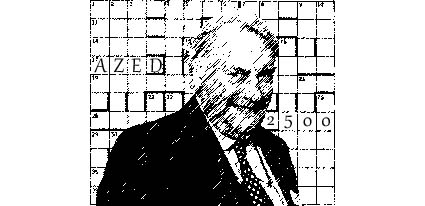
Congratulations to Azed on reaching puzzle number 2,500. Who would have thought, when the first Azed puzzle was published on 5th March 1972, that the series would still be going strong more than 48 years later? What an extraordinary achievement to have provided on a weekly basis scrupulously fair and highly entertaining crossword, including a number of specials, some of them of Azed’s own devising. And not for Azed is the recording and re-use of clues; whenever he clues a word that has appeared before, he consciously tries to find a new treatment for it.

There is little more to be said. Without the confidence gained from entering the clue writing competitions and reading the slips, I would never have started setting crosswords myself. But no-one should hold that against him. My thanks to Azed for all the entertainment which he has provided – long may he, and it, continue!

Is Azed Always Right?

What constitutes acceptable clueing in barred puzzles, both plain and thematic, is a highly subjective topic. In his early days, Azed discussed in the competition slips many dissenting comments from correspondents, although in recent years it is much rarer for him to analyse specific criticisms. I have to say that there is very little about Azed’s clueing, or his views on sound clueing, with which I disagree. Of course now and then there will be the odd anagram indicator or abbreviation which causes a slight elevation of the eyebrow, but these are trivial differences of opinion. There are, though, just a few areas where our views diverge, in particular:

String of words in a clue governing a plural verb

This is something on which we certainly don’t agree. Quoting from Azed’s comments in the slip for 2,036:

An interesting point was raised by a very experienced campaigner. In my clue to PLIANCY (‘Being flexible I can swim in strand’) should not ‘swim’ be ‘swims’ for the anagram to work cryptically? This took me back to a similar question I put many years ago to Ximenes when the late Eric Chalkley won first prize with this clue to PANTOPHAGIST: ‘What pig has to become when gripped by hunger? (anag. in pant, & lit.). Surely, I asked, it should be ‘becomes’, unless he accepted that as a singular string of words or a plural set of words, in this case three of them, it could govern a singular or a plural verb. He replied (I still have his pencilled note) that yes, he did think either a singular or a plural verb was OK, ever since when I’ve followed his dictum, both in my own clues and in my judgement on those of others.

I can see no justification for an uninterrupted string of words being treated any differently from an uninterrupted string of letters; neither Azed nor I would consider “they go off” an acceptable way of indicating an anagram of ‘they’, so why should ‘they all go off’ be valid for an anagram of ‘they all’? A number of prize-winning clues have taken advantage of Azed’s latitude in this area, none better than Dr Eddie Young’s clue for ROUGH-AND-READY (AZ 1,775), “A hard tussle with Dr E. Young plainly winning”.

Reversal indicators for down entries

Azed makes no secret of the fact that he does not accept indicators such as ‘back’ and ‘backward’ to indicate reversal in a down entry. In the slip for 2,417 he notes:

I might as well repeat (since it came up quite often this time) that as a devout Ximenean I am implacably averse to the use of ‘back’ to indicate reversal in down clues. You may disagree, but I shall not be moved on this.

Well I do disagree, on two counts. Firstly, the words in the clue appear in a horizontal plane, so it is perfectly reasonably to assume that the solution is assembled from the clue prior to entry in the grid. Not convinced by that? Well then, Chambers gives a meaning of backward as “in a direction opposite to the normal”. It would be perfectly reasonable for a parachutist (who has already jumped out of a horizontal plane) to say that he was plummeting towards the ground until he felt a sudden tug pulling him back. QED.

Use of radio code words

Azed has regularly rejected clues which have used radio code words (alpha, bravo etc) to indicate single letters. In August 2004 he wrote:

Interestingly, a number of clues submitted used w = whisk(e)y, I assume from the NATO phonetic alphabet. This alphabet is not given in Chambers and I can’t find it in other dictionaries of comparable size, so I’m not too happy about allowing it (as distinct from, say, the IVR abbreviations, which are all in C).

In truth, I think the issue relates more to the fact that the individual code words appear under discrete headings in Chambers, eg

Mike or mike
n (in international radio communication) a code word for the letter m.

rather than under the single letter which they represent. Azed did acknowledge this in the slip for 1,685, adding:

It still seems odd to me that the lexicographers chose to deal with them in this way without at the same time including them as abbreviations at the single-letter entries. But I must clearly overcome my reluctance to use them myself and allow you to use them likewise.

That first sentence doesn’t seem right to me – H is not abbreviation of Hotel, rather Hotel is the word used in oral communication to indicate H; the entry in Chambers for H does not show ‘aitch’, which again has its own entry. However, I believe that Azed frequently still rejects clues which make use of these words, and a number of seasoned competitors are therefore careful to avoid them.

Use of an adjective or participle to define a noun

In a 2006 slip, Azed writes:

One other clue of mine deserves comment, In ‘Name on box may give information to the police’ for NARK the last six words form the definition, i.e. a verb clause indicating the noun that could be its subject. I’m sure I’ve mentioned before that I regard this device as acceptable (and have awarded prizes to clues that use it); what I don’t accept is that nouns can be defined by adjectival phrases, such as past participles and the like.

If it’s reasonable to assume a pronoun preceding the verb, so here ‘[he] may give information to the police’, I can’t see why an adjectival phrase shouldn’t be used in he same way, with [pronoun is] being assumed. Personally, I don’t consider any of these constructions acceptable, as the solver is asked to separate the wordplay from something which cannot as it stands be a definition, except perhaps in &lit clues (where no separation is required), such as JPH Hirst’s 1972 classic for VINEGAR:

Unconventionally given for Jack’s head [GIVEN* replacing T of TAR, &lit]

Since Azed accepted this clue, he clearly changed his mind during the intervening years.

Azed at 2,500 – Deza Vu

With the approach of Azed 2,500, I have put together this plain puzzle which features eight of my favourite prizewinning clues from 48 years of Azed competitions. Clues are included from the two clue writers whom I consider pre-eminent during their respective eras, and no competitor is represented more than once. There is also a 1994 clue from Azed which shows him on top form, while the rest of the clues are mine – among them are a slight variation on the entry which scored my first ever HC (in 2008) and a later competition clue which was returned to me by Azed – much to my chagrin – with a blatant typo circled in red ink! I hope you enjoy the puzzle, regardless of whether you are relatively new to Azed or you remember all the successful entries reproduced here.

For a printable PDF version of this puzzle, click here.

To view the solution (with explanations and identification of the prize winning clues) as a PDF, click here.

With thanks to John Tozer for his superb Azed archive, to be found at andlit.org.uk

Azed’s 200th Birthday Party

Azed celebrated his 200th birthday in January 1976 with a special puzzle to mark the occasion.

Solvers familiar with Azed’s current style will find that not too much has changed in the intervening 44 years. Note that in 24ac the ‘Lever’ being referenced is Peter Lever, the Lancashire and England fast-medium bowler.

For a printable PDF version of the puzzle, click here.

Please feel free to leave comments on the puzzle. To view the solution, click here.

Azed – The Beginning

On Sunday 10th May this year the 2,500th Azed crossword will be published, a remarkable landmark for this series which has become the yardstick for innovative, entertaining and scrupulously fair clueing. It was through Azed that I became interested in the technical details of clue writing, and for my money there is no crossword regularly published in the UK which comes close in terms of quality. In the run-up to Azed 2,500 I plan to post a number of items, which will include some puzzles. It seems only fitting that the first puzzle should be Azed No.1, originally published in March 1972, where Azed’s inimitable style and sense of fun are already very evident.

For a printable PDF version of the puzzle, click here.


Note that the entry at 5ac was the competition clue word; the clue that appears here is S L Paton’s winning entry.

Please feel free to leave comments on the puzzle. To view the solution, click here.

Continue reading