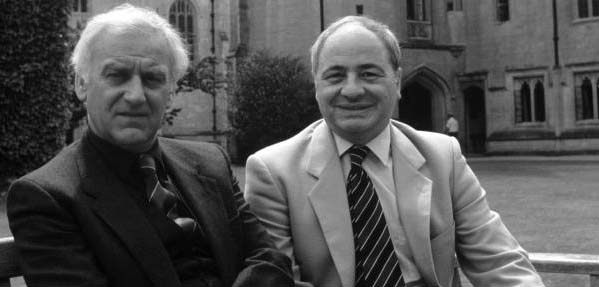
Whether or not you’re a fan of Colin Dexter’s first Morse novel, Last Bus to Woodstock, it certainly holds plenty of interest for crossword aficionados. Dexter recalled how he started writing the book in 1972:
‘We were in a little house halfway between Caernarfon and Pwllheli. It was a Saturday and it was raining – it’s not unknown for it to rain in North Wales. The children were moaning. I was sitting at the kitchen table with nothing else to do, and I wrote the first few paragraphs of a potential detective novel.’ (There are many variations on this story to be found in different interviews with Dexter, but the Welsh rain and the kitchen table are constants.)
We learn early on in the book that Detective Inspector Morse is a keen crossword solver during the following exchange with Sergeant Lewis:
By a quarter to midnight Lewis had finished his task and he reported to Morse, who was sitting with The Times in the manager’s office, drinking what looked very much like whisky. ‘Ah Lewis.’ He thrust the paper across. ‘Have a look at 14 down. Appropriate eh?’ Lewis looked at 14 down: Take in bachelor? It could do (3). He saw what Morse had written into the completed diagram: BRA. What was he supposed to say? He had never worked with Morse before. ‘Good clue, don’t you think?’ Lewis, who had occasionally managed the Daily Mirror coffee-time crossword was out of his depth, and felt much puzzled. ‘I’m afraid I’m not very hot on crosswords, sir.’ ‘”Bachelor” – that’s BA and “take” is the letter “r”; recipe in Latin. Did you never do any Latin?’ ‘No sir.’ ‘Do you think I’m wasting your time, Lewis?’ Lewis was nobody’s fool and was a man of some honesty and integrity. ‘Yes, sir.’ An engaging smile crept across Morse’s mouth. He thought they would get on well together.
A little later, to the accompaniment of the Prelude from Das Rheingold, Morse is reading the preamble from the latest Listener crossword,
Each of the across clues contains, in the definition, a deliberate misprint. Each of the down clues is normal, although the words to be entered in the diagram will contain a misprint of a single letter. Working from 1 across to 28 down the misprinted letters form a well-known quotation which solvers…
At this point he leaps to his feet and heads for the police station, realising that a letter to Jennifer Coleby which he had previously taken to reflect a depressing decline in standards of literacy was in fact a cunningly coded message where the ‘carelessly’ omitted or included letters (eg an S missing from ‘asessing’ and an extra O in ‘loose’) spelt out the warning ‘Say nothing’. An ingenious device, although Morse does then have to spend a couple of pages at the end of the book explaining to Lewis (and the more enquiring reader) why Bernard Crowther chose this rather unusual route to communicate with Ms Widdowson rather than, say, ringing her up.
‘The hobby and the habit of solving crosswords is the most serene and civilised way of wasting time that I have yet discovered.’ Colin Dexter
Such was Dexter’s absorption in his new endeavour that he took a sabbatical from the Azed competitions between April 1973 and December 1978; in June 1976, Azed reported: “Some of you may have wondered at the disappearance from these lists for some time of N. C. (Colin) Dexter, for many years a redoubtable competitor. I’m delighted to report that he’s alive and well and a close neighbour of mine in Oxford, where he is an examiner on the local exam board. He forswore crosswords for a spell to devote his leisure hours to clues of another kind, writing detective novels. Solvers who may care to read Last Bus to Woodstock or Last Seen Wearing (just published) will be amused to find many familiar names among his characters. NCD admits to some nostalgia for the less burdensome (if no less stimulating) mental challenge of Azed puzzles and has promised to ‘return to the fold’ before long.”
It’s widely known that Dexter named his two main characters after two regular (and very successful) competitors in the Ximenes clue-writing competitions in The Observer. In his foreword to the 2001 re-issue of Ximenes on the Art of the Crossword, Dexter wrote:
For me one of the greatest delights of the Ximenean years was the camaraderie which had grown up among the solvers. During those heady years I regularly recognized several of the brightest fixed stars in the firmament: S. B. Green, R. Postill, C. Allen Baker, C. J. Morse, D. P. M Michael, Mrs L. Jarman, Dorothy Taylor (aka Mrs B. Lewis)… Indeed I used two of those names as the principal detectives in a TV series.

‘Lewis and Morse’
Jeremy Morse, knighted in 1975 and chairman of Lloyds Bank between 1977 and 1993, was a highly-skilled clue writer, crossword setter and composer of chess problems. ‘Mrs B. Lewis’ was a pseudonym assumed by Dorothy Taylor, Lewis having been the maiden name of her sister-in-law; a very successful Ximenes competitor under her own name, Taylor was asked by Derrick Macnutt (Ximenes) to join Alec Robins in setting the Everyman crossword for The Observer in 1963 in succession to Macnutt himself. As an employee of the newspaper, she would thenceforth technically have been barred from entering the Ximenes competitions, hence the nom de guerre (although her true identity was clearly an open secret within Observer circles, the name change coinciding with fellow Everyman setter and Ximenes competitor Alec Robins’s rebirth as ‘L. F. Leason’). She held senior positions within the Inland Revenue and was appointed MBE in 1971.
In the Ximenes competitions, Morse scored an impressive 14 wins, 28 other podium placings, and 158 ‘best of the rest’ finishes (the last-named being termed ‘highly commended’ until October 1963 and ‘very highly commended’ thereafter). Miss Taylor in her two incarnations scored 11/16/101. Morse’s most famous clue is perhaps this one from AZ419 (click on the clue to reveal the solution):
Marlborough’s second crusher in conclusive quartet of victories (9)
RAMILLIES [(A +MILL) in (victo)RIES, & lit.]
Taylor’s winning entries include this clue from X997:
Material for a black confection that might become Electra (7)
TREACLE [ELECTRA*; ref: O’Neill, ‘Mourning Becomes Electra’]

J. B. Widdowson (second left)
What is perhaps less well known is that the surname of every character in the book was ‘borrowed’ from a Ximenes competitor. I read an article where Dexter was quoted as recalling that the murderer (Sue Widdowson) was the one person whose surname was not that of a 1960s competitor, but in fact there are no exceptions – the perpetrator of the car park slaying was named after J. B. (John Bartholomew) Widdowson, the setter of 31 Listener puzzles as ‘Bart’ and a Ximenes regular. Either side of his involvement in the war, Widdowson studied at St. John’s College, Oxford, where he was known as ‘Wally Widdowson’ to a group of friends including Edward du Cann, Philip Larkin and Kingsley Amis. The photograph shows Widdowson (second left) taking part in a 1942 enactment of ‘In the Rear of the Enemy’ in the college grounds, along with du Cann (third left) and, kneeling front and centre, the author of the ‘pantomime’ (as Larkin described it), Amis. Subsequently becoming a school headmaster in Scotland, Widdowson had a measure of success in the annual Times crossword competition (although he never won it), competed in Mastermind, was a very active member of Mensa, wrote the Collins Gem Crossword Dictionary and lectured nationally on the teaching of mathematics. He had a rather less spectacular Ximenes competition record than those on the enforcement side of the legal fence, at 0/0/14. Perhaps his best entry was this one from X945:
Bitter aloe growing rampageous in scrub (10)
OBLITERATE [(BITTER ALOE)*]
Of the 26 surnames used in the book, a scan through the slips for the Ximenes competitions 856, 878, 1062 and 1119 yields 25 of them. The exception is Green, S. B. Green having died in 1963 (see below). The characters derived their surnames as follows (where two characters share a surname I have listed only one of them).
The victim, Sylvia Kaye: Sir Stephen Henry Gordon Kaye, 3rd Baronet of Huddersfield (1/4/25) was educated at Stowe School and Trinity College, Cambridge, and was a Listener crossword solver. His single winning clue was this entry for X962:
Early stop in recurrent adverse balance of trade might well protect pound (6)
PALING [LIN in GAP<; see pound(2) in Chambers]
In the TV adaptation, Sylvia’s surname was changed to Kane, thus breaking the ‘Ximenean chain’.

Norah Jarman, fashionista
Mabel Jarman got her name from Mrs Norah Jarman (16/16/59), a master cluesmith who was surely without parallel when it came to the ‘cryptic definition’ clue (a clue without wordplay, eg ‘Naughty type of Limerick‘ for SPALPEEN in X202). Mrs Jarman was a dedicated collector of postcards, spending many hours cataloguing her collection and dealing with other deltiologists worldwide; among those with whom she enjoyed swapping cards was the comedian, Ronnie Barker. A highly talented musician who could play several instruments, Mrs Jarman had an upright piano in the dining room of the house in Mousehole to which she moved in the 1960s. From time to time the members of the Mousehole Male Voice Choir, suitably invigorated by refreshments at the Ship Inn, would call in and give an impromptu performance around her piano. Her grandson has fond memories of Mrs Jarman sitting in the bay window on the first floor of her house working on crosswords whilst looking out over Mousehole harbour and Mount’s Bay. Although cryptic definition clues have been outlawed by Ximeneans since the early 1970s, Norah Jarman also produced many top-class clues that did include a subsidiary indication of the solution, among which is the superb
Alien to Ruth, like the corn (7)
CALLOUS [two defs; ruth = pity]
from X1140, the reference in the surface being to the lines ‘Through the sad heart of Ruth, when, sick for home, / She stood in tears amid the alien corn’ in Keats’ Ode to a Nightingale.
Gaye McFee: Mrs E. McFee (2/9/55). Her one winning entry in a ‘plain’ competition was in X834:
Bore will give the reverse of a short account – and what could be drier! (7)
CARRIED [A/C< + DRIER*; bore = carried]
John Sanders: T. E. Sanders (11/10/91) competed in the Observer competitions from the Torquemada era (1926-1939) through to his second place in Azed 1026 in 1992. Azed rated his winning clue in AZ competition 221 –
Ire-lander? (10)
PADDY-WHACK [PADDY + WHACK, &lit.]
as one of the all-time greats.
Lewis: ‘So he did kill Nicholas Quinn.’
Morse: ‘Or did he, did he? Nah! How could he have done? He set the best crosswords in England.’
Jennifer Coleby – John Coleby (0/1/16) was a research chemist, Brain of Britain competitor and chess player as well as being a regular Listener solver and occasional prizewinner. He was also a contestant on Mastermind in 1973, and legend had it that when he selected the Life and Music of Liszt as his specialist subject, the BBC contacted the secretary of the Liszt Society to ask them who would be best qualified to set the questions and they duly recommended one John Coleby, whom the corporation then requested to do the necessary. Sadly, Magnus Magnusson recorded in his memoir of the programme I’ve Started So I’ll Finish that, while the BBC had indeed contacted the society, what came back was a set of questions set by the committee of the society, with John Coleby having discreetly stepped out of the meeting at an appropriate point. Unfortunately, it was a requirement that the setting be done by one person, so the committee’s submission was rejected and the questions were provided by someone unconnected with the society. John Coleby reached the second round of the contest even without the advantage of being asked questions that he had himself set. Here’s his ‘highly commended’ clue for X283:
Composed to greet the Queen (5)
SOBER [SOB + ER; greet(2) = lament]
Constable Dickson is named for Commander H. H. L. (Harold Hugh Lindsay) Dickson (6/7/43). Educated at the Royal Naval College, Osborne, he went to sea in 1919 and retired from the Royal Navy in October 1933 with the rank of Lieutenant-Commander, although he was recalled to the service on the outbreak of war in 1939 and served as gunnery commander aboard HMS Excellent, being promoted to Commander in 1943. After leaving the Navy he bought a farm near Fareham, standing as a Liberal candidate for the Petersfield constituency at the 1950 general election, and coming third (of three) with 14% of the vote; he had another go in 1951, with a similar placing (but only a 10% vote share). He arranged the first Ximenes dinner in London in 1949. This is his winning clue for X195, presumably a ‘down’ entry:
By degrees the feller gets us down (8)
WALLABAS [WALLA + BAS, &lit.]

Azed, Jonathan Crowther
Bernard Crowther takes his surname from someone who will be familiar to all Azed solvers, Jonathan Crowther aka Azed himself. When Dexter started work on his first Morse novel, Crowther had just taken over from Ximenes (although Macnutt died in 1971, his stockpile of unpublished crosswords ran through to number 1200, published in early 1972 – Azed number 1 was published on 5th March of that year). He worked for the Oxford University Press between his graduation with a Classics degree from Corpus Christi College, Oxford, in 1964 and his retirement in 2000. Before assuming the mantle of Azed, he had 16 puzzles published in the Listener series under the pseudonym ‘Gong’, a family nickname. The young Crowther’s record in Ximenes competitions was sound rather than spectacular (0/2/23); his first commended effort (written while he was still at Cambridge University) came in X743 (a competition which incidentally featured another brilliant winning clue from Mrs Jarman):
Leading pair of ministers in the Treasury once tried to debase the gold standard (7)
CHEMIST [MI(nisters) in CHEST; ref alchemy] – Mrs Jarman’s clue was ‘I provide something you can rattle up and down in a box’ [M1 in CHEST, &lit.]
Mrs Baines – Colonel P. S. (Peter Stanhope) Baines (listed as Major and Lieutenant-Colonel in earlier competitions) had a Ximenes record of 3/4/37. He served in the Royal Engineers, was awarded the US Bronze Star Medal in 1947, was created MBE in 1958 and retired in 1966. I feel he deserved more than an HC for this clue in X105,
These miners show little signs of striking (11)
SMITHEREENS [(THESE MINERS)*]
although these days ‘show’ would certainly not be acceptable as the anagram indicator – the clue would now need to be more along the lines of ‘Little signs of striking from these miners, possibly’.

Frank Palmer
Clive Palmer – F. R. (Frank) Palmer’s greatest successes came in the Azed competitions, with three outright first places in the annual table. Educated at Bristol Grammar School and New College, Oxford, he is a highly distinguished linguist who worked extensively on Ethiopian languages in the 1950s, and edited the Journal of Linguistics between 1969 and 1979. A Fellow of the British Academy, he was Professor of Linguistic Science at the University of Reading between 1965 and his retirement in 1987, whereupon he became Emeritus Professor. He is the author of several works on linguistics and co-author of The Cambridge Grammar of the English Language. His worldwide reputation resulted in extensive travelling during his professional life, including many trips to the Americas, North Africa and Asia, and in 1981 he was Distinguished Visiting Professor at the Foreign Languages Institute, Beijing. His record in Ximenes competitions was 0/0/6, with perhaps his best clue being this one for X993:
Inhabitant of N.E., perhaps, needs some sort of hat on in a winter month (8)
JONATHAN [(HAT ON)* in JAN; N.E. = New England]
Peter Newlove – F. E. (Eric) Newlove had a Ximenes competition record of 8/13/91. He set Listener puzzles under the pseudonym ‘Novamor’ and also competed with success in those crosswords. This is his winning clue from X382,
Put a saint in a bath of champagne and see if he does! (7)
ABSTAIN [ST in (A BAIN), &lit.; bain = bath in French]
another clue which is perhaps a little ‘loose’ for today’s tastes.
Adele Cecil [to Morse]: ‘People who like crosswords have blanks in their lives, and they haven’t a clue how to fill them in, don’t you think?’
Felix Tompsett – D. H. (David) Tompsett (2/0/15) was the final winner of “Xim’s No.1 Cup” in June 1971, and presented a new trophy to be awarded to winners of the Azed competition (incidentally he passed the Ximenes cup to the late Eric Chalkley, another of the ‘Woodstock clan’). An electrical engineer and expert on the works of Reginald Kapp, he has contributed to a number of technical publications as well as making occasional appearances in The Guardian’s Notes and Queries column, including this response to the question, ‘Did theologians ever really debate the number of angels that could dance on the head of a pin?’: ‘What a pity this question is always misstated. The scholars knew that even the tiniest scrap of matter had to be located somewhere, whereas angels required no such accommodation. They therefore chose a place that provided no area at all for dancing – the point of a pin (there is room for an infinity of angels on the head of a pin).’ I’m glad that’s been cleared up. Here’s his clue from X251:
Careless on much detail (12)
UNMETHODICAL [(ON MUCH DETAIL)*, &lit.]
George Baker – C. A. (Allen) Baker (17/20/141). A regular Listener competitor, he kept extensive records of the Ximenes and Azed competitions and assisted Azed in his early years by checking his scoring for the annual honours lists (he was described by AZ as being ‘an invaluable long-stop behind my unreliable wicket-keeping’). Among many excellent clues in his canon is this one for X438:
It must be swell, being a little waterproof duck in a rain-storm (8)
MACARONI [MAC + (O in RAIN*); macaroni = a dandy]
Stephen Westbrook – Rev C. D. (Colin David) Westbrook (0/2/8) was elevated to the priesthood in 1962. His last entry for an Observer competition was in 1985, but he is now the Reverend Canon Westbrook, Priest in charge of the Newport St John Baptist parish in the diocese of Monmouth. As befits a man of the cloth, his most successful Ximenes entry made reference to the good book, specifically the parable of the rich man and Lazarus recounted in Luke 16, in this second-placed clue from X1115:
Dives enjoyed it while alive: he slept to fry in torment (12)
FLESH-POTTERY [(HE SLEPT TO FRY)*]

Tommy Melluish
The ‘young don’ Melhuish – T. W. (Tommy) Melluish (5/14/84), whose surname was modified to a more familiar form for his fictional alter ego, graduated with a degree in Classics from Christ’s College Cambridge. He was for many years senior Classics master at the Bec Grammar School in Tooting, and was a regular contributor of Greek and Latin crosswords, acrostics and verse compositions to the periodicals Acta Diurna and Greece and Rome. A skilled raconteur and public speaker, a friend wrote of him after his death, ‘Whenever he rose to speak…there was among the audience an expectation of good things that was never disappointed’ (what a great thing to have said about you). The same friend also recalled playing Pyramus to Melluish’s Thisbe at a Summer School: ‘I remember him, diminutive in stature but a greathearted hero, advancing blindly onto the stage, his vision almost totally obscured by the coal-scuttle which he wore for a helmet.’ A short article by Melluish is included in the book Liberal Studies: An Outline Course by E. G. Rayner and a certain N. C. Dexter. Undoubtedly a skilled clue writer, many of his clues are probably a little too erudite for today’s tastes. I think this is a smashing little effort from X582 though,
Give the maid a ring when my boxes arrive (5)
MARRY [MY around ARR]
which despite getting only a ‘highly commended’ rating reads beautifully and for my money is better than the three prize-winning clues.
Poliewoman Fuller – Mrs J. O. Fuller (1/2/6). This is her wonderfully simple clue for X369:
Remember ether masks what is usually felt! (5)
BERET [(remem)BER ET(her)]
Constable McPherson – Mrs S. M. MacPherson (0/1/6) had her ‘Mac’ modified by Dexter as well as having her sex changed. Her best clue was perhaps seen in one of the early Azed competitions, AZ23:
Crusty cleric stormed about missing start of Test (12)
SCLERODERMIC [{CLERIC STORMED – T(est)}*]

Eric Chalkley
Mr Chalkley – Eric Chalkley (1/0/9) left school at 13 and spent his whole working life as a carpenter. Things changed dramatically for him in 1966, when he got hold of a copy of Ximenes on the Art of the Crossword, about which he later said: ‘It was like a conjuror giving all his tricks away. I discovered that a Ximenes crossword was governed by principles. If you got to know what they were, you could work out each clue and solve the puzzle.’ His admiration for Ximenes inspired him to ‘ape X’, hence the pseudonym Apex under which he set 71 Listener puzzles, the first appearing in June 1969. A master of the themed crossword, he would set special puzzles for people that he admired – thus began long correspondences with the crossword devotees Leonard Bernstein and Stephen Sondheim, the latter responding with a clue (of sorts!) for Chalkley’s own name – ‘I ache with clerkly contortions‘ (incidentally, Sondheim himself competed in the second half on the 1960s, his best effort perhaps being ‘Pop art panel, derived from Dada‘ for PATERNAL in X864). In 1972, he started sending out a Christmas crossword – A Puzzle Every Xmas – to a select group of solvers, which was combined with a clue writing competition. The list of winners reads like a “Who’s Who” of the best clue writers of their day, with Norah Jarman’s submission for COMEDIES being a cracker: ‘The Frogs etc issue croaks‘ (come + dies). Chalkley also set puzzles for The Guardian, The Times and The Sunday Telegraph. He was awarded the MBE in 2002 for ‘services to the newspaper industry’, the first crossword setter to receive such an honour. His first (and only) win came in Ximenes competition 1097 with:
What pig has to become when gripped by hunger(12)
PANTOPHAGIST [(PIG HAS TO)* in PANT, &lit.]
Doctor Eyres – L. E. Eyres (3/6/34). Laurence Eyres was a highly-respected classical scholar and a lifelong friend of Monsignor Ronald Knox, with whom he exchanged copious correspondence between 1912 and Knox’s death in 1957. After his ordination as a Catholic priest in 1918, Knox joined the staff of St. Edmund’s College, Ware. Here, he rapidly set about recruiting lay-masters and wrote to ‘Sligger’ Urquhart, Dean of Balliol, asking him to recommend undergraduates in their final term; one of Urquhart’s suggestions was Knox’s friend Eyres, who had returned to Trinity College following the war to take his finals. In 1926, Eyres moved to Ampleforth, where he remained. When Eyres retired from teaching Classics at Ampleforth, he was succeeded in the post by J. R. R. Tolkien’s son Michael. It’s hard to escape the thought that Knox himself might have written a nifty clue, although it would almost certainly not have been handwritten – he wrote a letter to Eyres in 1927 in which he began to type part way through, explaining, “I’m sorry, but I can’t think properly with a pen.” When researching his biography of Knox, Evelyn Waugh travelled to Ampleforth to meet with Eyres, whose contribution to Waugh’s book is prominently acknowledged in the preface. Eyres managed to get a reference to Knox into his clue for WATSON (X192), but perhaps his best clue is this one from X843:
‘Enspirit’ is wrongly spelt: that’s archaic (8)
PRISTINE [ENSPIRIT*; pristine = belonging to the earliest time, ‘enspirit’ is an archaic form of ‘inspirit’]

Ted Kimmons
Kimmons Typewriters – R. E. (Robert Edward) Kimmons (2/4/15), born in 1923 in a mining village in Derbyshire, gained a scholarship to Chesterfield Grammar School and went on to Nottingham University. Ted Kimmons was married in 1950, and a few years later started teaching French at Corby Grammar School. Here he was a contemporary of Colin Dexter, who taught Classics, and the two would tackle the Times crossword in the staffroom. He remained in the Corby area up until his retirement; he had an active interest in Rugby Union – as both player and referee – and did some amateur Gilbert & Sullivan, but according to his son his overriding passion was crosswords and especially the Ximenes/Azed competitions. In 1987 he reached the quarter-finals of Countdown, having defeated Roger Squires in the preliminary rounds. There doesn’t seem to be any reason why Dexter chose to attach Kimmons’ name to a firm of typewriter specialists; his son could not even remember either of his parents ever using one; however, Dexter himself never used one either, all his novels being written out in longhand, so perhaps that has something to do with it. Both his Ximenes competition winners are excellent clues, his first success coming with his first published clue, in X773 (definitely for a ‘down’ entry):
If going uphill watch the gear you’re in (6)
FIT-OUT [IF< + TOUT; see tout(1) in Chambers]
Doctor Green – At the time of S. B. Green’s sudden death in 1963 he had the best overall record in Ximenes competitions, having won 16 first prizes and 19 other prizes as well as being highly commended on 114 occasions. I am grateful to Barbara Midgley for the biographical information that follows. Born in London in 1900 to William Green, a solicitor’s clerk, and his wife Clara, Stanley Bernard Green was married in 1925 at Westbourne Park Baptist Chapel, Islington, at which point he was living at home with his widowed mother. A chartered accountant by profession, it would appear that he and his wife Florence had no children. Such was his standing that a special competition was set by Ximenes as a tribute (X756), incorporating a number of Mr Green’s best clues. One of his very finest was surely that for X190:
Inlaid boards used by cabinet-makers (8)
CHEQUERS [two meanings; ref: PM’s country residence]
Lewis: ‘Well, he’s clever, Morse. At crosswords and that’
Inspector Bell – Thomas Edward (Tom) Bell (3/3/24) was brought up in the North Yorkshire village of Sutton-in-Craven. In 1941 he went straight from Keighley Boys’ Grammar School, where he had demonstrated considerable academic and sporting talent, into the Royal Navy. He held the rank of Lieutenant and was shipwrecked on three occasions. After the war he took up a place at Cambridge University and went on to teach Modern Languages at Queen Elizabeth’s Grammar School, Gainsborough. A popular master, he became ill while still teaching at the school and died in 1975. Tom’s son (also Tom) was himself a schoolteacher before joining the police and rising to the rank of Chief Inspector; he has recently published the book Tom’s Krazy Kwerky Kwizzes. Of Tom senior’s three winning clues, perhaps the best is this one from X334:
It lends to a Tory personality we admire a certain aroma—not half! (7)
CHEROOT [C + HERO + OT(to), &lit.; ref: Churchill]
Chief Superintendent Strange – T. L. Strange (0/1/14). This is his clue from X738:
‘I can see that needs drilling’ … It’s guaranteed to unnerve you at the dentist’s (11)
ANAESTHETIC [(I CAN SEE THAT)*]
Mr Thorogood – M. F. (Maurice Frank) Thorogood (0/0/1) flew many bombing missions in the second world war as a Navigator on Avro Lancasters for No. 75 (NZ) squadron of the RAF, and was a member of the New Zealand Society of Great Britain. Mr Thorogood’s only published clue was for a Printer’s Devilry competition – however, C. A. Thorogood (who I’m hoping was a relation) was something of a ‘one-hit wonder’, this first prize winner for X103 (1949) being his only published entry:
The mosquitoes leave nothing out, he prophesied (5)
MOSES [MOSQUITOES less (QUIT O); ref: plagues of Egypt]
In all, the ‘cast’ recorded 122 winning clues and 182 second or third placed entries in the 452 Ximenes competitions between 1945 and 1971.
Crosswords were a passion with Morse, although since the death of the great Ximenes he had found few composers to please his taste
Although Ximenes himself does not lend his surname to a character in any of the Morse books, we are introduced to Desmond McNutt [sic] in the fifteenth episode of the TV Series, Masonic Mysteries, written by Julian Mitchell. McNutt is Morse’s former mentor, who has left the police force and entered the priesthood; his corpse rather inconveniently turns up in Morse’s airing cupboard (possible explanation: ‘It must have been in the bag that came back from the laundry last week…’). In the TV prequel Endeavour (episode 9 – Neverland), the young Morse is recommended by his boss Fred Thursday to seek out ‘Inspector McNutt’ as a wise counsellor when Thursday retires…so it can surely only be a matter of time before the character is back on the screen.
 All the clues published in the Ximenes competition slips can be found online in the splendid Ximenes archive at andlit.org.uk
My thanks to Michael Jarman and John Tozer for their help in putting this article together, and to Barbara Midgley for providing additional biographical information (including information about R E Kimmons kindly provided by his son Geoff).
Photographs of Dorothy Taylor/Sir Christopher Morse and Eric Chalkley are taken from the gallery at The Crossword Centre and are reproduced by kind permission of the copyright holder, Derek Harrison. Photograph of Ted Kimmons courtesy of Geoff Kimmons.
Please let me know via the Comments or email if you are able to provide any additional detail or if you believe there are any errors in the article (which there may well be given that much of the content has been pieced together from information on the Web).